
Financial Education Privacy & Compliance
NFEC Identifies Student Data Privacy Gaps in 11 Financial Education Standards (Including D.C.)
An NFEC analysis finds financial education standards and legislation requiring activities involving sensitive personally identifiable information (PII), including Social Security numbers, birthdates, and home addresses, without clear safeguards for student privacy, compliance, or data security.
Across the United States, financial education standards increasingly require students to complete sensitive documents such as W-4s, loan applications, FAFSA forms, banking documents, and employee benefit paperwork as part of financial education coursework. These standards create significant compliance, privacy, and data protection concerns for students and can expose schools and program providers to serious risks if safeguards are not properly implemented. With no states requiring comprehensive educator training, the risks associated with these instructional activities become substantially more severe.
Student Financial Data Privacy & Security Risks
Instructional activities involving sensitive financial documents can create serious identity theft, privacy, and data security risks – especially when educators receive no training.
Students may be required to complete W-4s, I-9s, medical forms, student loan applications, and other sensitive documents containing Social Security numbers, full names, home addresses, date of birth, and employment information. When these activities are conducted in classroom settings, they can create significant privacy, identity theft, and data security risks if strict safeguards and secure handling procedures are not in place. Potential risks:
- Student throws the form away
- Teacher stores forms improperly
- Forms shared digitally without safeguards
- Classroom copies left unattended
- Third-party platforms collect data
Federal Agencies Recognize Financial and Personal Data as High-Risk Information
Federal agencies including the Consumer Financial Protection Bureau, Federal Trade Commission, Internal Revenue Service, and U.S. Department of Education consistently recognize financial and employment-related information as highly sensitive data that requires strong privacy protections and secure handling procedures.
These agencies warn that documents such as tax returns, FAFSA forms, W-4s, I-9s, banking records, and loan applications contain information that can expose individuals to identity theft, fraud, unauthorized account access, and cybersecurity risks if improperly handled. The concern becomes especially significant in educational settings where students may be asked to complete or share sensitive financial information without comprehensive educator training in compliance, privacy, and data security procedures.
States with High-Risk Financial Education Standards: Overview
The following states have adopted financial education standards that explicitly require or direct students to complete highly sensitive documents without any requirement to use fictional or sample data and without corresponding educator training in privacy protection or secure document handling.
- Arkansas standards requiring completion of W-4s, I-9s, medical forms, life insurance forms, retirement forms, and employee benefit forms
- South Carolina standards involving loan applications, W-4 and I-9
- Washington standards requiring completion of IRS W-4 form
- Virginia standards requiring banking account documentation and employment tax forms
- Colorado legislation requiring the completion of federal or state financial aid forms and applications
- Florida legislation requiring completion of a loan application and the Free Application for Federal Student Aid (FAFSA)
- Pennsylvania standards requiring completion of federal, state, and local tax forms
- Mississippi standards requiring W-4s, I-9s, and tax forms
- Tennessee standards requiring FAFSA applications, W-4s, and 1040 tax forms
- New York standards requiring students to complete a tax return form such as the IRS Form 1040
- Washington, D.C. standards require students to complete an IRS Form W-4.
Corrective Actions Taken
This section highlights states that have taken corrective action in response to NFEC’s notification regarding student privacy and data-security risks in financial education standards. As states update their standards or implement new safeguards following our outreach, they will be listed here.
- New York, July 14, 2026. The Office of Standards and Instruction has confirmed it will revise Learning Objective 3.6. The Department’s Personal Finance webpage has been updated to state that public schools and educators must implement the learning objectives in ways that protect student data in accordance with applicable privacy laws. NYSED will also include expectations for protecting student personally identifiable information (PII) in future guidance.
Breakdown of State Specific Privacy & Consumer Protection Risks

Arkansas

South Carolina

Washington

Virginia

Pennsylvania

Mississippi

Tennessee

New York

Colorado

Florida

Washington, D.C.
Student Data Privacy Risks Discovered During National Financial Education Policy Review
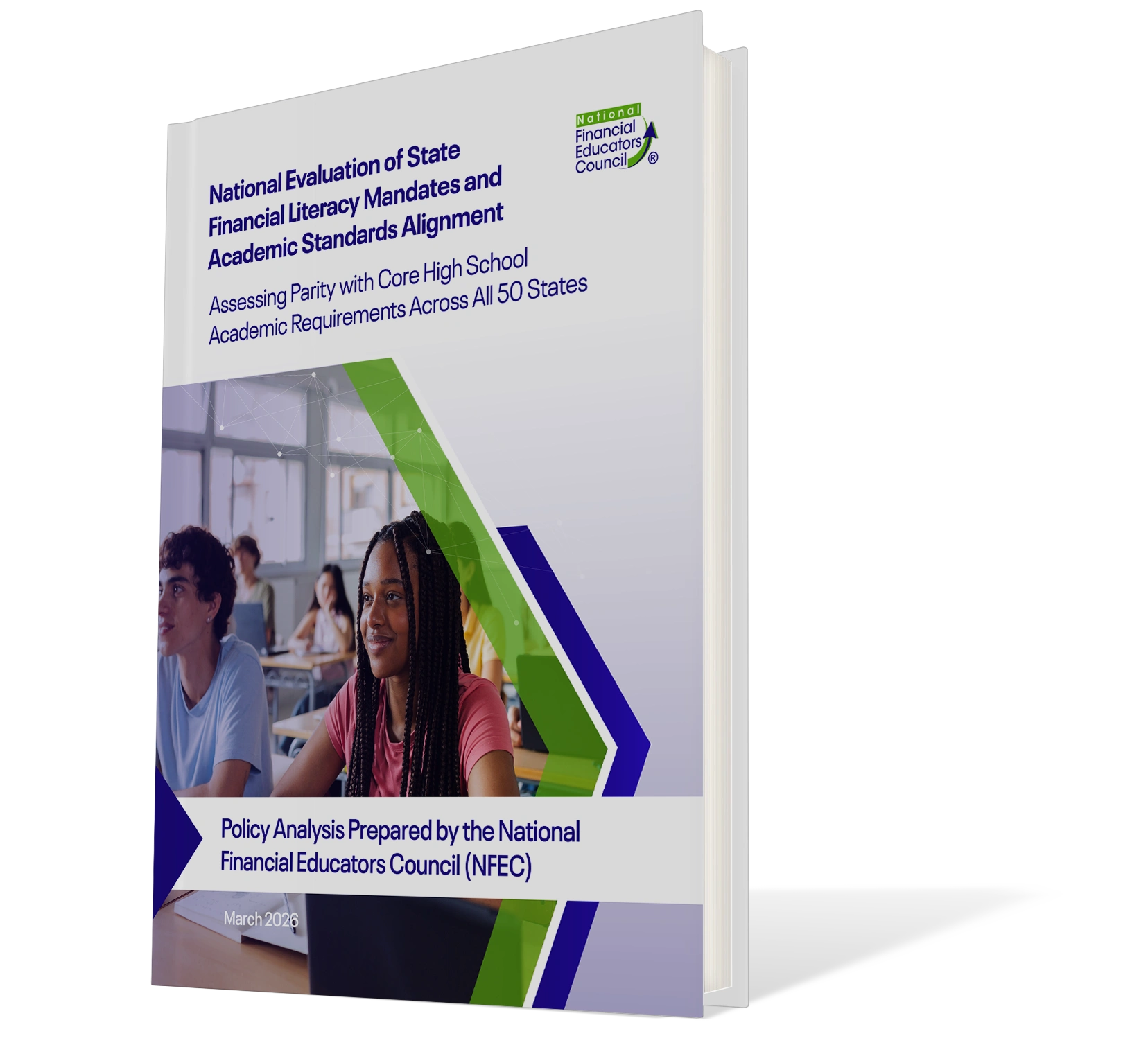
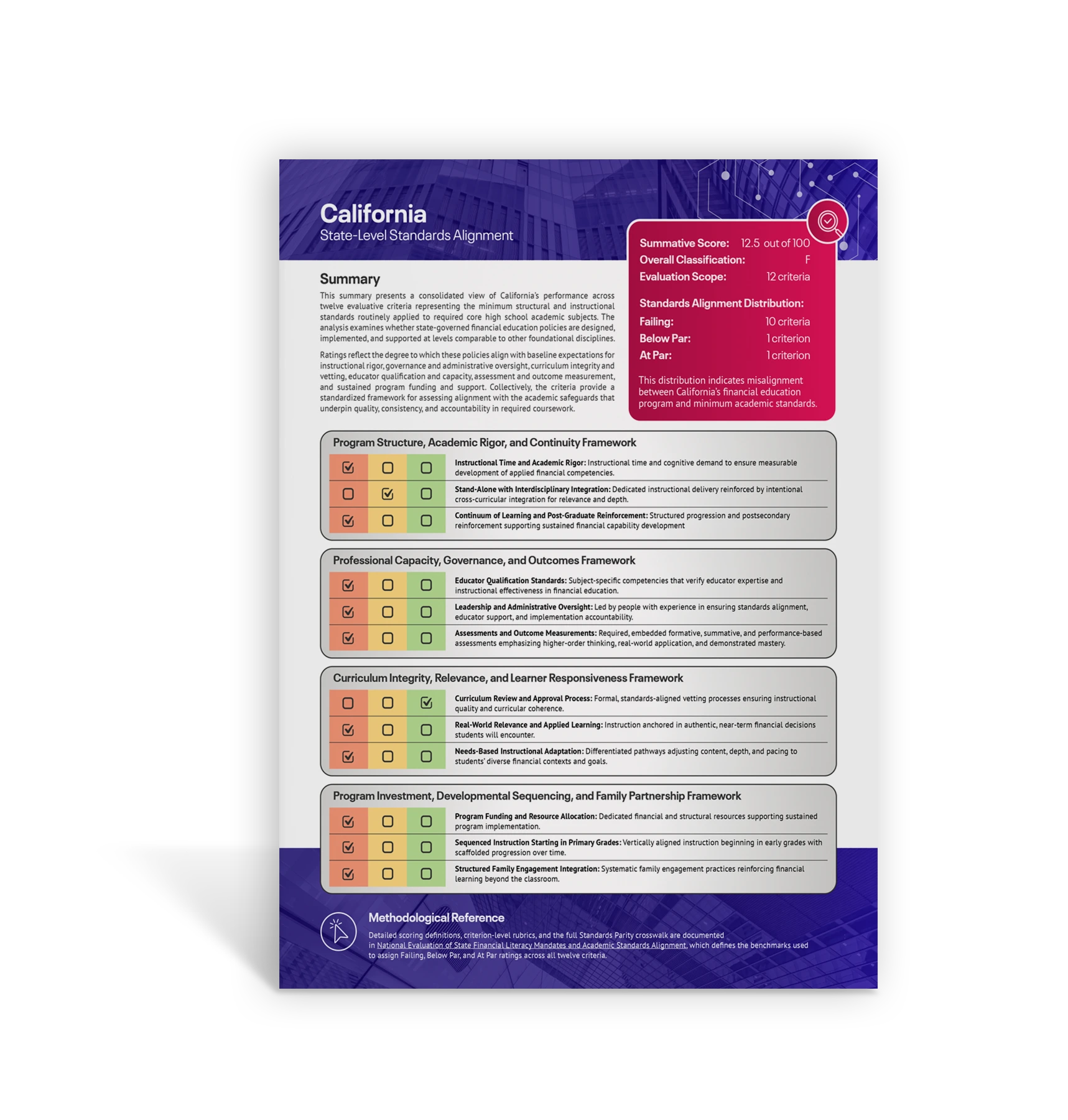
The privacy and compliance concerns identified in this analysis were uncovered during the development of two broader national policy reports examining the quality and structure of financial education in schools: the “National Evaluation of State Financial Literacy Mandates and Academic Standards Alignment” and the companion “National Rankings of State Financial Education Standards: State-by-State Ranking.” These reports evaluated whether state financial education requirements meet the same minimum academic standards commonly applied to core subjects such as math, science, and English – including instructional rigor, educator qualifications, curriculum structure, assessment practices, and accountability for measurable outcomes. During that review process, it became clear that many states now require students to complete highly sensitive financial and employment documents while offering little to no educator training related to compliance, privacy protection, cybersecurity, or secure handling of personal financial information.