

Tennessee Financial Literacy Standards and Mandates: Academic Alignment Review
This page offers a standards-based assessment of Tennessee’s financial literacy requirements in relation to the minimum structural, instructional, and accountability expectations commonly applied to core high school subjects such as mathematics, science, and English/language arts.
The analysis evaluates whether Tennessee’s state-directed financial education policies are developed, implemented, and supported at levels comparable to those of other foundational academic disciplines. The findings consider alignment with baseline expectations for instructional rigor, curriculum review processes, educator qualifications, assessment practices, governance structures, and ongoing program support.
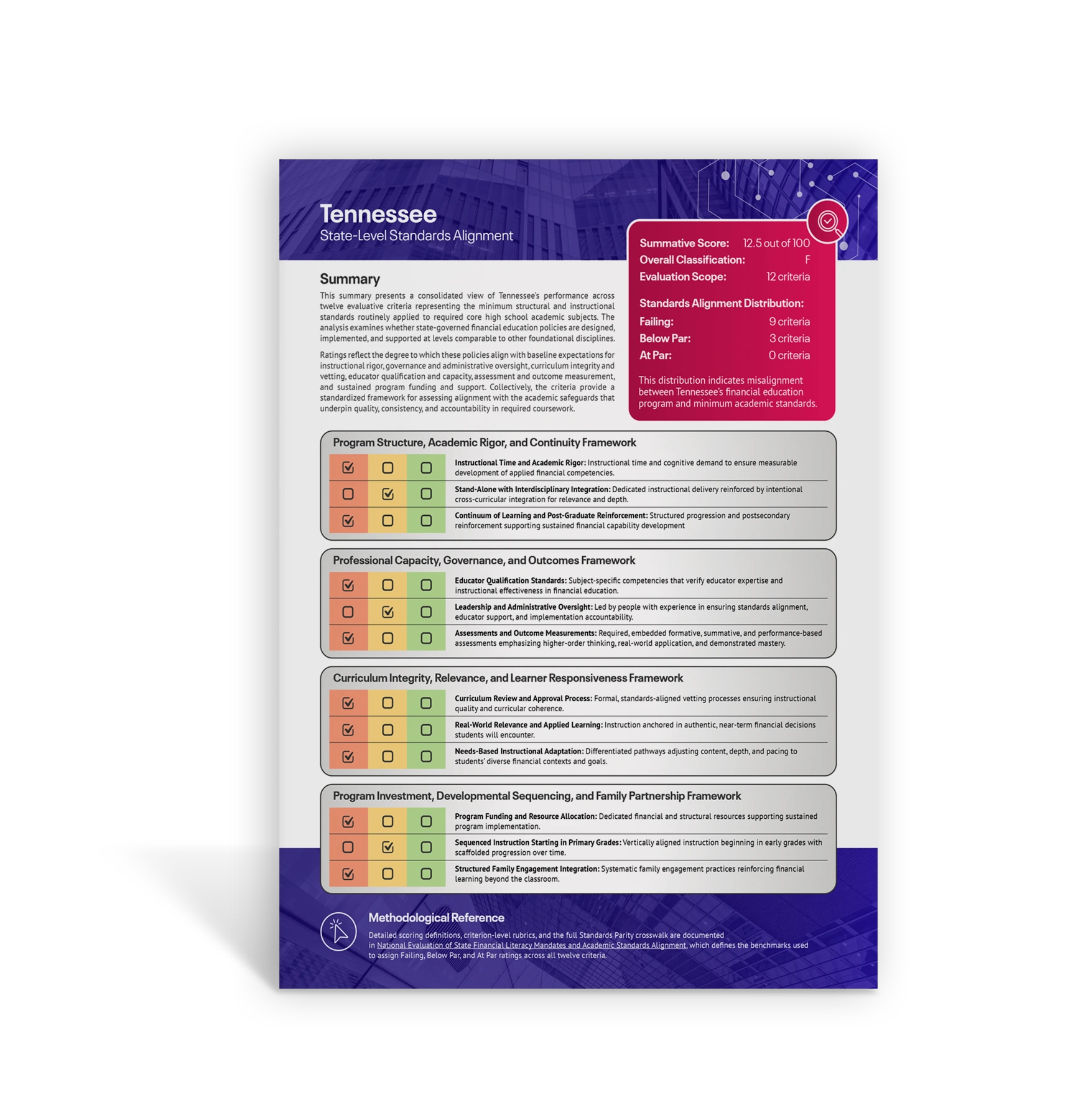
Standards Alignment Snapshot (Tennessee)
This distribution indicates structural misalignment between Tennessee’s financial education approach and the minimum standards applied to other required academic subjects.
Failing
Overall Classification
Evaluation Scope: 12 criteria
Standards Alignment Distribution
Tennessee: Financial Literacy Standards and Mandates Overview
Tennessee requires all high school students to complete one-half credit of Personal Finance as part of the state’s graduation requirements. This policy has been in effect for students graduating as early as the Class of 2013 and continues today, ensuring that every Tennessee public high school student receives structured personal finance instruction prior to graduation. Source.
Personal Finance in Tennessee is a standalone academic credit that covers topics such as budgeting, money management, savings, investing, credit and debt, and financial decision-making. Three years of JROTC may be substituted for the Personal Finance credit if the JROTC instructor has completed state-approved Personal Finance training. Source.
Tennessee’s State Board of Education sets the Personal Finance credit requirement as part of the State’s 22-credit graduation policy, placing it alongside core subjects such as math, English, and science. Source.

Tennessee Financial Literacy Programs in National Context: A 50-State Academic Alignment Analysis
The National Evaluation of State Financial Literacy Mandates and Academic Standards Alignment provides the first standards-based, 50-state comparison of high school financial education, examining whether state mandates meet the minimum academic, governance, and accountability expectations applied to core subjects. Using a uniform 12-criterion framework, the analysis evaluates instructional rigor, curriculum oversight, educator qualifications, assessment systems, funding, sequencing, and family engagement nationwide.
The findings reveal widespread underalignment. No state reaches parity with core academic standards, and even the highest-performing states fall below baseline expectations. The report enables direct state-by-state comparison, including how Tennessee’s financial literacy standards compare with the other 49 states, and offers an evidence-based roadmap to strengthen financial education through standards parity, coherent implementation, and accountable governance.


Opportunities to Advance Financial Literacy Education Across Tennessee
To address the gaps identified in Tennessee’s financial education standards, the National Financial Educators Council (NFEC), in partnership with its Tennessee Financial Educators Council Chapter, provides a coordinated set of advocacy and policy support resources designed to elevate financial education to parity with other core academic subjects.
NFEC’s mission is to ensure that all learners graduate prepared to navigate real-world financial decisions by elevating financial education to the same level of quality, accountability, and instructional integrity as other required core academic subjects.
Standards and Policy Resources
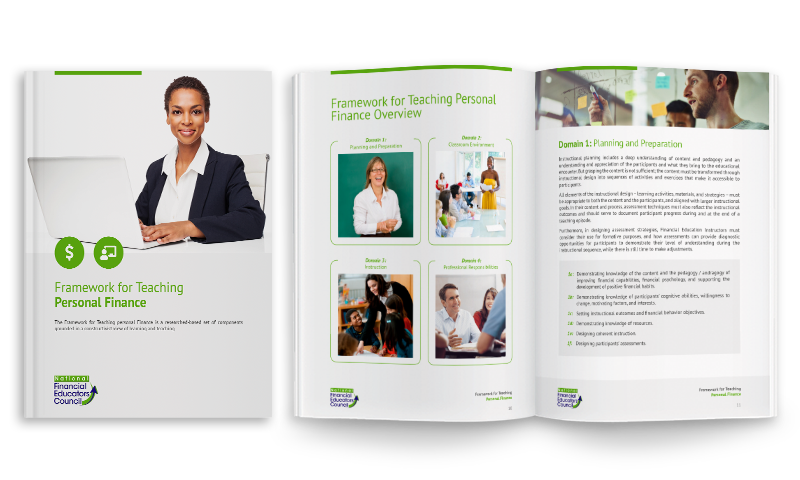
NFEC offers comprehensive financial literacy standards and policy guidance, including the Framework for Teaching Personal Finance, learner outcome standards, educator competency frameworks, and national research on financial education across all 50 states.
Advocacy Committee Engagement
Stakeholders are invited to join NFEC’s Advocacy Committee, which convenes educators, community leaders, and policy stakeholders to advance standards-based reform and align financial education with established academic expectations.

Video Review of Tennessee’s Financial Literacy Standards
Watch the video reviewing Tennessee’s financial literacy standards presented by the NFEC’s CEO Vince Shorb.
Thank you for joining me as I review Tennessee’s financial literacy standards and mandates. We review state standards based on a few criteria. Number one, does it meet minimum education standards required by other topics? And number two, will it prepare our youth for the near-term financial challenges they will face? That’s our two measurement criteria. And while other agencies rate Tennessee an A rating, they don’t come even remotely close to passing with us. And it’s sad. I have high hopes for Tennessee. Let’s dive into this. One positive thing I will say is Tennessee was one of the first states to implement financial literacy programming back in two thousand and ten. This Financial Literacy Program Act of two thousand and ten, which set aside and created the Tennessee Financial Literacy Commission. So that was an early thing. And they were tasked with a few things. One, to formulate education programs to improve financial literacy of the citizens of the state, not just the students, even broader, which I do like. Educate the public about retirement savings, college savings, etc. I like that. Have a public website where they can get this financial literacy education. Great. Establish and maintain a website. Wonderful. Make grants and awards. initiate education programs deemed acceptable to the board, and conduct reviews of the programming. They further get into a rough outline of the topics that should be included, decision-making, earning income, saving spending, use of credit, budgeting. I do like when state bills, they leave some flexibility for what is taught. Often states will say exactly what is needed to be taught. For instance, Florida says you need to teach what to do with inheritance money. Massachusetts says you need to teach cryptocurrency and online stock trading. Really crazy bill in Massachusetts. But I like this bill because it gives the expert, the educator, and the program development person the freedom to choose the topics that are most relevant to them. And let’s see how Tennessee does along those lines. Here’s a website from the Tennessee Department of Education. A few things that immediately raised alarm bells with me and that immediately told me that they don’t take financial literacy education serious at all. Number one, I see nothing in the menu about this. I had to do a deep dive search to find this personal finance section. So it was not easy to find. It did list out on there that you see personal finance is required for a half a credit. That’s there or it’s an option or it could be substituted for JROTC. So it’s not a mandate that all students go through. And so that’s not a good thing. I think all students need to go through that even when they’re going through ROTC and other programs. If there’s not direct personal financial education, there’s people falling through the loop there that will not get that. So that’s a little problematic. As I dove deeper into the site, remember, the job of the Financial Literacy Commission is to maintain a website And this one is just from the Tennessee Department of Education. But as you see here, when you look at standards, when you look at the learning lessons, there’s no personal finance standards listed there in either the standard area or the learning lesson area. Now, I went to the Career and Technical Education CTE. That’s where the financial piece falls under. And I was equally as disappointed because when you type in The CTE, twelfth grade, and I did this for all grades. I started with pre-K, I did it through all twelfth grades. So with finance, nothing was found for any teacher resources. So if they’re supposed to be maintaining a website, what’s a teacher going to do? And really, on the Tennessee, I was looking for a long time. Tennessee, I’ve done twenty-three state reviews at this point. Tennessee has been one of the most difficult to find on all aspects. So a lot of links weren’t working. and I’ll get into that as well. I did find another illustration of how little they value financial literacy education in this document. It’s a thirty-four page document on the rules of state board education where other topics, your math, science, get a lot of real estate. Personal finance gets two sentences. So again, another indication they’re not taking this as serious as they could. And let’s move ahead to their framework. These are the standards that they have, and it’s the front page. And a few things here. It says grade levels, credit, half of credit, grade levels nine through twelve. They say it’s a graduation for requirement. but it’s not if you’re in the ROTC, so that statement there is incorrect, and that should be corrected. This is an elective course in the finance career cluster, and you saw I did my research under that finance in the career and technical education cluster, and there’s no information. Credentials for the teacher endorsements, they can have their teaching credentials in teach us course, and Teacher training is only required for those endorsements that are not specified above. So you don’t need any specific teacher training to teach personal finance. As for anybody who’s seen my other videos, everybody knows that the teachers are the most important asset when it comes to student achievement, and not having teacher training specified for that is a big miss. Every single math teacher, every single science teacher, every single art teacher, every single language arts teacher, every single social studies teacher, they have specific training. They went through elementary, high school, college, and even extended college learning how to teach those specific subjects and gaining content knowledge on those specific subjects. But with personal finance, you don’t need it. Just go teach it. And it’s the most complex subject of all those because their behaviors, emotions, habits, different beliefs, it’s a challenging subject to teach for them to ignore the teacher training is a big miss. And when we come down to the teacher resources, Guess what? The link doesn’t work again. So major fail across the board on just accessing information, making it relevant, and showing that, hey, financial literacy is important to them. Just with the low attention they put into making it hard to find and not keeping things up to date, show me that they’re not serious about that. teacher training again it’s not required if you have some other credentials but they do have if you don’t you have to take a teacher training course and the university of tennessee is offering that it’s a fifteen hour course and let me tell you it let me just read the questions it’s i can’t even believe the university of tennessee would offer a course like this it does nothing to help a teacher the pre-test will give you indication of the low quality there i’ll read a few of these questions the best way to reconcile checking account is to use a transaction register What’s a transaction register? I don’t even know, right? Is that important for a teacher to know? Absolutely not. First off, all of these questions are content knowledge based and they’re the lowest rigor. And a lot of these are just ridiculous questions, right? So very low rigor, ridiculous questions are talking nothing about the behavioral finance aspects, the emotions, the psychology, all those things are very important to financial literacy. In fact, the most important aspects. Teaching isn’t just content knowledge. Content knowledge is one small aspect. It’s, hey, how do I use research-based education methodologies in helping people that have behaviors, emotions, and sentiment and psychology on a challenging subject to better help them? Will this question do anything? The best way to reconcile a checking account is a transactional register, no. Should you accept, you must accept federal aid given. Is that important? Smart goal, what does the A represent? Who cares, right? It’s good to have a framework, but that’s not that critical. Let’s see, why is it important to start saving early life? I think that’s pretty basic. If you don’t know that, that’s interesting. The attorney general office recommends which method of payment. Well, it doesn’t matter what the attorney general there recommends. It’s just, hey, what’s the recommended best practice, right? Moving on to the next page. And this test was only twenty five questions, twenty four questions. Here’s a good one. Again, I’m doing this video in twenty twenty four. What is the standard deduction for a single taxpayer in the year twenty twenty? Absolute joke. University of Tennessee, you’re putting this out? Come on. What does FAFSA stand for? Doesn’t matter. I’d much rather have a student know that there’s opportunities to fund and pathways. How do you apply for FAFSA? Not what does it stand for? It doesn’t matter. How do you apply for it? Everybody refers to it as FAFSA. You don’t need to know the breakdown of what it says. What are the three R’s of money? Well, that might be aligned with the curriculum, but it’s not anything well known, right? So these questions are basic, generic. It’s not going to make a better teacher, right? and their entire training and it’s free you guys could register it’s free online uh the it was buggy it wasn’t allowing me to go forward it’s just not a good training and no teacher that goes through that will be remotely even qualified to teach in fact i would say that they’re at more dangerous position to teach than if they did not have the knowledge and acquired it through other methods so it’s a very bad training and again it points to the the uh them not emphasizing the teacher quality and again i can give a high performing teacher an excellent teacher that’s a that has expertise in the space that knows the behavioral finance that knows the psychology i can give them the worst curriculum they’re going to make that class great but i can’t i can’t if i give an underperforming teacher that passes this i can give them the best curriculum the students are going to suffer Let’s move on here because that is very frustrating to me because it’s just, again, every educator knows the educator is the primary benefit that will offer the majority of the benefits in the class. And for them to ignore the teacher training, that’s bad. And I’ll show you examples later of that as well. Now we’re getting into the core standards. Okay, so this is the core standards. Personal finance is a foundation course designed to inform students, help them make decision-making skills, and the big thing, upon completion of the course, proficient students will understand how their decisions impact their future well-being. Now, language is important. Understanding, Comprehensing, Informing is at the lowest level of rigor. I’m going to skip ahead just so you can see the language usage. And these are very common education frameworks. Bloom’s Taxonomy of Higher-Order Thinking Skillsets and Webb’s Depth of Knowledge. And basically, there’s low order thinking skill sets, understanding, remembering, knowledge, informing, low level. A student at the end of that may be able to pass a pre and post test. It’s not going to benefit them at all in the real world because of learning loss. They’re going to forget it very quickly. In addition, they’re not working toward higher order thinking skill sets, application, creation, analysis. That is where we get the memory working so they can actually apply what they learned in the real world. And all of their standards are really rooted in these low order thinking skill sets. I’m gonna go through some of these areas. Again, personal finance, one point one. Define the concept of personal finance. Again, low order thinking skill set, which is fine. You always wanna have some low order thinking skill sets that you can build upon and scaffold. The problem here is there’s not enough time. You have a half a credit, not enough time to really scaffold to get them to those higher order thinking skill sets. So again, students are susceptible to learning loss. They’re gonna forget this very quickly. In addition, because it’s the opportunity to take those classes between ninth and twelfth grade, if somebody’s taking this as a freshman, by the time they’re a senior and they need to apply it, it’ll be forgotten. it’s important that if you have a short low rigor class like what they’re presenting you need to have it in the more near term when they can actually apply what they learned that will help reduce learning loss to help them apply it but again language is important to find Okay, so the one piece of language I like here, consider how personal finance concepts fit into key life events and stages. They were onto something there, but the rest of us, they got away from that. Every curriculum should be built around a student’s life experience and stages. Sophomore may be buying a car. Senior may be moving out on your own. What to do with the flood of credit card offers that you’ll get when you’re eighteen. How to set up your accounts properly. Again, goals, right short, long-term goals, evaluating career and things. Okay, that’s fine. I mean, unless there’s strategy behind that, it’s kind of a made-up activity, and some kids will go through that pretty quick. I think there’s other ways they can do that. Section two is all about career. The first two, I like this first one, career aptitude surveys, strengths and interests, I love that. Most students will never get any career planning, so kudos on two point one. Most students will never explore careers or see where their strengths are or learn about their aptitudes until they’re, you know, they have to figure it out on their own. Most schools never have any career training, so that’s good. Two point two, kind of, I think they’re missing the key things. Create a chart, cost benefit of education. I think that’s good, but what are they missing here? Well, how about students complete a resume, practice their interviews, clean up their online profile. We wanna get students in a position to get jobs, right? That should be first and foremost so they can earn money. Anything else we do with personal finance is useless unless they have money coming in. There’s nothing to manage. and they’re missing a big opportunity here. Again, two point one, I like. Starting to explore careers, and I think that should be really a more extensive project-based learning. In fact, with that alone, that’s gonna take twenty plus hours just to explore careers. So having just a half a credit not enough time to get through that on any significant basis um but again two point two resume online presence uh you know make sure they can get a job interview skills that’s what gets people hired and so forth moving on to the next area post-secondary financing uh so two point two point two point three um it is for college for for just for those attending college But in Tennessee, forty four percent of students in twenty twenty three won’t go to college. So this is completely useless information for them. Right. They don’t need to know if you’re not going to college, you don’t need that information. So there could be other tracks that they have planned and so forth. So you don’t need that information unless you’re going to college. I think they should have a class maybe on. What they mentioned before, ROI in college, if it works and aligns with your skill sets and opportunities. If not, why would they take this? It’s not beneficial to them. In fact, we have thirty three percent of kids that drop out of college. So already fifty, sixty percent of kids will not benefit from what they’re learning here. Take-home pay, again, they’re talking about take-home pay before they’re talking about how to get a job, right? Big missed opportunity. Here they start to get very disorganized. Planning and money management, they talk about net worth, right? Well, is net worth critical now? Every kid in the class will have close to zero net worth for the most part. So is that important? And I think this should be moved to an investing section up here. Monthly budget. You know, research local sources, cost of living, I like this, but they could have gone a step further and made it a project-based learning activity where students are actually putting themselves in a position of moving out on their own, creating a budget, doing the research, seeing what rental rates are, contacting the electric company and contacting the cable company. It’s kind of heading that way, but it’s not, it needs to give more specific instruction. Again, standards are meant to guide the educator These are very loose. I have no guidance. When we write standards, it’s step by step. Here’s what to teach. Here’s what skillsets they should have. And it’s organized by low order thinking skillsets, mid and high level thinking skillsets. That’s a basic structure of quality standards. These are just random phrases written together in a paragraph. And a teacher could take this anyway. Financial institutions, you know, they’re crafting an essay to support their choice. Okay. Reconcile account, write a check, verify account accuracy. Well, they’re not opening accounts. What accounts to open, right? Have they opened an account? Have they found it? I think that can be an opportunity there. Moving on, again, it doesn’t get any better. I’ll kind of get through these pretty quick. Credit reporting, their call to action at the bottom, you know, is basic education. Their call to action is summarize specific activities to maintain a good credit score. Well, the students don’t have a credit score. The majority don’t. And you have to know how to build your credit score before you maintain it. So whoever wrote these was not thinking about the students. Students have to build a credit score. How do they build it? What are the strategies? How do they protect their credit as they are building that? Once they have good credit, now they can maintain. But until then, it’s a process of building. They probably won’t have a good credit score until, you know, many years down the road after the first credit card made, first card payment, et cetera. So it should be about how to build and protect your credit. The end goal here is way off, does not align with students at all. And again, you may think I’m harsh. All I care about is the students, right? The people who wrote this, whatever, take offense, I get it. But it’s not a quality format for these kids to truly benefit. Cost of borrowing. I mean, they can use specific examples. What are the main things that kids borrow for early on? It is for car loans, typically. I think they mentioned lease or buying a car. It might be okay. Some might not be bad, but again, around life stages. Risk management insurance. I think they should focus on near-term things. Auto health. I guess I’ve written too bad. so forth. Let’s get down to savings and investing again. We’re talking about savings and investing. Well, why is this not associated, it should be savings, which should be associated with the budgeting in section three point two, right? Savings and budgeting go hand in hand. Budgeting, the whole goal of budgeting is to be able to save money, right? So those associate together. Saving and investing, that’s the next step after you save. So if saving and budgeting go together, investing would go with net worth and other things. But again, a lot of these things, it’s great to give an overview of topics. I think a compounding interest lesson is always exciting to show these young adults. But again, just the organization was off there. So again, many misses on the standards. These teachers are gonna be completely lost and because the standards are not clear, they’re not going to have a good indicator of what to teach and every teacher will be teaching differently. The key is to standardize education so you can make data-driven modifications as the data comes in, which they failed to do. Updated Bill. Just to reaffirm the Tennessee Code with regards to the Tennessee Financial Literacy Commission. Look at the actual amount they have to play with, right? And if we look at this, again, it shows the lack of commitment to financial literacy education. Now, Tennessee has a five billion dollar state budget for education. And from the state, we have a hundred and twenty-five thousand to financial education. That’s a quarter of a thousandth of a percent. Point O-O-Two-Five goes to financial literacy education. Absolute joke. Again, it points, if you think back before, they don’t feature this on the website. Hard to find. Things are disorganized. Links are broken. Now look at the money. A hundred twenty-five thousand comes from the state. I wish I knew who these contributions were from. They should be transparent in that. It was not in their report. I could not find that anywhere. I want to know, is it coming from credit card companies? Who is it coming from? I see here they had a special thing for the Department of Financial Institutions. That’s good, but all that’s coming from the state is a hundred twenty five thousand dollars and as usual with most education agencies very top-heavy with a general administration over half their working budget for the year and even if they’re spending that this year spent five hundred thousand bucks what is that one one hundredth of a percent of their total budget goes to financial education if we consider these outside contributions as well they don’t take it seriously the budget proves it and I want to know who those other people are contributing to this and and why they’re not spending more on financial literacy education again I think there’s a illustrating a pattern of it being treated as a not as important subject as math science English social studies foreign language, et cetera. Here’s the Tennessee Financial Literacy Commission. Here’s their vision. They have a report online, which is cool. Let’s look at their core values, their vision. Every Tennessee student have access to quality financial literacy resources. Well, if you don’t have trained, qualified educators, forget the resources. Their mission statement is wrong. Every student should graduate prepared and confident to meet near-term financial challenges so they avoid problems that average students face. We’re going to measure this by comparing the outcomes of our students with the general population that does not receive it. Bad mission. Core values, excellence, nope. Access, nope, I couldn’t find links. Where’s access, right? It’s confusing. Again, Tennessee’s one of the worst sites. I’ve had, I have twenty-three states. I’ve done detailed reviews on finding information. Innovation, saw a couple cool things we’ll get to in a second. Collaboration, maybe. I don’t know about that. Let’s continue here. If we look at the funding, I should have put this slide before. Again, this is the Tennessee, talking about the Tennessee budget in their five billion dollars, right? Where’s that second bullet point part of the way down? Two and a half thousandths of a percent they’re getting. We look at their annual report. Cool thing. I like this one, right? They’re doing things for kids. This is one shining thing. They’re doing things for kids. Wonderful. High school, I think, is critical. It’s important that we’re helping these kids shape positive behaviors. But the reality of it, with this campaign they did, twenty-six Tennessee high schools received this Money Week education. Now, that sounds great, but there’s nine hundred and thirty seven elementary schools in Tennessee. There’s another three hundred ish private elementary schools in Tennessee. So twenty six student schools are getting it. Again, this is in their annual report as well. Next thing we get to, they talk about the success of their professional development. I would be embarrassed by putting this in an annual report. I would be embarrassed. They have the seventeen training sessions that are our piece. They’ve only trained five hundred and forty six educators and on average five sessions. So average educator gets five hours of education. I would hide this. This is embarrassing. You mean the parents in Tennessee, first off, this is all the qualifications that they’re getting to teach your kids is embarrassing. Most will never get this because there’s a lot more than the five hundred forty six teachers when you consider there’s nine hundred thirty seven public schools. I don’t know the number of teachers, but my guess is times out by a hundred per school, you know, and a small percentage are even trained to teach the subject matter. No teacher should be teaching financial literacy unless they’re trained and competent, just like any other subject. Every other subject requires that. Again, they have these virtual summits, one hour courses. Not very impressive at all on that. And they’re highlighting that. But let me go through and rate Tennessee here because as you could guess, they probably won’t get a high rating because it’s just way off, way off. And I’m gonna zoom in here a bit so we can all see. Okay. Delivered in a standalone class and integrated into other subjects. It is a standalone class. It is integrated into other subjects. I’ll give them a green check there. So we have, you saw green check means good. Yellow means okay. Red means fail. Assign adequate time and rigor, absolutely not half a credit, and also the rigor as was described through their standards, very low, and when you don’t have qualified teachers, you’re not gonna be able to have a rigor class, and rigor is required to stop learning loss and make a real difference in participants’ lives. Conduct ongoing education to support long-term outcomes, nothing mentioned anywhere on that. Relevant content, absolutely not. I didn’t see relevant content there. In fact, the standards were very confusing. Every teacher will be teaching differently. Everything should be built around life stages on things that are going to be happening to them in the near term, especially with a short class like they have. Very good. Adopt proven curriculum that encourages higher order thinking application. I’ve seen the curriculum, okay, but the standards aren’t there. I don’t see higher order thinking skill sets emphasized, and it may be the fact that the time is too short. They can’t get to that rigorous thing, but major miss there. Customized lesson plan based on student needs absolutely not And there’s a big difference when you’re teaching from somebody from a lower socioeconomic Excuse me economic status versus a high socioeconomic status There’s major differences in how you’re teaching when I started teaching there. I saw that firsthand One side of Warner Avenue Avenue was very low socioeconomic where I started my volunteer work in teaching the other side was a wealthy area and The discrepancies are obvious. Actually, the people in lower socioeconomic status know more about budgeting, delayed gratification, but they don’t have a lot of hope for the future. People in the higher socioeconomic status typically know less about budgeting, know less about delayed gratification, but have a lot more hope for the future. So that’s just one very blatant thing that was very apparent to me. So lesson plans need to be customized there. don’t need to get more into this major fail here this is always the biggest problem i have with these state mandates this is no different than any other state i reviewed the teacher training at least they have some but it’s it’s embarrassing that the quality of the teacher training is an absolute joke content knowledge is one small portion of what is needed to be an effective educator especially when it comes to personal finance psychology emotions behaviors uh learner assessments i did see some learner assessments but Learner assessments, to me, need to indicate outcomes and potential for outcomes. Content knowledge focused assessments don’t do that. Again, you can memorize things and pass a test. Are you going to be able to apply it in your real life? So the assessments we use have content knowledge of small Porsche, behavior change measures have they changed one simple question since you started the course have you changed any financial behaviors that would be a good indicator there’s other ones but that’s one of my favorite sentiments since you started the course are you more confident in making decisions that are near term that’s again there’s more sentiment questions that’s one of my favorite have they set up systems or processes to manage your finances budget Maybe they set up their accounts, online bill pay, have they done that? Have they found team members to support them? And have there been any real outcomes? Has somebody gotten a job? Is somebody starting to save money? Is somebody doing something? Those are real indicators. So learner assessment there. I mean, honestly, they do have funding. Really, they should have a green check, but I just can’t bring myself to do it. A hundred and twenty five thousand coming from the state on a five billion dollar budget. i really want to give them a red x there that’s what they deserve uh but it is some type of funding so i’ll give them that but it that’s that’s just ridiculous um and and it’s just how they’re spending their budget again it’s always top heavy on the admin side but that’s an absolute joke as far as funding now i know they’re pulling money from the career and technical education side as well but i like direct funding for financial literacy education the career and technical education they have ingrained programs it’s always hard to pull money out of existing coursework start fundamental lessons elementary school So I got to give them an okay there. Not every kid is getting reached by that. And so there’s a lot more work to do. I like the direction they’re going. So kudos there, Tennessee. Nice direction. I like that focus. I like what you’re doing there, interactive events. But just because of the scope and the number of people you’re serving, I can’t give you that green check. Yellow circle for you there now. Encourage parental involvement, the resources, I saw nothing of that. I did see one event in, I think it was their annual thing where they had something to do with parents, but it wasn’t on a wide basis. So again, what do we have here? One green check, the rest fail. And this is from a state where other people in this industry rate them an A. How could you give Tennessee an A rating? How can you give them an A rating with this big miss? It’s doing harm to the industry, harm to the students. You cannot give them an A rating. It’s a complete F, a major fail. And again, I’m not just coming with problems. We have clear outlines, not only a clear outline of standards and learning outcomes, but we also outline a policy and standard framework for legislatures and administrators implementing financial education programming that lay out the core things. And what this lays out is the minimum education requirements of other core topics it’s not anything super crazy it’s just the other core topics like for math science english you know you’re going to have somebody as a department head that has years of experience doing that personal finance absolutely not you know with math science english social studies you’re going to have Quality educators that have passed rigorous exams. Nope, financial literacy not. All these other subjects, you’re going to have massive amounts of funding, five billion divided by that. Well, financial literacy, you get one hundred twenty five thousand out of that five billion dollars. Clear outcomes, you know, standards all missing. No way Tennessee is rated A. They get an absolute F. It’s an embarrassment. And I hate to be hard on people, but we need to do better for these kids. These kids are gonna graduate unprepared. They’re gonna get into financial trouble like I did, many of you did as well. You know the struggles people are going through. We see this as a national emergency. The main problems people are facing are financial in nature, And Tennessee is doing nothing to improve that. It’s time to do better. We’re here to support you for those that are working there, that want to elevate that, that truly care about the kids. Let’s do this together, Tennessee. Let’s ensure these kids graduate self-sufficient and contributing members of society.
Tennessee Financial Educators Council
Tennessee Department of Education – Personal Finance Standards & Graduation Requirements
Tennessee Graduation Requirements (Personal Finance 0.5 credit)
Tennessee Financial Literacy Program Act Tenn. Comp. R. & Regs. 0520-01-03-.06
History of Tennessee’s Financial Literacy Legislation, Standards, and Mandates
Tennessee’s financial literacy policy dates back more than a decade, with a half-credit Personal Finance requirement mandated for high school graduation beginning with the Class of 2013. This early adoption positioned Tennessee among the leaders in guaranteed access to personal finance education.
The Personal Finance course is defined with state standards covering practical topics such as budgeting, income, credit, savings, and investing; and the requirement is codified within statewide graduation policy. Three years of JROTC may fulfill the Personal Finance credit only if the instructor completes approved Personal Finance training, supporting alternative pathways where appropriate.
While Tennessee’s policy ensures nearly universal access to structured financial education in high school, there remains room to strengthen instructional quality and outcomes by instituting performance-based assessments and expanding comprehensive financial literacy pathways earlier in K-12 education.
Tennessee requires most students to complete a ½-unit course on personal finance to graduate. While this mandate represents a positive step toward ensuring that students acquire essential financial knowledge, it falls short of meeting the minimum educational standards established for other core high school subjects. As a result, students who complete the proposed coursework may not be adequately prepared to face near-term financial challenges.
While our review is critical, we want to express our gratitude to everyone dedicated to advancing legislation aimed at teaching financial literacy. Thank you for your time and effort in developing this policy to its current stage. Our critique stems from a place of constructive feedback to improve existing mandates and enhance bills to ensure they make a significant and lasting impact on our youth. We are committed to fostering a future where financial literacy is not just taught but is high-impact and meaningful for the generations to come.
Unfortunately, Tennessee’s financial literacy mandate falls significantly short, failing to meet 9 out of 12 key measures and only conditionally addressing three areas. While the mandate is well-intentioned, it raises serious concerns due to the absence of many crucial elements necessary for ensuring positive outcomes for students.