

Policy Analysis: National Evaluation of State Financial Literacy Mandates and Academic Standards Alignment
Assessing Parity with Core High School Academic Requirements Across All 50 States
Over the past two decades, financial education has gained widespread recognition as an essential component of preparing students for adult life. In response, states have steadily expanded financial literacy requirements within high school systems. Yet an important question has remained largely unexamined: Is financial education governed with the same rigor, accountability, and structural standards as other required academic subjects?
Purpose and Scope of the National Evaluation
This report presents the first comprehensive, standards-based national evaluation of state-governed financial education policies. Rather than assessing whether financial education exists, the analysis evaluates how it is structured, implemented, and supported relative to the minimum expectations applied to core academic subjects such as mathematics, science, and English/language arts.
The findings provide an objective view of how financial education is governed across the United States and identify structural gaps that must be addressed to ensure students graduate prepared to make informed financial decisions in early adulthood.
While core subjects are supported by clear expectations for instructional time, curriculum oversight, educator preparation, assessment systems, funding, and accountability, financial education has often developed outside of these structures. As mandates have expanded, less attention has been given to whether programs meet these baseline standards, creating uncertainty around quality, consistency, and long-term impact.
By applying consistent, evidence-based criteria across all states, this analysis establishes a baseline foundation for policy improvement and alignment with established academic standards.

Key National Findings & State-by-State Ranking
The results reveal widespread and systemic underalignment between financial education policies and the minimum expectations applied to core academic subjects. Across all states, gaps were consistent in areas such as instructional structure, oversight, accountability, and program support – indicating that financial education is not governed with the same rigor as other required disciplines.
Among the most significant findings:
- No state met parity with minimum core academic standards across financial education programming
- No state achieved parity across more than one criterion
- No state met parity at the programmatic level
These findings demonstrate that the challenges facing financial education are structural rather than isolated or incidental. Even in states that have taken steps to expand access or implement mandates, alignment with baseline academic standards remains limited. As a result, financial education programs often lack the consistency, infrastructure, and accountability necessary to produce reliable and measurable outcomes for students.
What the Report Evaluates
The evaluation examines statewide financial education policies using a structured framework grounded in widely accepted academic standards and governance practices. These criteria reflect the foundational components that support consistent delivery, accountability, and measurable outcomes in required core academic subjects.
The report evaluates whether financial education is supported by comparable state-level structures. The analysis focuses on the core elements that define quality in required high school coursework, including:
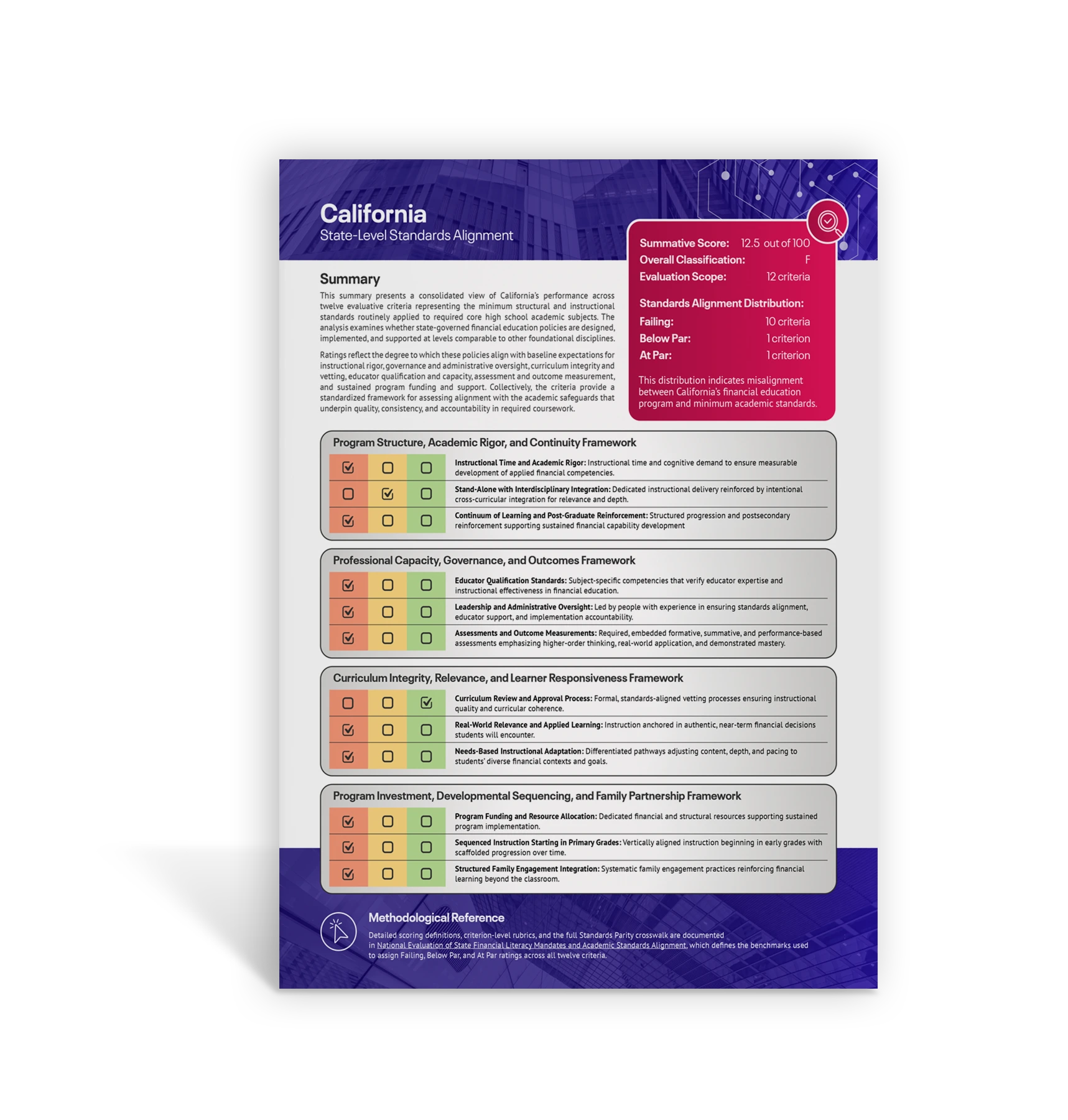
Program Structure, Academic Rigor, and Continuity Framework
- 1Instructional Time and Academic Rigor: Dedicated instructional time and cognitive demand to ensure measurable development of applied financial competencies.
-
- ●
0 At Par States - ●
0 Below Par States - ●
50 Failing States
- ●
-
- 2Stand-Alone with Interdisciplinary Integration: Dedicated instructional delivery reinforced by intentional cross-curricular integration for relevance and depth.
-
- ●
0 At Par States - ●
28 Below Par States - ●
22 Failing States
- ●
-
- 3Continuum of Learning and Post-Graduate Reinforcement: Structured progression and postsecondary reinforcement supporting sustained financial capability development.
-
- ●
0 At Par States - ●
0 Below Par States - ●
50 Failing States
- ●
-
Professional Capacity, Governance, and Outcomes Framework
- 1Educator Qualification Standards: Subject-specific competencies that verify educator expertise and instructional effectiveness in financial education.
-
- ●
0 At Par States - ●
0 Below Par States - ●
50 Failing States
- ●
-
- 2Leadership and Administrative Oversight: Led by people with experience in ensuring standards alignment, educator support, and implementation accountability.
-
- ●
1 At Par States - ●
3 Below Par States - ●
46 Failing States
- ●
-
- 3Assessments and Outcome Measurements: Required embedded formative, summative, and performance-based assessments emphasizing higher-order thinking, real-world application, and demonstrated mastery.
-
- ●
0 At Par States - ●
2 Below Par States - ●
48 Failing States
- ●
-
Curriculum Integrity, Relevance, and Learner Responsiveness Framework
- 1Curriculum Review and Approval Process: Formal, standards-aligned vetting processes ensuring instructional quality and curricular coherence.
-
- ●
1 At Par States - ●
1 Below Par States - ●
48 Failing States
- ●
-
- 2Real-World Relevance and Applied Learning: Instruction anchored in authentic, near-term financial decisions students will encounter.
-
- ●
0 At Par States - ●
0 Below Par States - ●
50 Failing States
- ●
-
- 3Needs-Based Instructional Adaptation Differentiated pathways adjusting content, depth, and pacing to students’ diverse financial contexts and goals.
-
- ●
0 At Par States - ●
0 Below Par States - ●
50 Failing States
- ●
-
Program Investment, Developmental Sequencing, and Family Partnership Framework
- 1Program Funding and Resource Allocation: Dedicated financial and structural resources supporting sustained program implementation.
-
- ●
0 At Par States - ●
0 Below Par States - ●
50 Failing States
- ●
-
- 2Sequenced Instruction Starting in Primary Grades: Vertically aligned instruction beginning in early grades with scaffolded progression over time.
-
- ●
0 At Par States - ●
12 Below Par States - ●
38 Failing States
- ●
-
- 3Structured Family Engagement Integration: Systematic family engagement practices reinforcing financial learning beyond the classroom.
-
- ●
0 At Par States - ●
0 Below Par States - ●
50 Failing States
- ●
-
Policy Analysis & State Comparison Report Downloads
Methodology of the 50-State Evaluation
The evaluation includes all 50 U.S. states and examines state-level education policy and governance frameworks governing financial education. Each state was assessed using a consistent methodology designed to ensure comparability across jurisdictions.
Key characteristics of the analysis include:
- A four-domain evaluation framework
- Twelve standardized criteria per state
- 600 total determinations
- A scoring system based on minimum baseline standards used in core academic subject
Importantly, the report evaluates financial education against the same minimum expectations already applied to required coursework. The findings, therefore, reflect differences in policy design and governance structures rather than differences in instructional intent or classroom effort.
What the Findings Mean
The report demonstrates that expanding financial education mandates alone is not sufficient to ensure meaningful outcomes. Sustainable improvement depends on coherent policy design, durable instructional infrastructure, and accountability systems capable of supporting implementation at scale.
When financial education is not governed with the same rigor as other required subjects, students may receive inconsistent instruction, limited reinforcement, and inadequate preparation for real-world financial responsibilities. Aligning financial education with established academic standards provides a pathway toward stronger instructional quality, improved consistency, and measurable long-term outcomes.
Intended Use of the Report
This report is designed to serve as both a diagnostic tool and a policy resource for stakeholders working to strengthen financial education. It provides a common reference point for evaluating program design, identifying structural gaps, and guiding standards-based reform efforts.
The findings are relevant to:
- Policymakers and education leaders
- State and district administrators
- Financial education advocates and practitioners
- Researchers and program evaluators
- Community and nonprofit organizations
- Employers and workforce development leaders
By clarifying where financial education diverges from established academic standards, the report supports informed decision-making and coordinated action to improve program quality and student readiness outcomes.