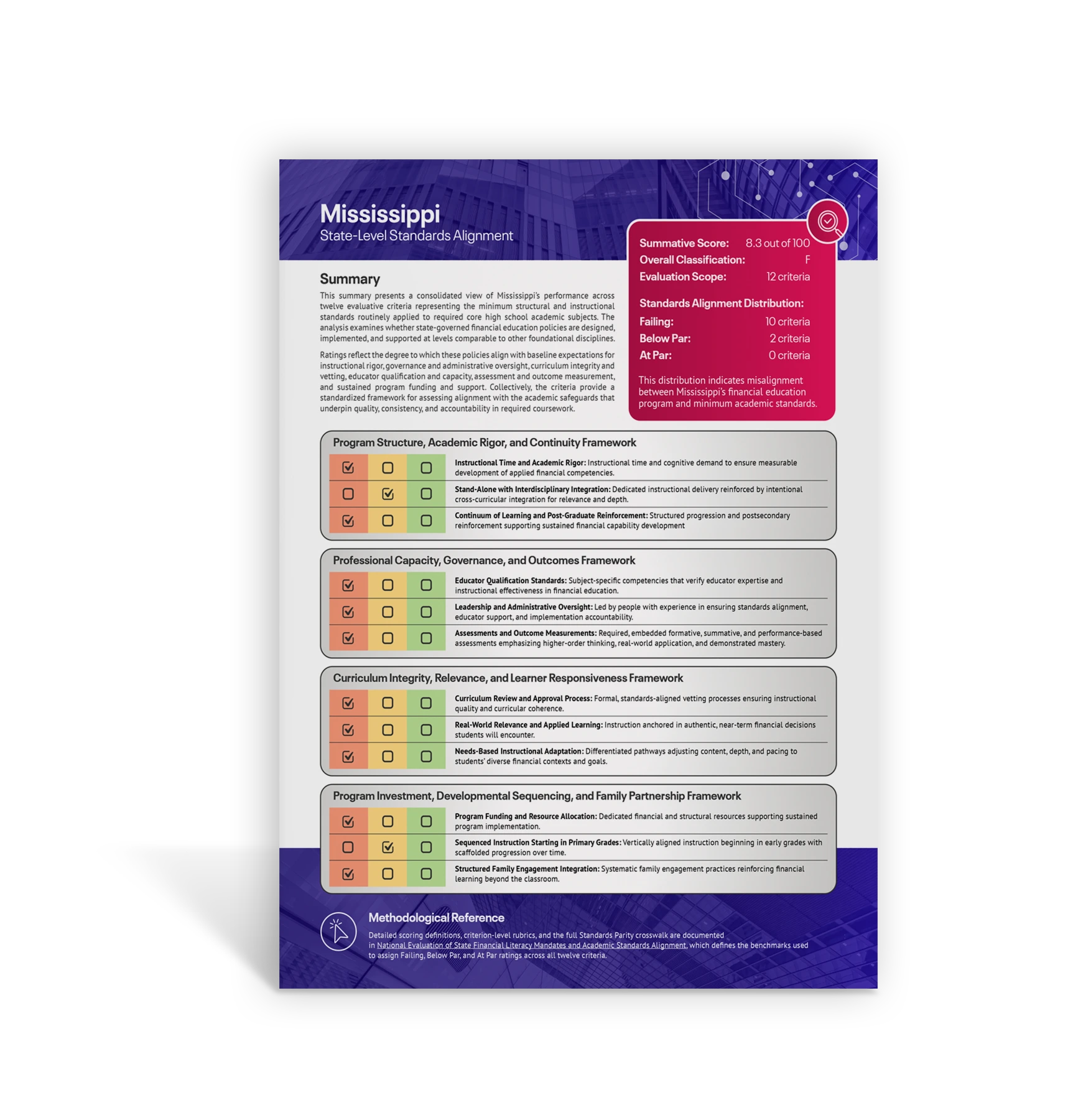
Thank you for joining me as I review Mississippi’s financial education standards and mandates. For those that have seen my prior videos reviewing state mandates, you know I look at two things. Does it meet minimum education requirements of other topics? Meaning topics like math, English, science, et cetera. Second, will students graduate with the competencies to make qualified financial decisions, especially in the near term? So things like moving out on their own, buying a car, paying for college if they choose to, opening the accounts. Can they make those decisions confidently and be in alignment with their longer term vision? That’s how I review these bills. And typically, I start with reviewing the actual legislation. Now with this, there is no legislation. They had some bills that we’re trying to get through Mississippi a few times that failed. So a big kudos to the Mississippi Department of Education and the Secretary of Treasury’s office. About ten years ago they said, hey, we’re not waiting for legislation. We’re going to bring this into the students now. This is the first that I’ve seen a state enact financial literacy education on this level without mandates from legislation. So a big kudos there. Let’s dive into the bill. This is head by the College and Career Readiness Department, which is great. And again, they started this on their own, which is saying a lot for their commitment to ensuring kids get relevant skills needed today. Now let’s dive into the review. And the first thing that comes up is it’s an elective course, meaning most kids will take this overall course. However, they have some ways that they can get around not taking this course. So I always like when every kid has to take this course to graduate, but it is an elective course. As far as the timeline, there’s one issue there. I like the fact that they’re prioritizing the junior and senior year. The reason I like when they prioritize the junior and senior year is the sooner that they can implement what they’ve learned. it reduces learning loss and they’re actually able to apply what they learned into real situations so I like the first three bullet points I’m not a big fan of the last one where they could take one semester in a freshman or sophomore year and the final ones in the junior or senior year I don’t like that simply because if you take it as a freshman, then you take it as a senior, you’re going to forget a lot of what you’ve learned. So I like when it’s the last two years of that, but I understand time restrictions and so forth. But that is there. So it is a one full year course. It’s divided by many different things. And personal finance takes up one semester, which is equivalent to about sixty teachable hours in the classroom. Now there are, this is where we get into some problems on the second page. And this is pulled from their website. They’re on the career and college readiness website of the Mississippi Department of Education. There is no separate teacher endorsement, meaning they don’t have to have training on how to teach personal finance. That’s a big problem. All research points to teachers as being the primary indicator of success of student outcomes, right? That’s the primary indicator of student success and achievement. You can give a underqualified teacher the best curriculum out there, the class will not be good. You can give a great instructor garbage curriculum and they’re going to make that class great. Now with personal finance, it is a very complex subject. We have emotions, behaviors, habits. Every kid has different goals. Every kid has different socioeconomic status. Every kid has something different. Habits, behaviors, beliefs, emotions involved with money. Maybe they saw their parents fight. Maybe they have big dreams or maybe they just want to have a basic lifestyle where they’re meeting their ends. It’s a tough subject to teach. And with all other subjects, If you’re teaching math or science, you went to elementary school studying math and science. You went to high school studying math and science. You went to college studying math and science. Then you went out and did some student teaching and basic supervised teaching to earn the ability to teach these kids. But with personal finance, all states don’t teach that, but it’s too bad that we’re not doing that in Mississippi. That is the primary thing that they need to do here, and they’re failing to do so. line item for financial literacy so they say one semester is required however I’m gonna give them credit for more simply because you’ll see in the next few pages when I get into the actual standards they’re including career planning education planning outside of financial literacy and and what the way we look at financial literacy is inclusive of the ability to earn income gain skill sets manage and grow their money so I think it’s a little longer from our definition in terms of one semester only well let’s move on to the actual standards and this is the the college and career readiness course curriculum you can find that on their website And here’s the table of contents. This is pretty exciting. Overall, what they’re teaching I think is the most comprehensive that I’ve seen amongst any state. A commitment to them being able to gain skills, to earn income, to plan money, and other soft skills that are critical. I love the whole idea. I won’t spend too much time here, but I love what they did with the student portfolio and exhibit where the students are building out a portfolio showcasing their skillsets. I love that. Of the college units, I’m never a big fan because just simply, if you’re going to college, I like to include those. I like to include ROI based on college and exploration of college as the right path for them. But I also understand that if every kid is forced to take college training, four out of ten won’t go to college, thirty-three percent will drop out. And of those that graduate a decade later, they’ll be in a job that does not require a college degree. So I like college training and FAFSA and all that stuff when for the kids that are college bound, for kids that aren’t, I think it’s better that we help them explore what the best education path is for them. Unit five, I love career planning internship. Unit six is where we’ll focus most of the attention, unit five and six. I like what they put together. Again, it shows a real commitment to helping kids gain the skills that they need out there today. So again, kudos on putting together a very comprehensive program. I think this is one of the most comprehensive. In fact, I would say it’s the most comprehensive program that I’ve seen out there. And I’ve reviewed almost all states at this point. So that is a very good thing. So I’m appreciative of those that put this together. I’m going to start with the career and internship chapter because, again, we consider career part of your overall financial wellness, right? If you don’t have income coming in, there’s no money to manage, no money to save, nothing can be done if you don’t have any income. And these standards here, they make a lot of sense to me. If we look at them, you know, if we look at the holistically at them, you know, it starts with the exploring careers, right? What are the in demand careers? Now, I don’t know about the Mississippi part. I think if they can explore careers anywhere in demand, I think that’s some really good research. and they have them doing some personal assessments of various career opportunities. That’s huge. It’s often missing. And the problem is when you don’t have this, kids go to college and they don’t know what to take. They end up wasting their time or dropping out or changing their majors multiple times. So I love the fact that they’re looking at in-demand careers. There’s a lot of careers that are really waning right now, especially with AI and other technology and automation and all that. So this is very important. they’re having them research different career paths wonderful what aligns with their skill sets and what they want to do that’s really key then it gets into creating a resume oh I’m sorry so I go to professional email address to utilize so important it’s you know a lot of these kids make funny emails and so forth and we even see them in adults I’ll have some old email like from a hotmail you know partyjoe hotmail.com not professional so I like that I would add completing their LinkedIn profile here as well. I think that’s a part of a professional appearance. They have them creating their resume, which is awesome. I would also like to include here interview practice. Resumes open the door, right? interviewing and interview skills get you hired. So that’s a very important piece. I would also like to add completing job applications and finding references that you can add on to those job applications, especially in those newer jobs, oftentimes they’re asking for references and things. So having them go through a job application, resume, interview practice, I think would round this out for them as well. And then it gets them and encourages them to participate in internships, job shadowing, etc. So big picture, this is aligned very nicely. You know, first, we’re going to research what careers are out there, what are growing fields, what you’re interested in, how to get a job, how to prepare and lay that foundation to get a job, and then getting those initial work things done. I would also like to add in here actually applying for jobs. I like when kids start working early, it develops a work ethic. In addition, any employer, most employers, I should say, I would never hire somebody without a preexisting job. Most employers want to see kids or people, young adults that have job experience, even if it’s an internship, that’s fine. If it’s working at Chick-fil-A, McDonald’s, it doesn’t matter. They’ve developed soft skills that often kids that don’t have jobs don’t develop until they have a job. Things like customer service, things like teamwork, and other soft skills that are very critical. So overall, their career planning is excellent. I think it’s nicely designed. If you look at the standards, It’s really built in a very succinct and organized format. And just by reading these six headlines, five headlines, I know what, if I’m looking at this from a teacher perspective, I know what I should be doing, right? It makes my life easy for me. And the way I look at standards in these outlines is, How easy is it for a teacher to look at and follow in where it makes logical, orderly sense, right? This makes logical and orderly sense. I also like to use standards to measure learner outcomes and what I should focus on as an educator. And these standards right here do a very good job. When we get into the financial literacy piece, it goes way haywire. I’m going to walk you through this just from a teacher standpoint and read them. I’ll get deeper into detail on this first one, but the problem persists throughout the eight different sections in the personal finance area. So let me dive into this. If we just read through going one to nine, I’m going to shorten these, but first I’m analyzing monetary, non-monetary value of employee benefits. Okay. Identify non-income factors that influence career choice. Okay. Compare cost of living between geographic areas. All right, it’s kind of out there, but okay. Now we get into compare the unemployment rate of workers with different levels of education. Well, that seems completely different than what we were talking about now. First, we were talking about job analysis. Now we jump into education, the skill sets needed. So as a teacher, I’d be very confused. What am I trying to do? And it gets worse. Now we’re talking about paycheck. What’s the relationship between gross and net income? And identify parts of the paycheck, right? Okay, now paycheck. Well, now we’re talking about taxes. Explain purpose of income tax, ways to file, W-for-farm, et cetera. So all these separate areas should have subtopics to make it easy and organized. The one big picture, compare sources of personal income and compensation that impact income, yes, it’s described there, but there’s so many different subsets. It’s very confusing for me as an educator. It took me a while to kind of organize this, and I review standards all the time. That’s what I do. So it’s very disorganized in what they’re trying to accomplish here. I like when it has a main point, a big picture, what am I trying to convey in this, and goes into those details. If we take a look back at um you know you know this uh career planning hey I know first one explore in demand careers in mississippi I know exactly what I’m doing and those sub points relate specifically to that research career paths every sub point relates nicely to that but again here they just lump a bunch of random things together so um one thing that uh you know and also it’s they’re missing the connection between what they did in the career planning. If we look at sub point one, Analyze monetary and non-monetary value of employee benefits in addition to wages and salaries. Well, they can enhance that activity by connecting it to what they did in that career planning, where they researched jobs that they were interested in. So we can have them research this monetary, non-monetary value of their specific job interest. So if they want to be an electrician, right? they can research those specific things that electric some get paid a commission based off sales some get this um you know they’re not going to get stock options right so if they can make it more personalized that would be easy way to make it more relevant in addition they can you know with the even the cost of living between geographic areas Maybe they want to be in the tech industry so they can compare Austin, San Francisco, and those other places that are developing and have a lot of tech jobs available, not just a broad blanket statement. So we can really make that personalized with just adding a few words there. It would connect with the career and planning section nicely. Now, number nine is scary. Number nine will get them into a lawsuit. It will get them in trouble. I can’t believe compliance even approved that. That stuck out to me like a sore thumb immediately. And when you have untrained teachers, they won’t catch this either. This is a big problem when you have untrained teachers. They will not be able to catch this because what does this Mississippi employer withholding statement ask for? Well, we see it here. Name, social security number, address, age, right? They’re giving their social security number and has them read this, analyze or complete a form, right? If they do the option B, complete this form, well, they’re giving their social security number out. That’s perfect for identity theft. If anybody in that class wants to steal somebody’s identity, all they need to get is that homework assignment or whatever. That’s a big mistake. I don’t know who on their legal team missed that. That is a major, major problem and perfect for identity theft. But just one of those things, I don’t know why they included that. You have to understand… There are standards out there, FTC, safeguard standards, other standards that have you protect people’s information. And when you’re in a classroom and things, we can use this as a teachable moment saying, hey, don’t fill out your social security number because that can put you in a bad position here. Only do it when it’s secure. So we can use that as a teachable moment. But you have untrained teachers delivering that. They’re not going to know. A lot of these kids are going to fill out their social and who knows where that ends up. Let’s move on to the next section. Apply reliable information and systematic decision-making to personal finance decisions. So first we have identify short and long-term goals. Well, that’s great. You know, we can identify short and long-term goals. We can just brainstorm those. But wouldn’t a better activity be, hey, here’s some short and long-term goals, right? Giving them some examples. Now create your own. We can take this from a low rigor, so we’ll talk about blooms and depth of knowledge here as far as higher-order thinking skill sets, but it takes it from a very low-level skill set, identify, to a high-level thinking skill set, which is creation and evaluation. So we can have them create their goals. So missed opportunity. Then it jumps to, again, it’s very sporadic. Now it jumps to evaluate reliable resources for financial advice or representation when making financial decisions. Well, these kids aren’t in a position to make those types of, no realtor’s gonna talk to them, no financial advisor’s gonna talk to them. They’re not in that stage yet, so I don’t know why it’s here. I think it’s important that they understand that, but it just doesn’t fit in here. Then we jump to explain how to make informed consumer decisions. Now it’s describe how inflation affects financial decisions. It’s all over the place. If I’m a student in the class and the teacher’s going in this order, I’m going to be completely confused the way our brain works we like to group information that’s relevant and like-minded and we’re throwing out random things it doesn’t work and it’s very confusing even for me having reviewed all the majority of state standards and written a very comprehensive standard for learners educators and and coaching clients it’s it’s just so confusing now we’re going into analyze marketing and advertising Now we jump to comparing advantages and disadvantages of owning a home. Well, again, they’re not going to be owning a home anytime soon. Wouldn’t it be better to have them do a project-based learning activity where they’re understanding what it’s like to move out on their own for the first time and paying rent, right? I get the fact that we want to introduce them to investing, but it’s just, again, it’s so sporadic and not well organized. Develop a definition of wealth plan. Okay, now we get into develop a budget to manage spending and saving, explain methods for adjusting budget for unexpected expenses. Again, random. Their older standards were much better organized. It is, makes a lot of sense. Identify short, long-term financial goals to construct a personal spending or savings plan, right? And they also, the thing I like, they aligned it with Webb’s depth of knowledge. It’s level one. I’ll get into that in a second. Then they define, categorize, and fix variable expenses. That makes sense to me. I need to know the expenses before I can complete a budget, right? The other one just jumps to develop a budget. We didn’t talk about expenses. We don’t know what fixed or variable expenses are. We want to know how to develop a budget without that knowledge. So they’re missing major gaps. then it gets into discuss and create a budget now some of these things here on this one aren’t very well organized but um you know if I’m going to discuss and create a budget um you know first it says research budgeting applications and discuss pros and cons of each I think that should be after you create a budget right you create a budget first on excel or whatever after that you can you can figure out the fancy tech stuff right um identify rules for budgeting I think should be first and That’s key details. Evaluate an example of monthly budget so they can review like a case study. Very good method. Case method approach to learning. Review third party examples of budget. Great way to learn. And we can do some student group learning through that. And even if they’re like the senior or junior where they already have some bills, they can actually create their own budget there. That would be a great thing. And with this, you know, it says it takes them to DOK level three. We can easily upgrade that to DOK level four. Let me show you this first. This is important. So at the very low, you’ve seen it a lot in the initial one, identify, describe, compare, develop. All those things are lower order thinking skill sets. Webb’s depth of level knowledge, the higher order thinking skill sets, the more you have competency over that, it will reduce learning loss and increase your ability to actually utilize what you’ve learned. And so we’re always trying to elevate these line items to higher order thinking skill sets, right? And so with this, we can easily make this a DOK level four if they create a budget, either a real budget for them now, or a great project-based learning activity is having them plan out the expenses associated with living on their own, where they’re researching rent in the area, if they need a roommate, cost of electricity, gas, all those are doing the research, cell phone, all that, they’re creating a personal budget. And then we throw in, after they do that, and they pull in the income to be expected from the jobs they did in the career section to make it very practical. And now we can use examples that throw off their budget. Hey, you just got in a, you know, you broke your leg, it cost you a thousand dollars in medical, right? What do you do? How do you adjust your budget? So we can throw in these different examples to bring them to that extended thinking, that evaluation, that creation level. So there’s some cool things we can do there. But again, this is based off their or two thousand twenty-three are worse. Originally, when I was reviewing this, I thought these were the old standards. I’m all, nice improvement. When I realized these are the new standards, it was disappointing to say the least. As an educator, I would be very confused and frustrated. And since they’re unqualified educators that haven’t had any training in personal finance, they’re not going to know how to bridge that gap and make it make sense. Let’s continue here. Analyze the purpose and functions of financial institutions. Okay, first off, what stands out to me right away, write a check. Nobody writes checks anymore. I don’t know why that’s there. Nobody does it. I haven’t written a check in five, ten years. I don’t know why it’s even there. Whatever. So the first thing they’re comparing future and cost of checking savings account, investigate accounts to open, identify ways to deposit funds, discuss various banking activities, reconcile checking account, identify common monthly bills. Well, identify common monthly bills, that should be before in the budgeting section, right? Why is it here? So we’re talking about budgeting expenses. The bills should be in that section, not here in the account management section. Describe difficulties unbanked people face. So whatever. So the described difficulties unbanked people face is part of reason building. I think that should go first, right? What are the benefits and consequences of banking? Because with any financial education and any education really, Helping students develop reasons is critical. That’s the primary, if you look at most things that we’re doing, if they have reasons to learn, they’re gonna be motivated to actually pick up that information. Then we can break that up into basics. So I’d have reasons for considering banking. get into what is banking what what does it do what functions do they provide then we can get into how to select a bank account with through a bank or credit union that best matches your goals what are you looking for what are the cost terms etc Then we can get into opening an account. I don’t know why they don’t have them teach them what you need to open an account. What do you need to gather? What does that process look like? Having them fill out sample account opening agreements that don’t ask for the personal information that could pose a liability to the school. And then how do you manage that, right? That makes logical sense. This is just all the stuff thrown on the page randomly. So again, I’d have reason building, understanding the basics of banking, how to select a bank that aligns with your goals, opening an account, and how to manage an account. That’s broken down into a very organized, succinct process. And this is kind of off the top of my head reviewing it, but we can get into greater detail. But that basic process makes sense here. It’s random stuff thrown on a page again. Untrained teachers are going to be very confused here. Moving ahead, and I think the theme of all these standards is they’re unorganized. Developing strategies to control and manage debt. As I went through this, there was nothing on how to minimize debt. Nothing on how to minimize debt. That should be the primary thing we’re talking to youth about. How do you stay out of the problems that impact the majority of young Americans here today? How do you minimize debt when it comes to education, when it comes to credit card? You know when you turn eighteen you’re going to get a lot of credit card offers in the mail. What do you do? How do you minimize debt? That should be the thing. They talk about benefit and cost of using credit. Then they get into Debt on net worth. Again, that’s advanced. That doesn’t really matter too much. Compare and contrast debt and credit cards. Examine credit card statement. Okay. Again, it’s disorganized, but they don’t address the most important thing. How do you minimize debt? I don’t know how you can miss that. I get frustrated sometimes, but all I want is the best for these kids. All we need to do is look at the primary challenges that the majority of kids face in this country today. They don’t know how to move out on their own. They get into college debt. They get into credit card debt. They don’t know how to open their accounts. They mismanage their accounts. They get into credit problems. That’s what we need to be addressing. It’s very simple. But by throwing random stuff on a page, it doesn’t do anything. This whole section is on investing with minimal, we’re never going to, these kids aren’t going to be able to leverage this in the amount of time they’re going to remember it. All this information will be lost. Of all the things that they’re talking about here, I would just focus them on compounding interest so they get hope for the future. So it shows them they have an advantage and encourage them to to learn about various investment options, whether they want crypto, real estate, stocks, starting a business. Encourage them to explore those areas, but they’re never gonna remember anything on this page. Asset allocation, explain the stock market, they’re never gonna remember that. saving and investing, it’s too advanced. When we have limited time, we need to address the most important and urgent areas. This is the basics of any education we deliver. It’s what is the most important and urgent thing facing these people? If I’m working with people that are in forty grand in credit card debt, we’re not talking about investing, we’re talking about improving their credit, paying off that debt, setting up an emergency fund. So they’re jumping way ahead. I don’t even see emergency fund in any of the budgeting section. Right. They’re skipping to very advanced things. Now, this last section, they’re talking about risk management. You know, I think if we narrow that down to insurance when it relates to car health and rental insurance, that could be where the focus is, because we know they’re going to need to make those decisions in the near term. Many of them are driving already. They need to understand their coverage. Looking back when I was younger, I’m like, I don’t have any money. I don’t need insurance. That was my thought process, which was wrong. But I know a lot of kids think that. So we need to focus them in on the things that they’ll actually need. The car, the rental, the health, all those aspects are critical. From an overall standpoint, you know, again, I’m appreciative that they took the initiative, the Department of Education, and the State Treasury, I believe it was, let me see, Secretary of Treasury’s office took the initiative. I’m grateful. They’re missing major, major components. Number one, teacher training, and I’ll get into the breakdown here now, but From a standards perspective, they should go back to their older standards and improve those. The new ones are just garbage thrown onto a page, not organized, and doesn’t make any sense to me, and that’s what I do. I build and review standards. It’s confusing to me. I can’t imagine what that would be to an untrained teacher that has never taught personal finance before. That would be super confusing and really disrupt the key thing we want, which is positive student outcomes. So let’s get to the ratings here. And again, we look at financial education and we rate it based on twelve factors. These twelve factors represent minimum education standards required by other core subjects in school. So these aren’t lofty standards. These aren’t the highest echelon of standards. These are the minimum standards required by math, science, English, foreign language, etc. Minimum. and on here we have some problems right um it’s it personal finance isn’t a standalone class so that’s good it is um more than one semester which is good again they said one semester but we count career and other aspects even what they did with some of the education planning would count there they didn’t mention anything about integrated into other subjects So I’m going to give them an okay there. Again, it’s more than most states do. Most states at maximum, there’s about a handful, two handfuls of states that require one semester. They’re actually requiring more. But when I say one semester, that’s sixty hours in in the reality is in the classroom environment that’s about fifty teachable hours after admin time and so forth so that’s like going to work for one week that’s all the financial education that that most students get here they’re getting a little more than one week education but definitely is not enough and there could be some work to easily integrate this into math and english and other coursework in there uh to really get that repetition that’s needed to you know repetition every educator knows we need to repeat things and people need to hear things in different ways we need to repeat it multiple ways either verbally or having them do activities that help cement that learning Assign adequate time and rigor, absolutely not. Major failure there. Again, this is nothing that’s just unique to Mississippi. No state teaches this with enough time and rigor. Mississippi does the most that I’ve seen, so kudos there, but still nowhere near passing. No kid would graduate able to make competent near-term financial decisions, especially with the standards. If we review those standards again, most are low order thinking skill sets. They only had them do higher order thinking skill sets when it came to creating a budget. And there’s one other one in there too. But that was it. The rest were describe, understand, you know, that’s very low level rigor, low level thinking skill sets, big problems there. Conduct ongoing education to support long-term outcomes. I missed there. That’s easy to do. And again, with all other subjects, we have multiple levels. So if you’re in a math, science, or English, and you’re behind, there’s some remedial classes, right? If you’re a little more advanced than that, there’s some college preppers in general. Then we have the AP and honors. So there’s different levels that we can do, but it’s missing there, and there’s no ongoing education described. And because we know the life stages that are coming up for these kids, we can really make that very relevant, having them, you know, providing them reminders of what to do at certain times. So if we know these kids are college bound, what should they do their junior year? Provide them email to them and their parents. Very simple to integrate, very cheap with technology and can really enhance actual application, which is key. Relevant content that prepares students for near-term life events? Absolutely not. It’s too confusing. And they’re getting to advanced subjects before they really even have the basics covered. Again, no kid will graduate confident to move out on their own. No kid will graduate knowing how to buy a car. No kid will graduate how to make a decision. Well, I didn’t review the college one in depth, so maybe they would. No kid will graduate knowing exactly how to open up a bank account, knowing how to stay out of debt or minimize their debt. Major misses. Adopt proven curriculum that encourages higher order thinking application. Absolutely not. There’s a list of some materials at the end, free materials you can find online, but nothing was really driving them to higher order thinking skill sets. And the fact that the standards are set so low, they’re they’re the teachers are just going to find things that meet that minimum requirement again I want to drill down on this because it is important so I can within a a couple class periods I can teach a kid about credit you know where they know hey seven hundred’s a good credit score um I should pay my bills on time and hey there’s three credit bureaus right I can teach that now But I don’t care about that. It doesn’t matter. They can look that up online anytime. What I would want a kid to know is, hey, here’s, you know, they can describe that. In addition, hey, I’ve gotten a copy of my credit report for free. I’ve gone through that process. So I know what it’s like. I’ve been able to evaluate that. And yeah, for most kids, there’s going to be nothing on there. Some kids are going to find that some of their identity has been taken. They may find some things they could proactively address early. So they’re going to be able to do that. They’ve created a credit plan. They’ve built out a calendar that lists when they pull their credit. So they’re developing systems and procedures. All these things are important. Nothing was mentioned there. So those higher order thinking skill sets and having them apply what they learned is critical. Customized lesson plans based on student needs, absolutely not. Customized lesson plans based on student needs also a big issue as i mentioned before there’s an issue when you don’t have a remedial college prep or average and also in advance otherwise students get bored but the biggest problem is with socio-economic differences we need to address those When I started, I started in Orange County, California. I did a lot of my presentations there, but also right over Warner Avenue, Santa Ana School District. I did a lot of my work there, Long Beach, LA, etc. And what I found was in lower socioeconomic systems and areas. the students actually had greater knowledge of budgeting, delayed gratification, and other financial principles, but they lacked hope for the future. In the Orange County side where there’s a lot of money, I noticed that kids lacked the skill sets, budgeting, and the fundamentals, but they had a lot more hope. for the future so there has to be unique ways we’re teaching these different socioeconomic uh kids the kids from different socioeconomic backgrounds to make sure we’re delivering lessons in a meaningful way to them so there needs to be some customization Courses led by highly qualified educators, absolute fail here. And this is one of my biggest pet peeves when it comes to personal finance. Every other teacher, math, science, English, foreign language, they went to school all their years. Well, let’s leave out foreign language for this example, math, science, and English. They went to elementary school, high school, college earn their masters they did teaching supervised teaching all to make sure they were qualified to teach a subject matter they needed the content knowledge also the education methodologies that were unique to that subject but no with personal finance let’s throw in a random coach or random educator there they’ll figure it out that’s absolutely insane the The baseline for any program to be considered an education program would be to have a trained and qualified educator. And that’s a big fail here. All research points to the educator, the teacher, being the biggest impact of student achievement. So that needs to change there. Program deployed and developed by experienced leaders. You know, I’m having problems with this one, and I’ll tell you why. First off, all the red checks show you the problems I have with it. Now, on the other side of the coin, This was something that they did and they were not mandated to do. Every other state I reviewed, they were mandated by politicians to teach personal finance. They were told to do it. This was a collaboration with the Treasury and the Department of Education there, which is awesome. So I have to give them credit for that. That shows care for the kids. In addition, I have to give them credit because this is longer training in personal finance than any other state that I’ve seen. Now, I know their financial literacy component is only a one semester, right? However, when you really look at this, we consider financial literacy the ability to earn income as well as identify certain skill sets needed to earn greater income. And just when you look at their overall curriculum they put together, it’s more than one semester on what I would consider financial literacy. So I have to give them credit there. And I think the cherry on top, there was a person there, she leads this initiative, Heather. And I emailed her on a Saturday. And I got a reply back on a Saturday. I emailed her back. I always have replies back within a day at the latest, I believe. It could have been even hours at the latest. But this shows that there’s somebody there and cares. Let me give an example. Most states aren’t like that. Most states, I have to struggle to find somebody. They don’t reply back. You can tell they don’t care. In fact, Alabama, I’ve been trying to get information for over a month and a half. Ten emails plus, five phone calls plus. They still don’t know who leads the program there. So this was a very refreshing change and it’s nice to have somebody that cares and you can tell. And there was a lot of consideration put into this program. And just because of that, I like leaders. I like people that take charge. I like people that are doing things not because they’re told, but because they care about kids. I’m going to give them a green check here. Now, some of my other things that I’ve said in this may indicate, you know, they don’t may deserve less than that. However, I think with leadership, you’re going to make some positive things, you’re going to make some negative things. My hope is this is a, this is critique, is helpful for them in shaping up their program. And I actually have faith that they’ll be able to improve their program because of this. One thing that they really need to do ASAP right away is take out the writing of the social security, a little thing, but it’s a major thing for legal reasons. But again, I think this is well deserved because I like people that take charge and that show leadership and show they really care. And by putting together a full year worth of curriculum, focus on helping students achieve more in the real world. Hey, kudos to them. And this is, I think, maybe the only state that has a green check there. So great job there. now let’s get back to the let’s get away from the kumbaya back back to the red x’s uh learner outcome focus and and assessed fail their major fail and they actually have some cool thing in one of their annual reports they measured the change in how many kids applied for fafsa since they started this this program and there’s a big jump in that And that’s a clear, measurable outcome. They need to apply that same idea, that same mentality to personal finance. Have they opened up their accounts? Do they have a plan? Do they create a budget to move out on their own? Do they have a system to check their credit once, twice a year? Do they have plans in place to minimize debt? All those major pitfalls that most kids get into, We can measure this through clear outcomes, but they have the right idea with that FAFSA measurement in one of their annual reports. Funding, they obviously have some money. I like to see what gets a green check here is when they have specific money earmarked specifically for financial literacy. That way it can’t get pulled away from other departments, other areas. So when they have a financial literacy fund, that’s when I give a green check. But they do have some money. They’re obviously doing some things. But I would also like to see money invested into professional development and curriculum. I don’t know why all these places just go, oh, use free curriculum, you find the line. There’s some investment that’s needed to make this program beneficial. Every other subject has money invested into education. professional development, teacher training, quality student materials, and again, here with personal finance. Nothing mentioned about starting lessons in elementary school of mass importance there, so it wasn’t mentioned anywhere significantly. And I did see nothing mentioning parental involvement, and I think this is a very big miss. And that’s really an essential element we need because we have limited time here with teaching personal finance. We need to get the parents involved and let them know. We’re covering the very, very basics. Your kid will not graduate able to make competent near-term decisions. It’s up to you to prepare them. And that’s a big problem with financial literacy mandates today is parents feel overconfident when they hear, oh, my kid’s getting financial literacy. Instead, they’re getting a very, I don’t call it financial education, I call it financial information. Because low order thinking skill sets, it’s just information. It’s not an education, it’s financial information. So we need to get parents involved here. So overall, Mississippi, not looking too good. But better than most states, sadly. So it is what it is. But again, the leadership there, I think there’s some potential to make some real good changes with good leadership. There’s opportunity for positive change. It’s my hope that we can work together to really advance the standards here in Mississippi and make a meaningful difference in kids’ lives. We do have a guide as well that we do. I just don’t come with problems in knocking down these programs. I want what’s best for these kids. And everything I measured this against was on two things. Number one, Does it meet minimum education standards required by other topics? None of the assessments, those twelve points I went through, were anything crazy. Not anything better. It’s the minimum requirements of all other coursework. All other courses required trained teachers, vetted curriculum, clear outcomes, good leadership, quality material, all those things, assessments. All those things are required of all of those subjects, but no, financial literacy not. The second thing we measure is will kids graduate able to make near-term financial decisions? And the answer to both is they failed across the board. We need to do better. We put together a guide for those passing legislation. If that ever gets to that point, I’ve seen some legislation trying to be passed through Mississippi. I don’t know if it would be better or worse. Several failed attempts as well. But we put together a guide for them and also for the school administrators. I will pass this on. And I want to be a resource in case you do need that help as well. But overall, we need to band together to people, parents in Mississippi, students in Mississippi, demand more. We need to ensure that you’re getting the information needed to make confident, well-informed financial decisions. when you graduate school administration let’s work together to make some change legislation and policy we advocate for four years of financial literacy entrepreneurship and career education it needs that much time to actually have a real impact because we have to do the same things we do with other subjects scaffold skill sets and help these students grow to be competent self-sufficient and good members of the community