

National Rankings of State Financial Education Standards

A State-by-State Standards Parity Report

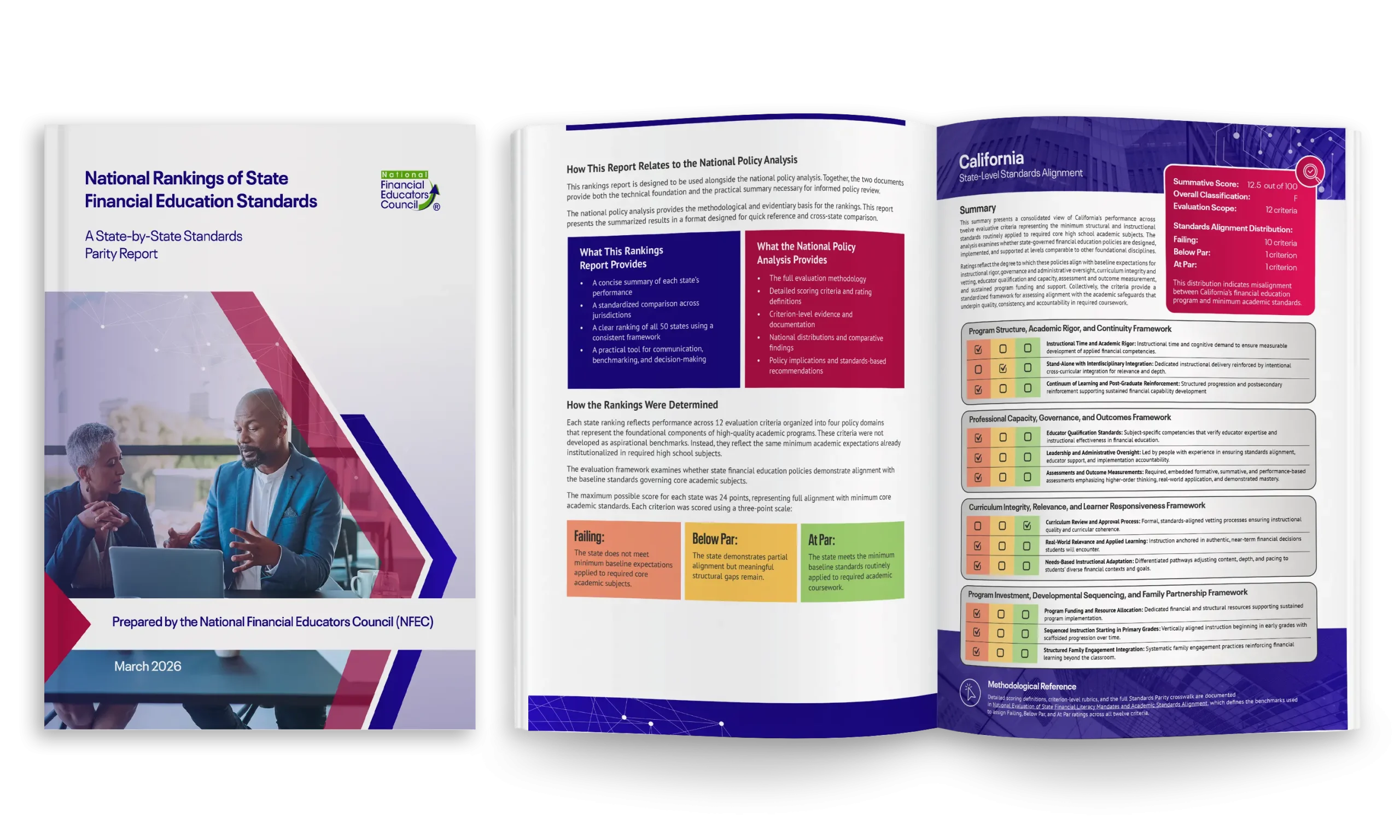
This report presents a concise, state-by-state summary of financial education policy performance across all 50 states. Using a consistent standards-parity framework, each state is ranked based on alignment with the minimum academic standards routinely applied to required core high school subjects such as mathematics, science, English language arts, and social studies.

The rankings provide a comparative snapshot of how state financial education mandates perform relative to established expectations for instructional rigor, governance, curriculum oversight, educator qualifications, assessment, program support, and long-term continuity. The goal is to make the findings accessible to policymakers, educators, advocates, journalists, and stakeholders seeking a practical reference for state-level review and action.

What This Report Includes

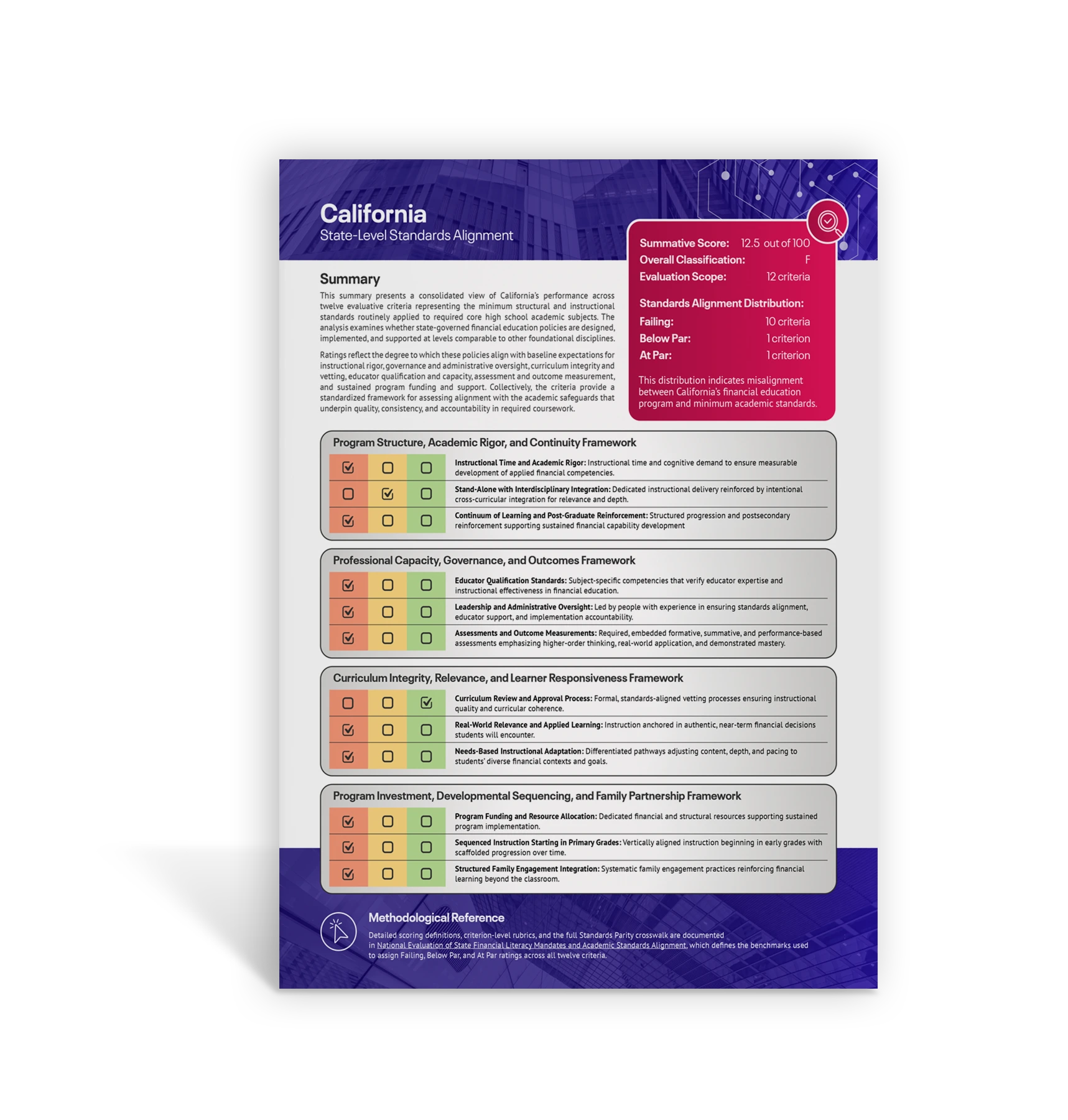
Each state page provides a standardized summary of financial education policy performance using the same evaluation structure across all jurisdictions. Profiles include the state’s overall ranking, standards alignment score, classification, and distribution of performance across twelve evaluation criteria. Together, these measures offer a clear picture of how state policy aligns with baseline academic expectations.

The report is designed for quick reference and comparison. Rather than requiring readers to review the full policy analysis, it brings the most important state-level findings into an accessible format that supports benchmarking, communication, and decision-making.
Key National Findings & State-by-State Ranking

The results reveal widespread and systemic underalignment between financial education policies and the minimum expectations applied to core academic subjects. Across all states, gaps were consistent in areas such as instructional structure, oversight, accountability, and program support – indicating that financial education is not governed with the same rigor as other required disciplines.

Among the most significant findings:

  • No state met parity with minimum core academic standards across financial education programming
  • No state achieved parity across more than one criterion
  • No state met parity at the programmatic level


These findings demonstrate that the challenges facing financial education are structural rather than isolated or incidental. Even in states that have taken steps to expand access or implement mandates, alignment with baseline academic standards remains limited. As a result, financial education programs often lack the consistency, infrastructure, and accountability necessary to produce reliable and measurable outcomes for students.

0%
Highest-performing state achieved only 16.7 percent of the maximum possible score
0%
National average alignment score reflecting widespread and systemic under-alignment
0
Only two instances across 600 evaluated criteria met minimum parity expectations
Rank Name Sum of Standards Points Score
1 Utah 4 out of 24 16.7%
2 California 3 out of 24 12.5%
3 Florida 3 out of 24 12.5%
4 Kentucky 3 out of 24 12.5%
5 Tennessee 3 out of 24 12.5%
6 Alabama 2 out of 24 8.3%
7 Colorado 2 out of 24 8.3%
8 Mississippi 2 out of 24 8.3%
9 New Hampshire 2 out of 24 8.3%
10 Ohio 2 out of 24 8.3%
11 Pennsylvania 2 out of 24 8.3%
12 Texas 2 out of 24 8.3%
13 Wisconsin 2 out of 24 8.3%
14 Connecticut 1 out of 24 4.2%
15 Delaware 1 out of 24 4.2%
16 Georgia 1 out of 24 4.2%
17 Illinois 1 out of 24 4.2%
18 Indiana 1 out of 24 4.2%
19 Iowa 1 out of 24 4.2%
20 Kansas 1 out of 24 4.2%
21 Louisiana 1 out of 24 4.2%
22 Maryland 1 out of 24 4.2%
23 Michigan 1 out of 24 4.2%
24 Minnesota 1 out of 24 4.2%
25 Missouri 1 out of 24 4.2%
26 Nebraska 1 out of 24 4.2%
27 Nevada 1 out of 24 4.2%
28 North Carolina 1 out of 24 4.2%
29 Oregon 1 out of 24 4.2%
30 Virginia 1 out of 24 4.2%
31 West Virginia 1 out of 24 4.2%
32 Alaska 0 out of 24 0.0%
33 Arizona 0 out of 24 0.0%
34 Arkansas 0 out of 24 0.0%
35 Hawaii 0 out of 24 0.0%
36 Idaho 0 out of 24 0.0%
37 Maine 0 out of 24 0.0%
38 Massachusetts 0 out of 24 0.0%
39 Montana 0 out of 24 0.0%
40 New Jersey 0 out of 24 0.0%
41 New Mexico 0 out of 24 0.0%
42 New York 0 out of 24 0.0%
43 North Dakota 0 out of 24 0.0%
44 Oklahoma 0 out of 24 0.0%
45 Rhode Island 0 out of 24 0.0%
46 South Carolina 0 out of 24 0.0%
47 South Dakota 0 out of 24 0.0%
48 Vermont 0 out of 24 0.0%
49 Washington 0 out of 24 0.0%
50 Wyoming 0 out of 24 0.0%

What Rankings Measure

Each ranking reflects performance across twelve evaluation criteria organized into four policy domains that represent the foundational components of high-quality academic programs. These criteria were not developed as aspirational benchmarks. Instead, they reflect the same minimum academic expectations already institutionalized in required high school subjects.

By applying a uniform framework across all 50 states, this report establishes a common baseline for identifying strengths, highlighting structural gaps, and understanding where financial education mandates are supported by the same academic safeguards as other required subjects.

What the Report Evaluates

The evaluation examines statewide financial education policies using a structured framework grounded in widely accepted academic standards and governance practices. These criteria reflect the foundational components that support consistent delivery, accountability, and measurable outcomes in required core academic subjects.

The report evaluates whether financial education is supported by comparable state-level structures. The analysis focuses on the core elements that define quality in required high school coursework, including:

Program Structure, Academic Rigor, and Continuity Framework

  • 1
    Instructional Time and Academic Rigor: Dedicated instructional time and cognitive demand to ensure measurable development of applied financial competencies.


      • 0 At Par States

      • 0 Below Par States

      • 50 Failing States
  • 2
    Stand-Alone with Interdisciplinary Integration: Dedicated instructional delivery reinforced by intentional cross-curricular integration for relevance and depth.


      • 0 At Par States

      • 28 Below Par States

      • 22 Failing States
  • 3
    Continuum of Learning and Post-Graduate Reinforcement: Structured progression and postsecondary reinforcement supporting sustained financial capability development.


      • 0 At Par States

      • 0 Below Par States

      • 50 Failing States

Professional Capacity, Governance, and Outcomes Framework

  • 1
    Educator Qualification Standards: Subject-specific competencies that verify educator expertise and instructional effectiveness in financial education.


      • 0 At Par States

      • 0 Below Par States

      • 50 Failing States
  • 2
    Leadership and Administrative Oversight: Led by people with experience in ensuring standards alignment, educator support, and implementation accountability.


      • 1 At Par States

      • 3 Below Par States

      • 46 Failing States
  • 3
    Assessments and Outcome Measurements: Required embedded formative, summative, and performance-based assessments emphasizing higher-order thinking, real-world application, and demonstrated mastery.


      • 0 At Par States

      • 2 Below Par States

      • 48 Failing States

Curriculum Integrity, Relevance, and Learner Responsiveness Framework

  • 1
    Curriculum Review and Approval Process: Formal, standards-aligned vetting processes ensuring instructional quality and curricular coherence.


      • 1 At Par States

      • 1 Below Par States

      • 48 Failing States
  • 2
    Real-World Relevance and Applied Learning: Instruction anchored in authentic, near-term financial decisions students will encounter.


      • 0 At Par States

      • 0 Below Par States

      • 50 Failing States
  • 3
    Needs-Based Instructional Adaptation Differentiated pathways adjusting content, depth, and pacing to students’ diverse financial contexts and goals.


      • 0 At Par States

      • 0 Below Par States

      • 50 Failing States

Program Investment, Developmental Sequencing, and Family Partnership Framework

  • 1
    Program Funding and Resource Allocation: Dedicated financial and structural resources supporting sustained program implementation.


      • 0 At Par States

      • 0 Below Par States

      • 50 Failing States
  • 2
    Sequenced Instruction Starting in Primary Grades: Vertically aligned instruction beginning in early grades with scaffolded progression over time.


      • 0 At Par States

      • 12 Below Par States

      • 38 Failing States
  • 3
    Structured Family Engagement Integration: Systematic family engagement practices reinforcing financial learning beyond the classroom.


      • 0 At Par States

      • 0 Below Par States

      • 50 Failing States

Companion to the National Policy Analysis

This rankings report is designed to be used alongside the companion policy analysis, which provides the full methodological foundation for the findings presented here. That analysis includes detailed scoring definitions, evaluation criteria, rating thresholds, criterion-level evidence, and policy recommendations.

Readers seeking detailed justification for individual state ratings, scoring methodology, or supporting documentation should review the companion report:

National Evaluation of State Financial Literacy Mandates and Academic Standards Alignment: Assessing Parity with Core High School Academic Requirements Across All 50 States


Why This Matters

States have increasingly adopted financial education requirements for high school graduation, but the structure and quality of those mandates vary significantly. In many cases, requirements exist without the infrastructure commonly associated with other required academic subjects. This report helps clarify where those gaps exist and provides a consistent framework for evaluating state policy performance.

Used together, the rankings and policy analysis provide both the technical foundation and the practical summary needed to support stronger standards, clearer accountability, and more consistent financial education systems nationwide.
Policy Analysis & State Comparison Report Downloads

National Evaluation of State Financial Literacy Mandates and Academic Standards Alignment

Policy analysis evaluating whether state financial education mandates meet the same minimum academic standards as core subjects, focusing on instructional time, rigor, educator qualifications, curriculum structure, and accountability for measurable student achievement.

National Rankings of State Financial Education Standards A State-by-State Standards Parity Report

Companion report that breaks down all 50 states’ rankings based on their alignment with core academic subject requirements, providing a clear comparison of how each state performs against established standards for quality, rigor, and student outcomes.