

Financial Illiteracy Cost Americans $1,819 in 2022
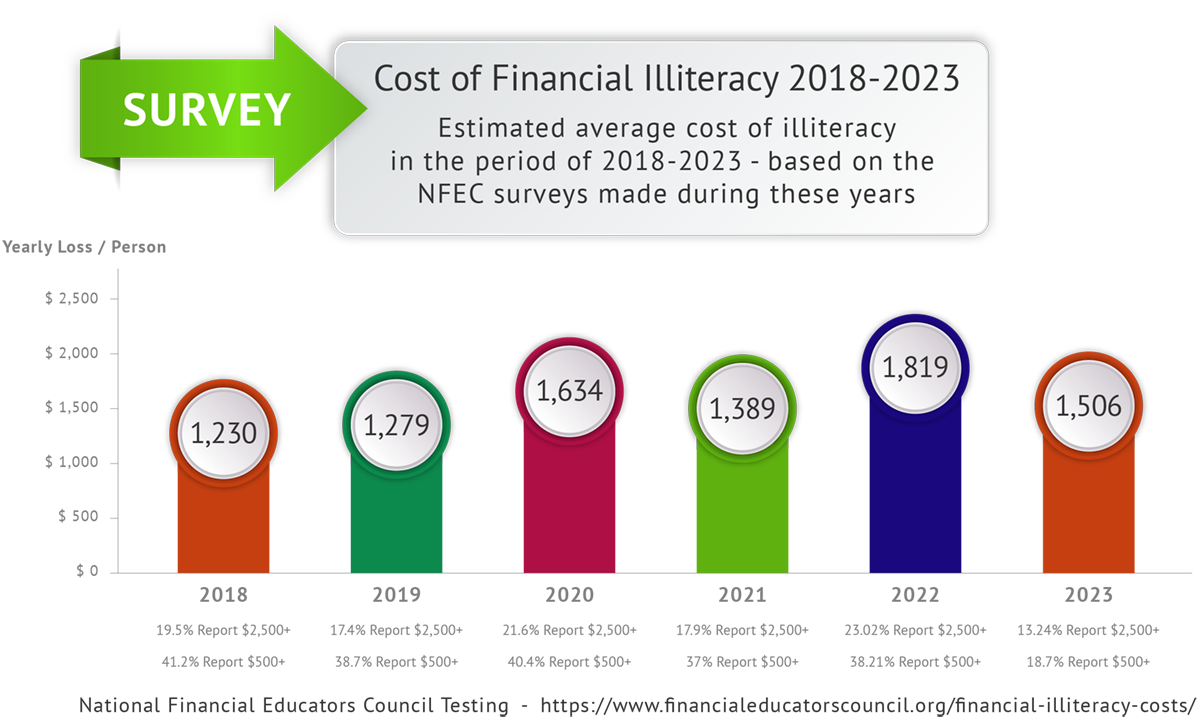
Lacking financial literacy and not knowing how to manage one’s personal finances carried a high cost in 2022. The NFEC conducted a survey asking American adults to estimate how much money they had lost during the year due to a lack of financial knowledge. The single-question survey asked U.S. residents across the country, “During the past year (2022), how much money do you think you lost because you lacked knowledge about personal finances?”
A total of 3,001 people responded to the survey between October 23rd and December 5th, 2022. Six different age groups across the U.S. were represented among those surveyed. Among this diverse group of respondents, the estimated average amount of money that lacking knowledge about personal finances cost people was $1,819 in 2022.
If we generalize the results to represent all of the approximately 254 million adults who live in the U.S., lack of financial literacy costs Americans a total of more than $436 billion in 2022.
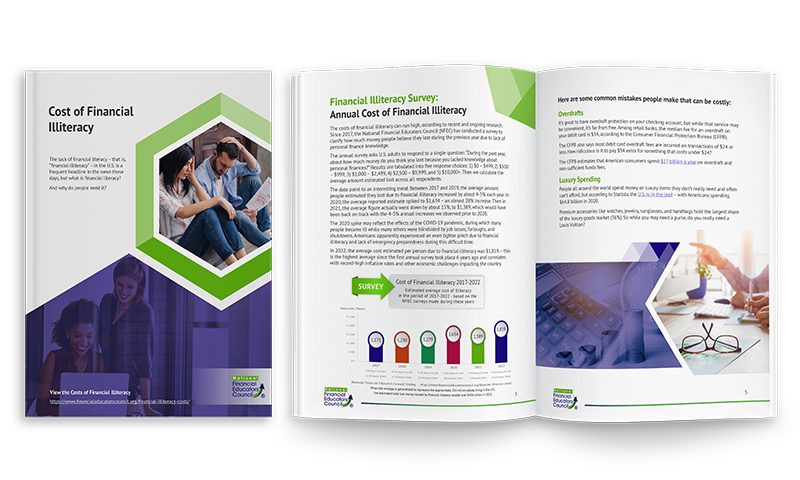
The Cost of Financial Illiteracy Report
In this report, the National Financial Educators Council looks at the definition of financial literacy and the cost of financial illiteracy in different areas of people’s lives.
Survey Results
The survey asked 3,001 people across six age groups the following question:
During the past year (2022), about how much money do you think you lost because you lacked knowledge about personal finances?
61.8%
$0 – $499
7.23%
$500 – $999
7.96%
$1,000 – $2,499
7.98%
$2,500 – $9,999
15.04%
$10,000+
Additional Data
$ 2,500
23.02% Report 2022 Loses at $2,500+
$ 500
38.21% Report 2022 Loses at $500+
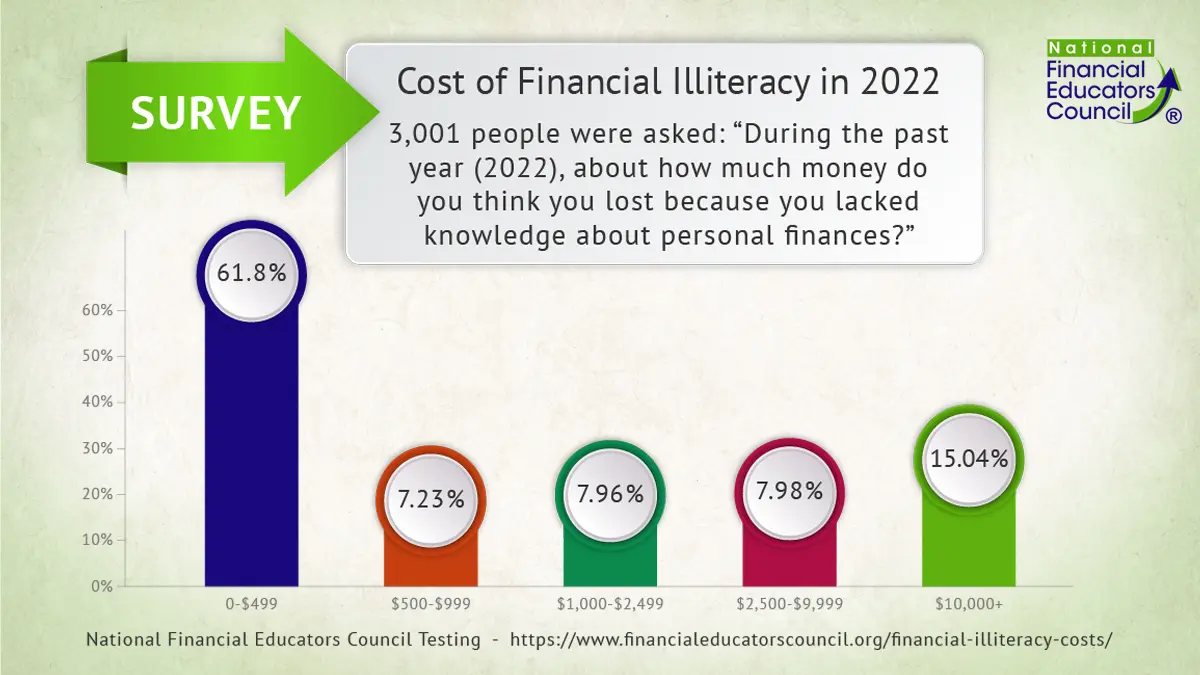
The average respondent lost $1,819 due to lack of financial knowledge in 2022.
2021 Data
Lacking financial literacy and not knowing how to manage one’s personal finances carried a high cost in 2021. The NFEC conducted a survey asking American adults to estimate how much money they had lost during the year due to lack of financial knowledge. The single-question survey asked U.S. residents across the country, “During the past year (2021), about how much money do you think you lost because you lacked knowledge about personal finances?”
A total of 3,389 people responded to the survey between November 23rd, 2021 and December 23rd, 2021. Six different age groups across the U.S. were represented among those surveyed. Among this diverse group of respondents, the estimated average amount of money that lacking knowledge about personal finances cost people was $1,389 in 2021.
If we generalize the results to represent the approximate adult population of the U.S., lack of financial literacy cost Americans a total of more than $352 billion in 2021.
The survey asked 3,389 people across six age groups the following question:
During the past year (2021), about how much money do you think you lost because you lacked knowledge about personal finances?
63%
$0 – $499
10.6%
$500 – $999
8.5%
$1,000 – $2,499
7.2%
$2,500 – $9,999
10.7%
$10,000+
Additional Data
$ 2,500
17.9% Report 2021 Loses at $2,500+
$ 500
37% Report 2021 Loses at $500+
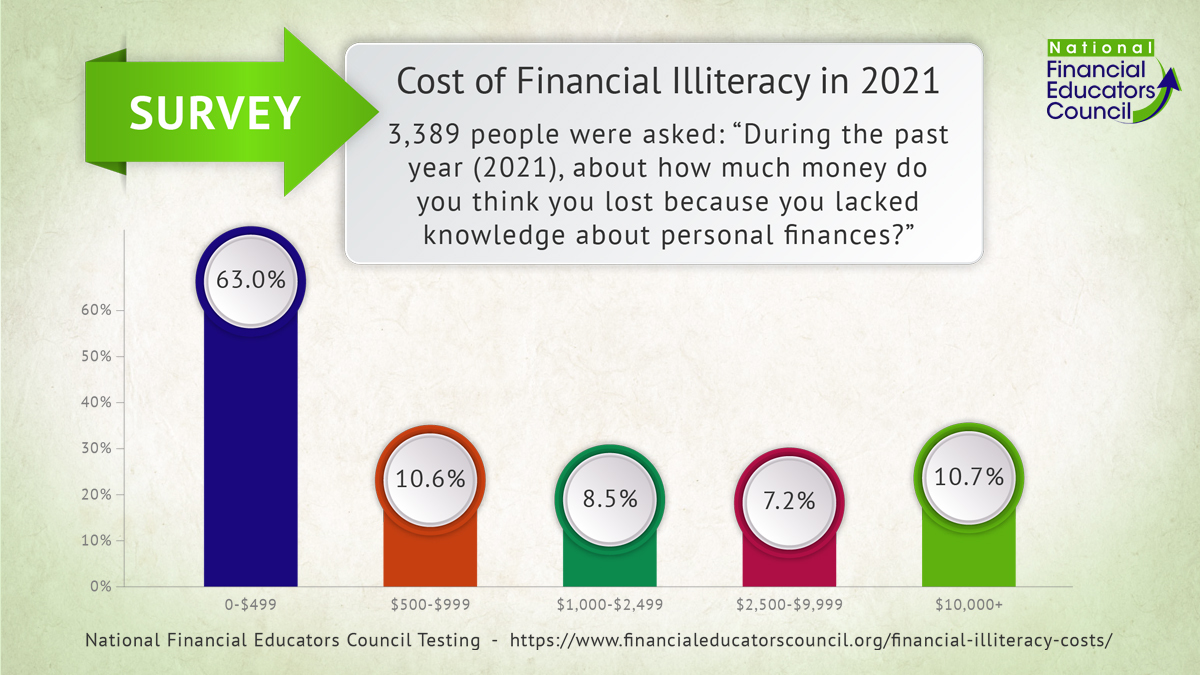
The average respondent lost $1,389 due to lack of financial knowledge in 2021.
2020 Data
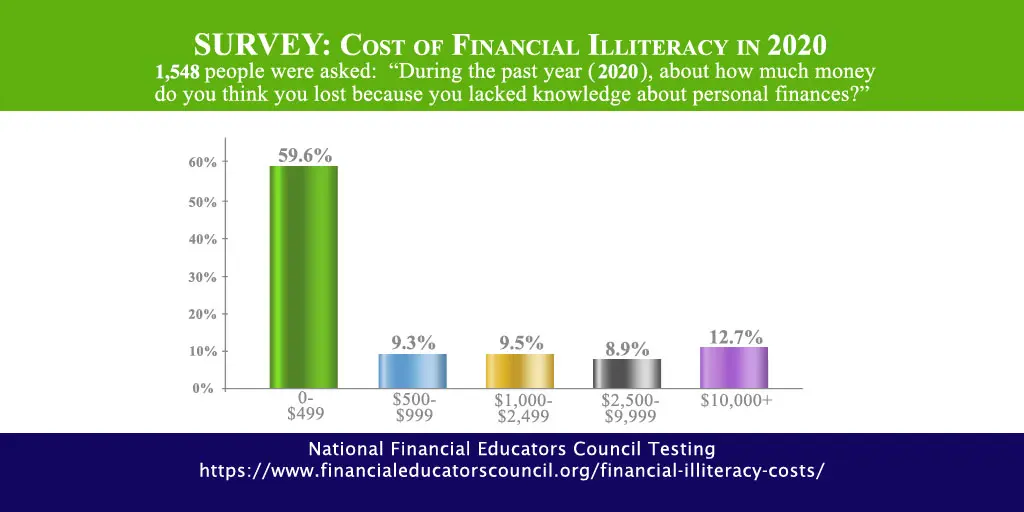
Lacking financial literacy and not knowing how to manage one’s personal finances carried a high cost in 2020. The NFEC conducted a survey asking American adults to estimate how much money they had lost during the year due to lack of financial knowledge. The single-question survey asked U.S. residents across the country, “During the past year (2020), about how much money do you think you lost because you lacked knowledge about personal finances?”
A total of 1,548 people responded to the survey between December 31st, 2020 and January 3rd, 2021. Six different age groups across the U.S. were represented among those surveyed. Among this diverse group of respondents, the estimated average amount of money that lacking knowledge about personal finances cost people was $1,634 in 2020.
If we generalize the results to represent the approximate adult pupulation of the U.S., lack of financial literacy cost Americans a total of more than $415 billion in 2020.
The survey asked 1,548 people across six age groups the following question:
During the past year (2020), about how much money do you think you lost because you lacked knowledge about personal finances?
59.6%
$0 – $499
9.3%
$500 – $999
9.5%
$1,000 – $2,499
8.9%
$2,500 – $9,999
12.7%
$10,000+
Additional Data
$ 2,500
21.6% Report 2020 Loses at $2,500+
$ 500
40.4% Report 2020 Loses at $500+
The average respondent lost $1,634 due to lack of financial knowledge in 2020.
2019 Data
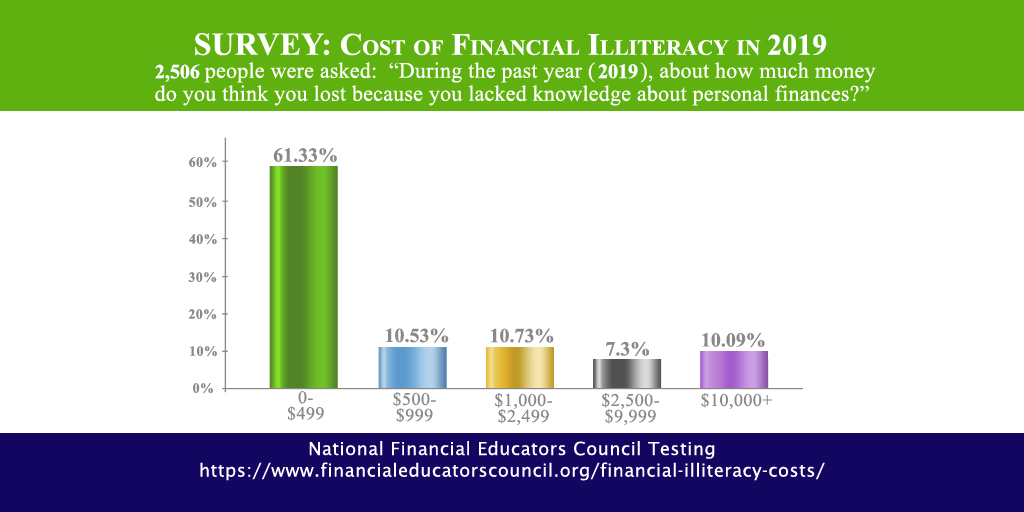
Lacking financial literacy and not knowing how to manage one’s personal finances carried a high cost in 2019. The NFEC conducted a survey asking American adults to estimate how much money they had lost during the year due to lack of financial knowledge. The single-question survey asked U.S. residents across the country, “During the past year (2019), about how much money do you think you lost because you lacked knowledge about personal finances?”
A total of 2,506 people responded to the survey between December 31st 2019 and January 3rd 2020. Six different age groups across the U.S. were represented among those surveyed. Among this diverse group of respondents, the estimated average amount of money that lacking knowledge about personal finances cost people was $1,279 in 2019.
The survey asked 2,506 people across six age groups the following question:
During the past year (2019), about how much money do you think you lost because you lacked knowledge about personal finances?
61.33%
$0 – $499
10.53%
$500 – $999
10.73%
$1,000 – $2,499
7.30%
$2,500 – $9,999
10.09%
$10,000+
Additional Data
$ 2,500
17.4% Report 2019 Loses at $2,500+
$ 500
38.7% Report 2019 Loses at $500+
The average respondent lost $1,279 due to lack of financial knowledge in 2019.
2018 Data
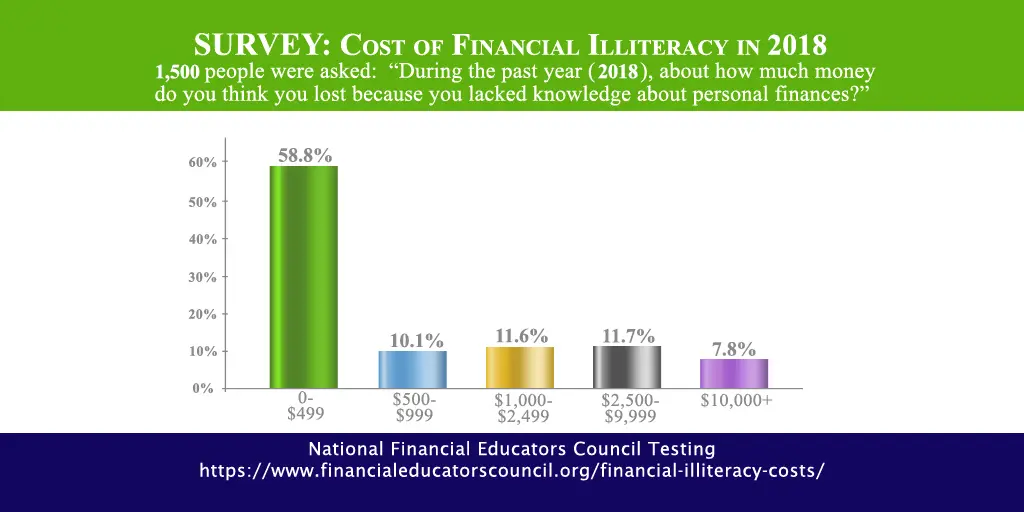
Lacking financial literacy and not knowing how to manage one’s personal finances carried a high cost in 2018. The National Financial Educators Council (NFEC) sought to find out how much money people estimated they had lost across the year due to a lack of financial knowledge. In a one-question online survey, U.S. residents were asked, “During the past year (2018), about how much money do you think you lost because you lacked knowledge about personal finances?”
A total of 1,500 participated in the survey between January 1st and January 4th, 2019, representing six age groups across the country. Among this diverse group, respondents estimated that lacking knowledge about personal finances cost them an average of $1,230 in 2018. This figure was calculated by averaging the total number of respondents selecting each category, using the lowest number in each spread.
The survey asked 1,500 people across six age groups the following question:
During the past year (2018), about how much money do you think you lost because you lacked knowledge about personal finances?
58.8%
$0 – $499
10.1%
$500 – $999
11.6%
$1,000 – $2,499
11.7%
$2,500 – $9,999
7.8%
$10,000+
Additional Data
$ 2,500
19.5% Report 2018 Loses at $2,500+
$ 500
41.2% Report 2018 Loses at $500+
The average respondent lost $1,230 due to lack of financial knowledge in 2018.
2017 Data
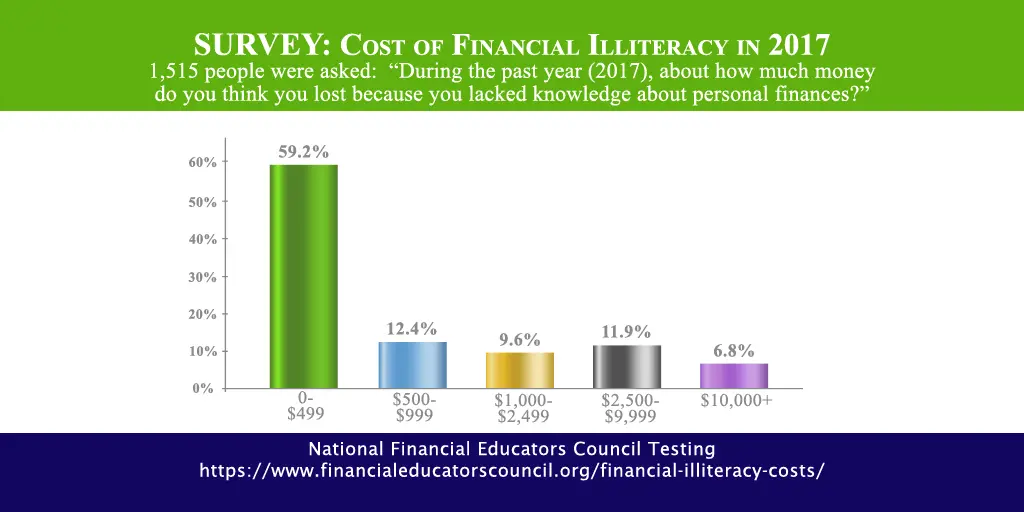
This is the 2nd survey conducted by the NFEC that sought to find out how much money people estimated they had lost across the year due to a lack of financial knowledge. In a one-question online survey, U.S. residents were asked, “During the past year (2017), about how much money do you think you lost because you lacked knowledge about personal finances?”
A total of 1,515 participated in the survey, representing six age groups across the country. Among this diverse group, respondents estimated that lacking knowledge about personal finances cost them an average of $1,171 in 2017. This figure was calculated by averaging the total number of respondents selecting each category, using the lowest number in each spread.
The survey asked 1,515 people across six age groups the following question:
During the past year (2017), about how much money do you think you lost because you lacked knowledge about personal finances?
%
$0 – $499
%
$500 – $999
%
$1,000 – $2,499
%
$2,500 – $9,999
%
$10,000+
Additional Data
$ 2,500
18% Report 2017 Loses at $2,500+
$ 500
41.2% Report 2017 Loses at $500+
The average respondent lost $1,170.95 due to lack of financial knowledge in 2017 alone.
March 2017 Data
Between March 12th and 17th 2017, the National Financial Educators Council asked 3,006 across the US, “Across your entire lifetime, about how much money do you think you have lost because you lacked knowledge about personal finances?”
The survey was conducted online, answers were randomized and inferred demographic data was used. Respondents from 6 age groups (18 – 24, 25 – 34, 35 – 44, 45 – 54, 55 – 64, 65+) participated. The goal of the survey was to measure people’s opinions about the value of personal finance education relative to other coursework commonly offered by high schools.
The survey asked 3,006 people across six age groups the following question:
Across your entire lifetime, about how much money do you think you have lost because you lacked knowledge about personal finances?
%
$0 – $499
%
$500 – $999
%
$1,000 – $2,499
%
$2,500 – $9,999
%
$10,000+
Additional Data
$ 15,000
Reported lifetime losses over $15,000 were reported by 1 out of 3 respondents.
$ 30,000
1 in 4 people reported losses over $30,000 due to a lack of financial knowledge.
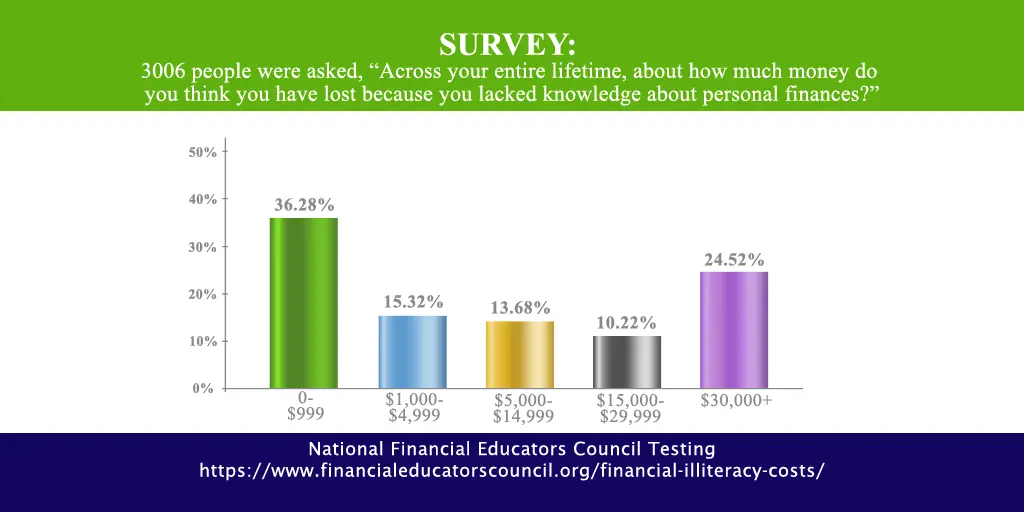
Using the low end of the numeric spread respondents lost $9,724.83 due to lack of financial knowledge.
Using the highest numeric spread ($30,000 was used for $30,000+ answer), respondents lost $13,237.94.
Results by Age Group (2017)
18 – 24 Year-Olds
$5,000-$14,999 - 11.2%
$15,000-$29,999 - 7.6%
$30,000+ - 15.8%
25 – 34 Year-Olds
0-$999 - 36.4%
$15,000-$29,999 - 11.6%
$30,000+ - 16%
35 – 44 Year-Olds
0-$999 - 35.2%
$1,000-$4,999 - 11.2%
$5,000-$14,999 - 15.6%
$15,000-$29,999 - 12.6%
$30,000+ - 25.4%
45 – 54 Year-Olds
0-$999 - 34.3%
$1,000-$4,999 - 11.5%
$5,000-$14,999 - 14.1%
$15,000-$29,999 - 11.7%
$30,000+ - 28.4%
55 – 64 Year-Olds
0-$999 - 34.9%
$1,000-$4,999 - 11.8%
$5,000-$14,999 - 11.8%
$15,000-$29,999 - 8.8%
$30,000+ - 32.7%
65+ Year-Olds
0-$999 - 34.4%
$1,000-$4,999 - 14.2%
$5,000-$14,999 - 13.6%
$15,000-$29,999 - 9%
$30,000+ - 28.8%
Financial illiteracy costs cannot be measured. The repercussions start with the individual who has not been exposed to sufficient education dealing with personal finance. Then it might spread to his or her family and friends. Add to this ripple-effect, the fact that people are influenced by their peers and by society as a whole and you wind up with a self-supporting system where financial illiteracy spreads throughout society. Thanks to recent studies on financial illiteracy costs, more people are becoming aware of the problem and statistics show that the effect is reversible through education, parental role-modeling of good financial behavior and public policy initiatives toward personal financial awareness.
What is the Cost of Financial Illiteracy?
Financial illiteracy costs are widespread and beset any member of society who was not fortunate enough to receive personal finance training. Without an understanding of the fundamentals of the economy and financial services, individuals are ill equipped to analyze public policy and its impact on their own lives. Financial illiteracy costs have been shown to have a very real impact on the financial standing of individuals. Financially illiterate individuals are more likely to make poor investment and financial decisions that erode their financial situation. Since most have limited access to personal finance classes and quality financial literacy curriculum, improving their finances is limited to a select few.
Signs of Financially Illiterate Young Adults
More than 20% of renters aged 18-24 overspent their income by $100 per month (Time). http://business.time.com
58% of 18-26 year-olds set aside a portion of their income as savings (Bank of America). https://bankofamerica.com
37% of recent college graduates have been late with a student loan payment at least once in the past year (US Financial Capability). http://www.usfinancialcapability.org/downloads/NFCS_2015_Report_Natl_Findings.pdf
Obvious Shadows of Financial Illiteracy in the US
11.5% of 2014 college graduates have loans in default (Federal Student Aid Office of the US Dept of Education). https://www2.ed.gov/offices/OSFAP/defaultmanagement/cdr.html
46% of Americans say they have set aside 3 months-worth of living expenses in the case of an emergency (US Financial Capability). http://www.usfinancialcapability.org/downloads/NFCS_2015_Report_Natl_Findings.pdf
National Financial Educators Council, “Financial illiteracy in America”
Culture and Experience Create Personal Attitudes Toward Finance
In a survey by OECD, well over a quarter of respondents replied that their culture influenced their attitudes toward wealth (Organization for Economic Cooperation and Development). https://www.oecd.org/finance/financial-education2017%20Seminar%20on%20financial%20education
%20and%20financial%20consumer%20protection%20LAC%20Wood%20.pdf
46% of those with low financial literacy index scores reported learning from personal experience, while 73% of those with high literacy scores claimed to learn from personal experience (Federal Reserve). https://www.federalreserve.gov
Repetition and Data-Tracking for Strong Financial Education Programs
When done correctly, financial literacy education amends the poor financial habits of learners and replaces them with a healthy and sustainable decision-making framework. Financial illiteracy is associated with low rates of saving, little knowledge of investment products, poor money management skills, and other harmful financial habits. Once these learners undergo a certified financial education program based on data and industry wide best practices, these individuals emerge with their poor financial habits supplanted by new, healthier habits.
The Coalition of Higher Education Assistance Organizations (COHEAO) emphasizes that repetition must find a place in a strong curriculum if the program is looking to impart long-term retention of financial concepts onto students. Repeated use of interactive activities and tests have been shown to enhance long-term retention (Coalition of Higher Education Assistance Organizations). http://www.coheao.com/wp-content/uploads/2011/04/COHEAO-Whitepaper-Financial-Literacy-on-Campus-.pdf
The Consumer Financial Protection Bureau (CFPB) suggests constructing measures of financial well-being as well as level of financial competency. This can help determine what knowledge or behaviors are responsible for the financial outcomes of individuals (Consumer Finance). https://files.consumerfinance.gov/f/201407_cfpb_report_financial-literacy-annual-report.pdf
Financial Experts on the Cost of Financial Illiteracy
“Financial literacy is not an end in itself, but a step-by-step process. It begins in childhood and continues throughout a person’s life all the way to retirement. Instilling the financial-literacy message in children is especially important, because they will carry it for the rest of their lives.” – George Karl, former NBA coach
“Many entrepreneurs struggle to understand payroll taxes, health care and other thorny issues… In other words, they don’t have the financial literacy to scale their businesses and attract investors.” – Daymond John, CEO of FUBU and Sharktank host
“The single biggest difference between financial success and financial failure is how well you manage your money. It’s simple: to master money, you must manage money.” – T. Harv Eker, author of Secrets of the Millionaire Mind
Financial Illiteracy Causes & Long-term Cost
With recent financial crisis like the dot-com bubble and 2008 housing crash fresh in mind, financial illiteracy costs become even larger. Not knowing how to allocate their assets or mitigate risk exposure, many financially illiterate individuals made poor investment choices during the 2008 financial crisis that culminated in them losing not only their entire savings but sometimes their homes too. Such a distressing event illustrates financial illiteracy costs. Fortunately, financial educators and policymakers have begun to strengthen financial literacy programs designed to imbue learners with a framework of financial thinking that will prevent such mishaps in the future.
[1] National Financial Educators Council, “Financial Illiteracy Definition”[2] National Financial Educators Council, “Financial Coach Certification“