
Leverage a Financial Literacy Quiz for Students for Continuing Expansion
When designing a financial literacy quiz for students, remember the desired outcome. When the right data are presented in the right way, the chances of continued funding go up and people become more willing to help you grow and sustain your financial education initiative. Our financial literacy tests for students are designed to give you the quantitative data donors require. Read on to learn about our comprehensive tests.



Comprehensive Personal Finance Quizzes and Tests for Students
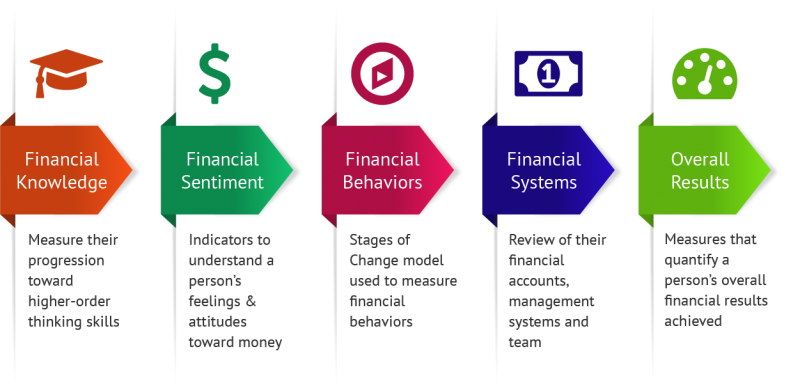
The testing methods of many financial educators only scratch the surface. They miss many of the necessary details that shine light on deeply-rooted attitudes and behaviors toward money. These potential roadblocks are often the most powerful and difficult to surmount.
Another common failing of a typical financial literacy quiz for students is accurately measuring behavior before and after the course. When assessments rely on surveys, the data are often skewed by unconscious participant bias such as thinking they’re doing better than the reality. In the pursuit of cleaner, more powerful data, the NFEC measures post-course behavior and grades assigned financial literacy activities for students.
A Financial Literacy Quiz for Students Aligns Curriculum for Optimum Learning
The NFEC aligns the curriculum with the students’ level of understanding during the learning process. Looking at Webb’s Depth of Knowledge scale, our financial literacy test for students determines just the right level of information that will keep students engaged yet not overwhelmed by ensuring that the knowledge is not delivered too fast or too slow.
The phases of learning must be followed in the correct sequence. If a phase is rushed or skipped when teaching students about money, they become frustrated. Monitoring depth of knowledge can reveal hidden weaknesses in a financial education program. For example, if students are progressing more slowly than expected, it might be because they can’t relate to the instructor or the delivery method.
