
Methodologies for Developing Adult Financial Education
Developing an adult financial education program requires a certain touch that takes into account the unique perspective of an adult learner. If you’re in process of working toward creating coursework in financial education for adults, you’ve reached a good place from which to commence your efforts. We offer tips and guidance for tailoring money lessons to adult audiences here.
Distinctive Points Regarding Financial Education for Adults
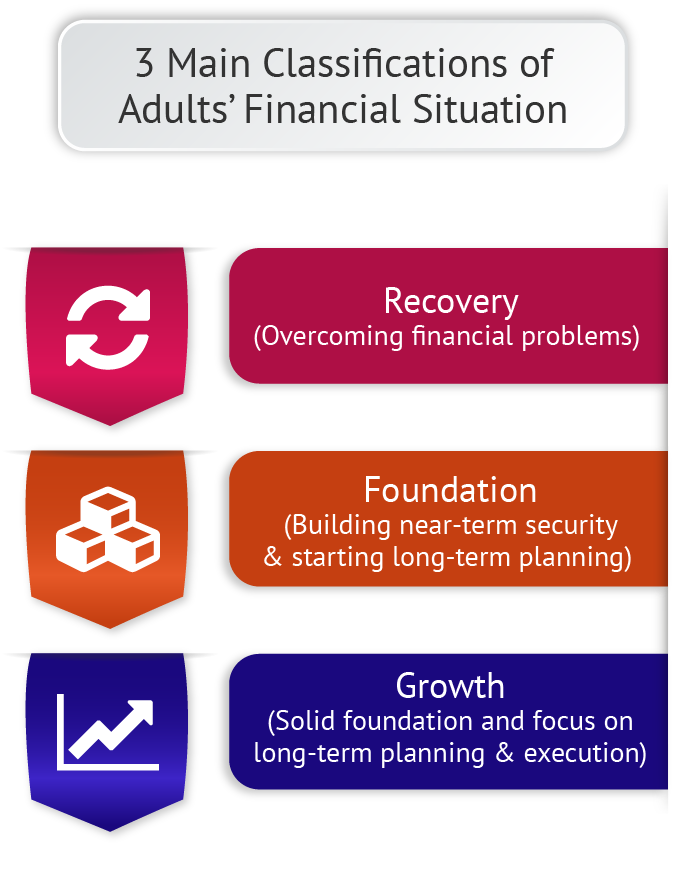
Anyone developing personal finance education for adults should become familiar with the three main phases in which adult learners may find themselves: Recovery, Foundation, or Growth.
At the recovery level, adult financial education should address difficulties the audience has already encountered. There are multiple possible pitfalls they may have run into – but they tend to cluster into these main areas:
1. They formed bad money habits young; problems spiraled out of control.
2. They haven’t defined how much money they need to sustain their lifestyles.
3. They never created financial plans.
4. They never received financial training.
5. They don’t have trusted financial mentors, or take tips from people who don’t know what they’re talking about.
6. They miscalculate returns they expect to get on investments.
The foundation level represents the stage at which adults are just starting out. Here they need to foster financial security in the short-term, while beginning to formulate plans for the longer-term.
The growth phase occurs after adults have formed solid foundations; they can turn focus toward long-term planning and putting plans into action.
Personal Finance Education for Adults: Where do they Fall on the Stages of Change Model?
The next consideration in developing personal finance education for adults is where the audience currently stands in terms of their readiness to make alterations in their behavior. For example, in workplace financial literacy systems, adult groups want to know about money topics that are relevant to their current life decisions. You can rely on the Transtheoretical Behavior Change Model (Prochaska & DiClemente, 1984) to gauge how willing they are to modify their actions.
The NFEC has identified strategies for teaching adult financial education at each of the Stages of Change:
Precontemplation – They haven’t developed any ideas about changing behavior. Use methods to help people increase their long-term awareness and recognize that their behavior may be problematical.
Contemplation – They’re starting to think about the benefits and drawbacks of what they’re doing. Use Neuro-linguistic Programming (NLP) methods to help learners identify benefits and consequences of their behavior.
Preparation – They’re getting ready to make changes. Provide action steps to guide participants forward.
Action – They have made a few modifications to their lifestyles and financial decisions. Offer continuing education components to reinforce their efforts.
Maintenance – They’ve changed their actions and have plans to keep them in place. Give support to help them stay on course and avoid overconfidence.
Termination – Their positive behavior change has become habit, so they can take it from here. For example, this article discusses a recent trend for retirees to return to college after successful careers.

Most people grasp the value of auto and homeowners’ insurance. But few people completely understand how life insurance fits in. Life insurance may be the single most important purchase people make. There are important tips they need to know about buying life insurance, information that should lie at the heart of a solid adult financial education.
As with any large purchase, buying life insurance has several potential pitfalls. Any adult financial literacy program should teach people how to avoid those mistakes. Choosing the best company, finding a good agent, and reviewing policies periodically are crucial to getting the right life insurance for your needs.
The National Financial Educators Council has developed a financial literacy curriculum for adults called Road to Retirement. A comprehensive insurance presentation covering life, disability, and long-term care insurance is part of the series. Tony Steuer, CLU, LA, CPFFE (Director of Financial Preparedness for United Policyholders) wrote the accompanying adult financial education insurance workbooks. Forbes named the life insurance workbook to its list of the top 9 great investment books.
As part of this financial education program, Tony recommends that people go over the following list every 2-3 years:
- Review your life insurance coverage. Make sure the product and coverage levels meet your needs. Review how long you need the coverage and whether the policy fits your budget.
- Make sure you fully understand the policy, terms, and definitions. Will the insurance meet your expectations?
- For a cash value life insurance policy, request an in-force illustration to help ensure that your policy will continue as long as you expect. Lower than expected interest rates/dividends or higher mortality costs may cause policies to terminate prior to maturity.
- Request written confirmation of contracts and beneficiaries. Keep your policy in a safe place where your advisors and/or beneficiaries can find it.
- Check to see if newer policies have hit the market that meet your needs better.
Tony Steuer’s vision is to provide financial education services so that all Americans can understand and monitor their insurance portfolios. Every program that teaches financial education for young adults through seniors should cover insurance—such a large part of the average person’s budget.