
What is Financial Literacy in High School?
A well-designed high school financial literacy program will teach the fundamentals of money management and explain different strategies for different stages of life. What is financial literacy in high school? It focuses on what young adults need to know when they are first setting out and beginning to make decisions about their own money. It will present real-world case studies and situations that young adults face and discuss the short-term and long-term consequences of different approaches. These programs should be data-driven and designed for maximum efficacy in molding sound personal monetary policy into these impressionable young adults. The goal of teaching financial literacy in high school should be a lifetime of prudent money management.
Elements of a High School Financial Literacy Program
Getting more specific, what is financial literacy in high school? The basic definition of financial literacy does not change in high school, rather the delivery methods and the financial knowledge that is being emphasized may be different in a high school setting than a workplace giving a retirement seminar. For those wondering, “What is financial literacy in high school?” the emphasis may be placed on topics most relevant to the students: student loan debt, how to maximize your credit score and the nuances associated with taking out a mortgage to finance a home. The key is sharing this information in a way that engages students. Hands on financial literacy activities for high school students combined with timely information helps.
Experts Define Financial Literacy
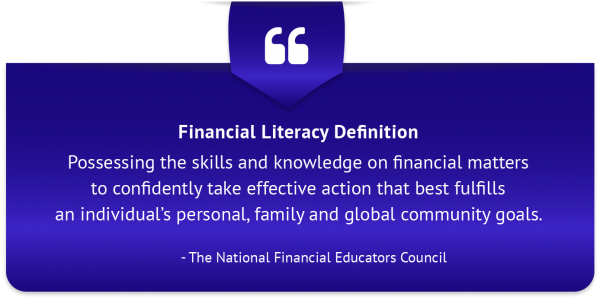
“Possessing the skills and knowledge on financial matters to confidently take effective action that best fulfills an individual’s personal, family and global community goals” (National Financial Educators Council).
“Financial literacy is the education and understanding of various financial areas. This topic focuses on the ability to manage personal finance matters in an efficient manner, and it includes the knowledge of making appropriate decisions about personal finance such as investing, insurance, real estate, paying for college, budgeting, retirement and tax planning” (Investopedia). https://www.investopedia.com
“To be financially literate is to have the knowledge, skills, and confidence to make responsible financial decisions that suit our own financial situations.” – Lucie Tedesco, former Commissioner of Financial Consumer Agency of Canada
“Financial literacy is the education and understanding of knowing how money is made, spent, and saved, as well as the skills and ability to use financial resources to make decisions. These decisions include how to generate, invest, spend, and save money” (My Accounting Course). https://www.myaccountingcourse.com
“I think people don’t understand compound interest because typically no one ever explains it to them and the level of financial literacy in the US is very low.” – James Surowiecki, journalist at The New Yorker and author of “The Financial Page” column
“The single biggest difference between financial success and financial failure is how well you manage your money. It’s simple: to master money, you must manage money.” – T. Harv Eker, author of Secrets of the Millionaire Mind
High School Financial Literacy Education Should Focus on Real-World Behavior
High school is the perfect time to begin financial literacy education. When properly done, financial literacy places an emphasis on behavioral change rather than just absorbing information. Empirical data reveals that financial education can be effective in promoting greater financial stability if the curriculum focuses on making the material practical to the lives of the students. Therefore, initiatives should craft their programs while keeping in mind that the ultimate goal is to have participants apply what they have learned to the real world.
The Financial Services Authority (FSA) of the United Kingdom suggests that different projects are required for different parts of the population and should have separate undertakings for distinct groups: schools, young adults, work, families, borrowing, retirement, and advice (Financial Conduct Authority). http://www.fsa.gov.uk
The OECD states the progress of each individual program should be closely monitored and suggestions given to improve its outcome (Organization for Economic Cooperation and Development). http://www.oecd.org
Financial Literacy Education Comes from Community, Not High School
A mere 31% of young Americans thought that their high school education adequately taught them good financial habits (Bank of America). https://about.bankofamerica.com
40.2% of those with low levels of financial literacy relied on parents, friends, and acquaintances as their most important source of financial knowledge, compared to 20.8% of those with the highest levels of financial literacy (National Bureau of Economic Research). http://www.nber.org
Nearly two in ten adults roll over $2,500 or more in credit card debt each month (National Foundation for Credit Counseling). https://www.nfcc.org
More than 20% of renters aged 18-24 overspent their income by $100 per month (Time). http://business.time.com
More than one in four (27%) U.S. adults admit to not paying their bills on time (National Foundation for Credit Counseling). https://www.nfcc.org
High School Financial Literacy Curriculum
What is financial literacy in high school? It is very much the same as other financial literacy programs, with an emphasis on what is important to young adults. At its core, financial literacy in a high school setting is not radically different than how financial literacy is defined in the workplace or to older audiences. All are focused on providing people with the most relevant skills they can readily apply to their own lives to improve their financial situations and set themselves up for future stability. The unique things about high school financial literacy classes are that the material is weighted more towards topics that are relevant to students. What is financial literacy in high school? Possibly the most important education of young people’s lives – so please provide high school students a financial literacy education.