
Money Management Definition
If you’re looking for a money management definition, you’ll find that it covers a broad spectrum of financial ideas, but the concept can be summarized rather succinctly. The goal of money management is to maximize gains while minimizing risk. The definition of money management then, is the process of doing this. Managing your money means to understand the many options and variables, consider them in the context of your situation and implement the best plan for meeting your goals, both short-term and long-term. While the details at first seem complex, a few underlying principles provide a clear roadmap of your options and how to develop a plan. When you remember the money management definition of maximizing gains while minimizing risk, you can focus on this goal when the details threaten to overwhelm you.
Money Management Definition
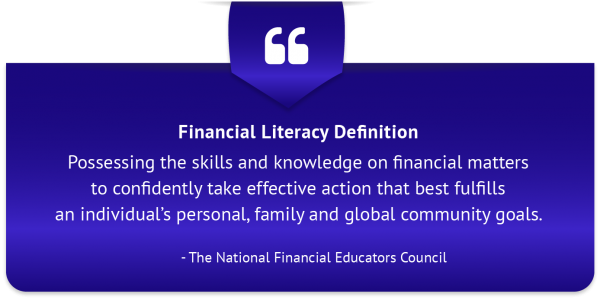
The money management definition developed by the National Financial Educators Council:
Exercising the skills and knowledge on financial matters necessary to confidently take effective action that best fulfills an individual’s personal, family and global community goals.
Broad Definition of Money Management
Take a look at a money management definition and you will find that money management encompasses a broad range of financial decisions and activities related to budgeting, tracking, saving, and investing personal capital in a prudent manner. A money management definition will include a section about retirement savings, creating effective budgets, finding smart investment decisions that suit your level of risk exposure and following through with those plans. All major financial education programs created by reputable companies or government agencies dedicate a portion of their curriculum to money management tips and tricks.
Respected Authorities Define Money Management
“The ability to make informed judgments and to take effective decisions regarding the use and management of money.” (Australian Securities and Investment Commission).
https://download.asic.gov.au
“A combination of awareness, knowledge, skill, attitude and behaviour necessary to make sound financial decisions and ultimately achieve individual financial wellbeing.” (Organization for Economic Cooperation and Development). https://www.oecd.org
“This would relate to someone manage the cash inflows and outflows of their financial world, as well as their investable assets, if any.” – Christopher Baker, Baker DMM
Financial Literacy Must Lead to Actual Money Management
Some best practices according to several published money management articles includes putting a person’s learned financial literacy into practice and actually improving their financial well-being. The impact of financial literacy can only be achieved if people are willing to actively apply their new knowledge with financial matters to their own financial situations. When teaching money management, those leading programs must communicate the importance of actually using what they’ve learned to improve their lives.
The Federal Reserve Board’s Division of Consumer and Community Affairs notes that one-on-one credit counseling was found to decrease the rate of mortgage delinquencies and raise credit scores. Programs could consider smaller class sizes and more personalized coaching to mold consumer behavior (Federal Reserve). https://www.federalreserve.gov
The Australian government offers the following advice: free access to unbiased educational materials is a vital step towards building a financially literate public. Targeted guidance should be offered to groups that are particularly susceptible to financial illiteracy (Financial Capability Australia). https://files.MoneySmart.gov.au
“We need to have financial literacy in America, not just complaining about obstructionism. We need solutions.” – Kabir Sehgal, bestselling author of 8 books
Money Management Taboo Leads to Poor Financial Habits
Bankrate.com conducted a survey showing that 41% of Generation Z, 38% of Millennials, 49% of Gen X, 53% of Boomers, and 59% of the Silent Generation feel uncomfortable talking about their credit card debt. As reported by Harvard Business Review’s Ascend
Two in five U.S. adults report keeping a budget and tracking their spending (National Foundation for Credit Counseling). https://www.nfcc.org
37% of recent college graduates have been late with a student loan payment at least once in the past year (US Financial Capability). http://www.usfinancialcapability.org
A statistically significant association was determined between negative financial habits, such as gambling among Australian youth, and the influence of peers and parents (Science Direct). https://www.sciencedirect.com
Parents who have three or more types of savings are more likely to have kids who discuss money with them (83% vs. 66%) and less likely to have kids who spend money as soon as they get it (40% vs. 52%) or lie about their spending (34% vs. 43%) (Money Confident Kids). http://www.moneyconfidentkids.com
People Don’t Understand Money Management
When people search for a money management definition, they will see that money management is an umbrella term for an array of financial actions all focused on the goal of increasing financial well-being and maximizing assets while maintaining acceptable risk exposure. Many people graduating from high school and those already in the workforce do not know a money management definition nor posses practical knowledge needed to help them work toward financial security and self-suffiency. This is due to a lack of proper financial education, a problem that independent financial literacy initiatives and some government agencies are attempting to tackle.
“The number one problem in today’s generation and economy is the lack of financial literacy.” – Alan Greenspan, former Chairman of the Federal Reserve