
Certified Financial Education Instructor® (CFEI®)
The Leading Financial Literacy Certification for Individuals Teaching Personal Finance
The Certified Financial Education Instructor® (CFEI®) is an industry-leading credential that prepares you to teach personal finance with confidence – and to prove your program’s impact.



Topics & Requirements
The CFEI® coursework meets standards for the highest academic rigor while providing practical financial education knowledge. Graduates possess the skills and teaching techniques that help them motivate, engage, educate, and move participants of all ages to take positive financial action.
Topics Covered
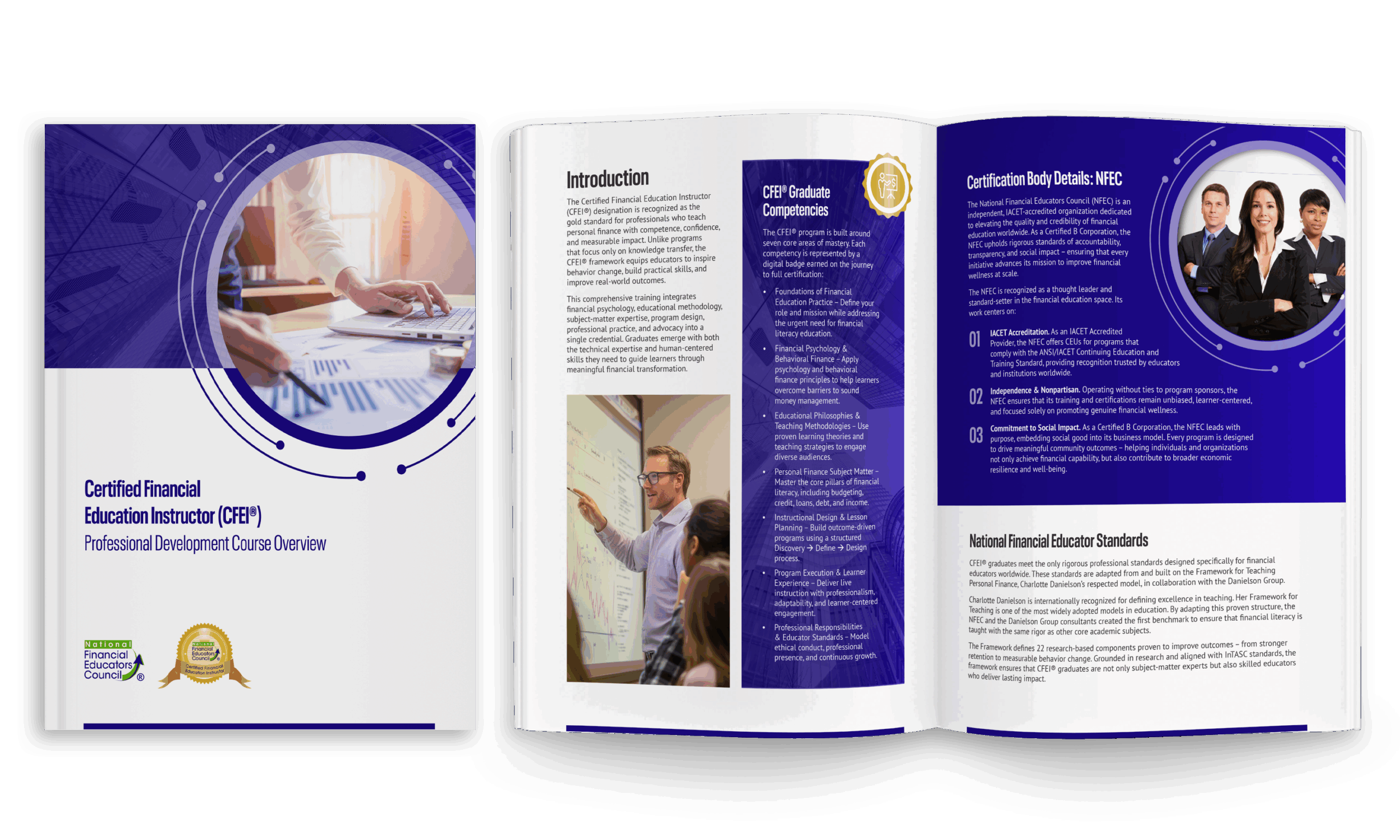
The core modules covered in the CFEI training equip educators with the knowledge, skills, and tools to design and deliver high-quality financial education that produces measurable results.

Foundations of Financial Education Practice
Clarity of mission and role as an educator, with a focus on the urgent need for financial literacy and advocacy for learners across all life stages and communities. You’ll gain the confidence to position yourself as a leader in this movement, equipped to inspire change and expand access to financial education where it’s needed most.

Financial Psychology & Behavioral Finance
In-depth knowledge of behavioral finance principles, financial psychology, and change models that empower learners to overcome emotional, cultural, and cognitive barriers to sound money management. This knowledge helps you connect with people on a deeper level, guiding them to lasting behavior change rather than short-term fixes.

Educational Philosophies & Teaching Methodologies
Application of proven learning theories and instructional strategies to engage diverse audiences, foster retention, and build practical financial skills with confidence. By learning how to adapt your approach, you’ll become a more effective educator who can meet learners where they are and drive real impact.

Personal Finance Subject Matter
Deep content knowledge across the core pillars of financial literacy: budgeting, saving, credit, loans and debt, income, account management, and supporting financial systems. You’ll be fully prepared to answer questions and guide learners through everyday money decisions with clarity and authority.

Instructional Design & Lesson Planning
Expertise in designing high-impact programs using the structured Discovery → Define → Design process, ensuring alignment with learner needs, educational standards, and measurable outcomes. This skill ensures that your programs are professional, well-structured, and capable of demonstrating measurable success to funders and stakeholders.

Program Execution & Learner Experience
The ability to deliver live sessions with professionalism and adaptability, creating safe, supportive, and engaging environments that motivate learners to take real-world action. You’ll gain practical strategies to handle any teaching environment with confidence, whether in classrooms, workshops, or online sessions.

Professional Responsibilities & Educator Standards
A demonstrated commitment to ethical practice, professional presence, accurate recordkeeping, and continuous professional development – ensuring trust, credibility, and long-term program excellence. This foundation strengthens your reputation as a trusted professional whose work meets the highest standards in education.
CFEI Piloting Phase
The Certified Financial Education Instructor® (CFEI®) program is recognized as a leading credential for financial educators due to its ongoing commitment to quality, relevance, and continuous improvement. Following the most comprehensive update since the program’s launch in 2012, all course materials have been fully revised and updated as of December 2025.
With this significant update, the CFEI program is entering a pilot phase through April 1, 2026. Individuals who enroll during this period may choose to participate in the pilot feedback process. Participation is optional and is designed to support program evaluation, time-on-task validation, and continued quality assurance.
Participants who accurately track training time and provide structured feedback in accordance with pilot guidelines will receive a $100 stipend, issued via PayPal upon successful completion of the required steps.

Graduate Survey Data
The NFEC conducts surveys throughout the course to gauge the impact of the training and track participant progress. These data reflect responses from 1,655 graduates who reported their experiences, outcomes, and the ways the CFEI® program has influenced their ability to deliver effective financial education.
Increase of Confidence
Do you feel more confident and qualified to empower others with financial wellness programming?
Recommend
Would you recommend that other financial educators complete this class before teaching financial literacy?
Standards for Financial Educators
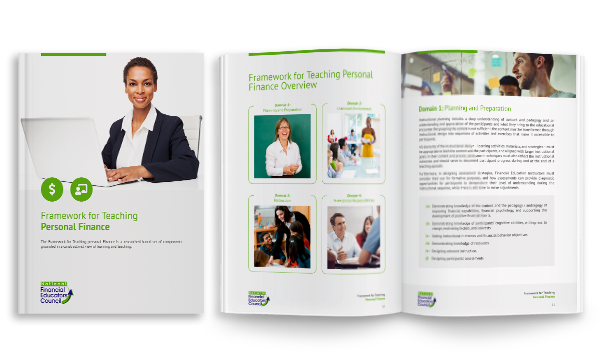
The NFEC developed the Framework for Teaching Personal Finance, the first – and only – national industry standards for financial education instructors. The Framework establishes clear benchmarks to help educators teach more effectively and equip learners with practical financial skills.
Developed in collaboration with the Danielson Group and aligned with InTASC, the Framework adapts Charlotte Danielson’s educational model for financial literacy. Grounded in constructivist learning, the standards define 22 evidence-based components that specify the knowledge, competencies, and performance expectations educators must demonstrate; and provide a roadmap of instructional practices tied to measurable participant gains and ongoing professional development. Danielson’s Framework for Teaching is backed by evidence-based research and widely accepted by educators, administrators, policymakers, and academics. The framework defines the skill sets distinguished educators should possess and performance levels that define educator capabilities. The Framework for Teaching has been adopted as a model approved in more than 20 states, making it the most widely-used teaching model in the US.
What’s Provided in The CFEI® Coursework
Training & Resources
Receive the training and resources you need to earn your Certified Financial Education Instructor® credential. The program combines practical lessons, hands-on activities, and tools designed to build your teaching skills and demonstrate measurable impact.
Testing & Graduation
The certification exam is delivered online; a passing score of 80% is required. If you don’t pass on your first attempt, you may retake the exam. Once you pass the final exam and all chapter tests, you have officially graduated and receive the following:
Awareness, Advocacy, & Funding
To highlight your accomplishments, help you raise awareness, and garner funding for your program, the NFEC provides an awareness package that builds your reputation as a qualified financial educator. Get exposure to our website visitors and highlight your role as a financial education advocate with these complimentary resources:
Limited Bonus for CFEI Graduates
As a bonus, CFEI® graduates receive a Program Toolkit ($349 value) complimentary ($0). This package saves time, raises professionalism, and makes it simple to demonstrate measurable impact – helping you fund and scale your program by providing results.
- Pre-programming: checklists, pre-participation surveys, marketing/registration templates, and full email sequences.
- Implementation: organizer guide, facilitator scripts, slide decks, handouts, and event checklists (including décor assets).
- Post-programming: recognition certificates/badges, follow-up assessments, and continuing education materials.
- Measurement & reporting: assessment bank, KPI templates, and a post-event impact report.
- Case study template: a polished, ready-to-use report for showcasing outcomes, stories, and metrics to partners and funders.
$349 value, provided complimentary to you
Accredited Financial Literacy Professional℠ Certification
Certified Personal Financial Wellness Consultant℠ Certification
Accredited Personal Financial Wellness Consultant℠ Certification
Accredited Personal Finance Instructor℠ Certification
Qualified Educators – Cornerstone of the Financial Literacy Programming
Interested in gaining your financial literacy certification? The NFEC provides options through coursework that gives you not only stellar credentials, but also the confidence and expertise to teach personal finance effectively. These packages provide practical lessons that maximize your impact as an educator and also meet standards for the highest academic rigor.
Graduates of this financial literacy certification program bring a valuable service to their communities by providing people with access to top-quality financial education. Our certified instructors – whether they deliver education to groups or individuals – are all focused on improving people’s financial wellness.
Standards of the Financial Literacy Certification Program
To standardize benchmarks for the financial education industry, the NFEC developed a framework that defines the skills and qualifications of a top-notch financial educator. These standards set forth the performance criteria that help educators become more effective instructors and coaches and provide them clear barometers for learner outcomes. The standards also offer an awareness tool to highlight the importance of having highly-skilled financial educators.
Financial Literacy Certification Program Aids Volunteer to Reach Goals
The following example highlights how the NFEC’s financial literacy certification empowers aspiring educators to reach their goals.
A young man had been serving as a community volunteer for some time, but wanted to learn how to bring financial education to other adults in his area. He didn’t know where to start, so he decided to do an online search. Right away he discovered the NFEC financial literacy certification program, which would deepen his knowledge about personal finance topics while giving him the credibility and self-confidence to teach effectively.
He graduated from the Certified Financial Education Instruction℠ program and, while still volunteering, also struck out on his own. Having done a couple of successful events, he was ready to brand his program. Since the NFEC provides free branding for CFEI graduates, he received custom materials with his colors and logo featured. He used these to promote some of the campaigns that graduates automatically become eligible to participate in, such as the Cash for Candy Halloween activity and survey promotions.
Financial Literacy Certification (CFEI®)
The NFEC’s Certified Financial Education Instructor℠ program helps individuals acquire the expertise, credibility, and self-assurance they need to teach money management lessons effectively. Those that earn the CFEI® financial literacy certification report that they experience greater enjoyment teaching and achieve better results among the audiences who attend their presentations.
The CFEI® coursework meets standards for the highest academic rigor while providing practical lessons that increase your impact as a financial educator. You will develop skills and learn techniques that help you motivate, engage, and move participants of all ages to take positive financial action.
Graduation from the NFEC’s financial literacy certification program demonstrates that you are qualified to teach the subject matter and increases your credibility as a financial education instructor. Graduates of the coursework take their place among the most highly-qualified personal finance educators in the nation, with proven ability to teach essential money management concepts effectively to people of all ages.
Qualified Educators – Cornerstone of the Financial Literacy Programming
Personal finance is a unique subject that requires specialized expertise to teach effectively; the educator directly influences both short-term student outcomes and long-term impact on their financial wellbeing. A key provision in the National Financial Capability Strategy, a report that compiled the overall strategies identified by 47 agencies to guide nationwide financial literacy promotion, is the training and deployment of qualified financial educators.
Researchers agree that effective educators help learners achieve better outcomes.
Teacher effectiveness has a cumulative, financially measurable effect on student achievement; those effects are long-lasting and sustainable.
[1] Teacher and Classroom Context Effects on Student Achievement
Students of qualified educators may expect higher lifetime earnings and greater security at retirement as well as improved mental and physical health and wellbeing.
[2]Baby Boomer Retirement Security
[3]Correlates of Health and Financial Literacy in Older Adults without Dementia.
Studies have identified the basic characteristics of good teachers and shown that better teachers help students achieve measurably higher test scores regarding a wide variety of academic subjects.
[4] Classroom Instruction That Works
Better-qualified teachers produce better-qualified graduates across a wide range of academic disciplines.
[5] Impact of Teachers on Lifetime Earnings.
[6] Linking Teacher Evaluation and Student Learning.
The more effective the teacher, the greater the
student gains.
[7] The Dallas Value-Added Accountability System Report.
Distinguished financial educators who graduate from the NFEC’s financial literacy certification program are not merely dispensers of knowledge; they are learning facilitators who can mold and modify participants’ behavior to guide them toward financial wellness. These certified instructors understand that the subject of personal finance is unique in that it elicits emotional reactions from participants, and are able to deliver training that helps people work toward their personal financial goals.
CFEI® Financial Literacy Certification Qualifications
The NFEC welcomes individuals with a passion for teaching personal finance and a desire to help people build the skills they need to achieve financial wellness. The NFEC has successfully trained people from various backgrounds to be financial education instructors. From seasoned financial professionals and experienced educators to those with no educational or financial backgrounds, the NFEC works with people of all abilities.
For individuals without a background in education or finance, the training is more challenging; however, they still gain the knowledge and skill sets they need to confidently teach personal finance. We regularly train volunteers, students for peer education programs, and entrepreneurs new to financial education. We even trained a high school student who successfully completed the CFEI® program in order to teach youth at a homeless shelter – Read Camille Ko’s Story.
The financial literacy movement needs qualified financial education instructors and we appreciate your interest in becoming an integral part of addressing the financial health of our nation’s citizens.
CFEI® Course Details: Topics & Continuing Education Units
The CFEI® course includes 2 components: 1) Methods of Teaching (pedagogy) and 2) Content Knowledge.
Graduates of the CFEI® coursework successfully complete practical lessons that help them present financial education topics in a group or one-on-one setting. The coursework is listed as a Professional Designation on FINRA’s website* and provides 3 Continuing Education Units (CEUs) for a total of 30 Professional Development Hours (PDH).
CFEI® Certification Meets National Standards for Financial Education Instructors
The Framework for Teaching is backed by evidence-based research and widely accepted by educators, administrators, policymakers, and academics. The Framework identifies skill sets qualified educators should possess and performance levels that define instructor capabilities. The Framework for Teaching is the most widely-used teaching model in the United States, and has been adopted as the single model, or one of several approved models, in more than 20 states.
The NFEC partnered with Danielson Group consultants to modify Charlotte Danielson’s Framework for Teaching to meet the specific needs of Financial Education Instructors. This collaboration yielded the first and only national standards for financial educators – the ‘Framework for Teaching Personal Finance’. The Framework identifies the responsibilities of financial educators proven by empirical studies and theoretical research to produce the highest gains in participant test scores, and provides clear benchmarks to enhance educators’ongoing professional development.
The Framework for Teaching Personal Finance is a research-based set of components aligned with InTASC standards and grounded in a constructivist view of learning and teaching. This Framework breaks down teaching financial literacy into 22 components recognized as best practices in the industry. To date the NFEC is the only organization to clearly define the knowledge, performance expectations, and skill sets in which financial educators should demonstrate competency.
Meet the Course Instructors
The CFEI’s Curriculum Advisory Board and team of educators are diverse and include traditional educators, personal finance experts, and financial professionals. This collaboration between more than 50 experts has yielded a professional development course that bridges the gap between theory-based education and practical application.
Diane Larsen is a NFEC Certified Financial Education Instructor℠ and award winning economics teacher at Mater Dei High School where she has taught for 26 years and was one of the first graduates of the financial literacy certification course. She was selected as Jump$tart Coalition Outstanding Educator and the only California teacher chosen by CEE and the U.S. State Department to travel to South Africa to teach and review other economics teachers in an exchange program. Her students have won high honors in the California State Stock Market Simulation placing 1st in 2008, 2009, and twice in 2012. Last year she had trained 5 of 10 teams in the top ten in the State and had a team win the National Stock Simulation. Diane’s students have scored in the upper 10% in the National Financial Literacy Challenge with one in the upper 1% of the nation. Her teams have been regulars in the CCEE Capital Markets Competition and last June had a team place in the top 6 in the Money Wise Teen competition sponsored by CCEE.
Steve Repak, is a Certified Financial Planner™, Army veteran, and author of Dollars & Uncommon Sense: Basic Training For Your Money. Steve graduated Summa Cum Laude with a Bachelor of Science in Management Communications from Amridge University. Steve has been a frequent guest on Fox and Friends, Fox Business, and the 700 Club. Steve has been interviewed on NPR, Bloomberg, Market Watch, and Wall Street Journal Radio. Steve’s work has been featured in Forbes, Investor’s Business Daily, BusinessWeek, MSN Money and Yahoo Finance. Steve is currently a contributor to the Equifax® Finance Blog, Choose Now Ministries and The Life of a Single Mom Ministries. Steve is an advocate for financial literacy and a 15 year veteran in the financial services industry. Steve has demonstrated expertise as an educator from how his presentations are well received by the audience, and from the post-surveys collected which demonstrated the material made an impact.
Erica K. Jackson served as Director for the Center for Financial and Consumer Outreach (at Penn State Erie, The Behrend College) and holds a certification as a Certified Financial Education Instructor℠ (CFEI®). In this role, she was responsible for financial literacy programming, project management, and community outreach /collaborations. Jackson has also served as the inaugural Executive Director for Junior Achievement’s Northwest PA Regional Office. Over the years, Erica has partnered with several agencies and organizations to advocate for financial capability including: National Financial Educators Council, Pennsylvania Treasury, Pennsylvania Department of Banking, and Jump$tart Coalition. Because of her active involvement throughout the state, Erica has been recognized for her commitment and dedication. This includes: Distinguished Leadership Award – Honored by Governor Edward Rendell, U.S. House of Representatives Congressional Certificate, and Women Making History.
Gary Jaeckel’s passion for improving people’s financial capabilities took him from the corporate world to the financial literacy industry. He brings real world experience to the academic side of the financial literacy field with his background in the financial and securities industries and corporate finance. He is a recognized expert in teaching personal finance and is known as an advocate promoting personal financial education as a stand-alone course in all schools across the country. At NFEC, Gary was instrumental in developing the Framework for Teaching Personal Finance and his textbook, Teaching Personal Financial Education, is used as part of the NFEC’s curriculum. He has also authored another textbook, Personal Finances and the Economy which covers the major personal finance and economic content standards. Gary holds a Masters degree in international business and a Secondary Education Teaching Certificate.
Vince Shorb is CEO of the NFEC and one of the Council’s original founders. Shorb remains involved in educational development and raising awareness for the financial literacy movement. Before joining the NFEC, Shorb talked with more than 20,000 people about their personal financial situation and reviewed the personal financial statements of more than 10,000 clients. This real-world experience in the financial literacy field contributes to his deep understanding of the challenges people face today. His passion for helping people improve their financial capabilities combined with his expertise in the financial education industry propelled him into a leadership role in the industry. Shorb was instrumental in developing the Framework for Teaching Personal Finance, the CFEI® training program, founded the first national speakers association for personal finance experts, created a PSA campaign covered by TIME, was the lead consultant on initiative that will reach over a half-million people, has lead the Curriculum Advisory Board on development of over 250 hours of curriculum and enlisted the support of top celebrities – Shorb’s credentials make him among the most qualified financial literacy advocates in the world.
Thank You
The NFEC appreciates your interest in improving the financial capabilities of your community members. The more people you reach with money management training, the closer it brings us to accomplishing our mission of “creating a world where people are informed and able to make qualified financial decisions that improve their lives, the lives of those they love, and the lives of those they reach around the globe.
View Profiles of a Few of Our CFEIs
All CFEI® Graduates receive a speaker’s profile page like this – complimentary.




[1] W. L. Sanders, S. P. Wright and S. P. Horn, University of Tennessee, Journal of Personnel Evaluation in Education, Vol. 11 (1997), Teacher and Classroom Context Effects on Student Achievement: Implications for Teacher Evaluation.
[2] Annamaria Lusardi and Olivia S. Mitchell, NBER Working Paper No. 17078 (May 2011), Baby Boomer Retirement Security: The Roles
of Planning, Financial Literacy, and Housing Wealth.
[3] Bennett et al., BMC Geriatrics, 12:30 (2012), Correlates of Health and Financial Literacy in Older Adults without Dementia.
[4] R. J. Marzano, D. J. Pickering and J. E. Pollock, Association for Supervision and Curriculum Development, Alexandria, VA (2001),
Classroom Instruction That Works: Research-based Strategies for Increasing Student Achievement
[5] Max Nisen, Business Insider (Sep. 16, 2013), Impact of Teachers on Lifetime Earnings.
[6] Pamela D. Tucker and James H. Stronge, Association for Supervision and Curriculum Development (2005), Linking Teacher
Evaluation and Student Learning.
[7] William J. Webster and Robert L. Mendro, Dallas Public Schools (1997), The Dallas Value-Added Accountability System Report.
[8] National Financial Educators Council (2016), National Financial Capability Strategy.
*FINRA does NOT approve or endorse any professional designation. Nor does a designation’s inclusion in this database imply that FINRA considers the designation to be acceptable for use by a registered representative.