

Applied Financial Capability Standards℠: Invitation to Apply for Public Review

The NFEC Applied Financial Capability Standards℠ establish clear, measurable expectations for preparing high school students and youth who are not yet living independently for the near-term financial decisions they will face as they transition into adulthood.

These standards move beyond financial knowledge and readiness alone. They emphasize demonstrated capability – students applying what they learn to financial decisions, completing real tasks, building systems, and producing resources they can use in their own lives.

The financial capability standards translate real-world financial responsibilities into measurable outcomes that require students to demonstrate what they can actually do. Performance is evidenced through the completion of financial actions, detailed plans for future actions, and the development of practical systems and processes students can use to manage current and near-term financial responsibilities.

The NFEC invites educators, researchers, financial professionals, youth-serving organizations, policymakers, and other stakeholders to review the proposed standards and provide public comment to help strengthen their rigor, usability, and alignment with the financial realities young people face.

Help Shape the Future of Applied Financial Capability

The NFEC identified a consistent gap across financial education standards used in mandated high school coursework: typical standards emphasize financial concepts, definitions, and lower-order thinking skills without requiring students to complete real-world tasks tied to actual financial situations. 

In its review of financial education standards across all 50 states, the NFEC policy analysis report titled National Evaluation of State Financial Literacy Mandates and Academic Standards Alignment found that no state offering high school financial education included outcome-based performance measures across its standards, and few included meaningful real-world application requirements. 

The Applied Financial Capability Standards℠ were developed to close this gap by shifting the focus from what students know to what they can produce and demonstrate.
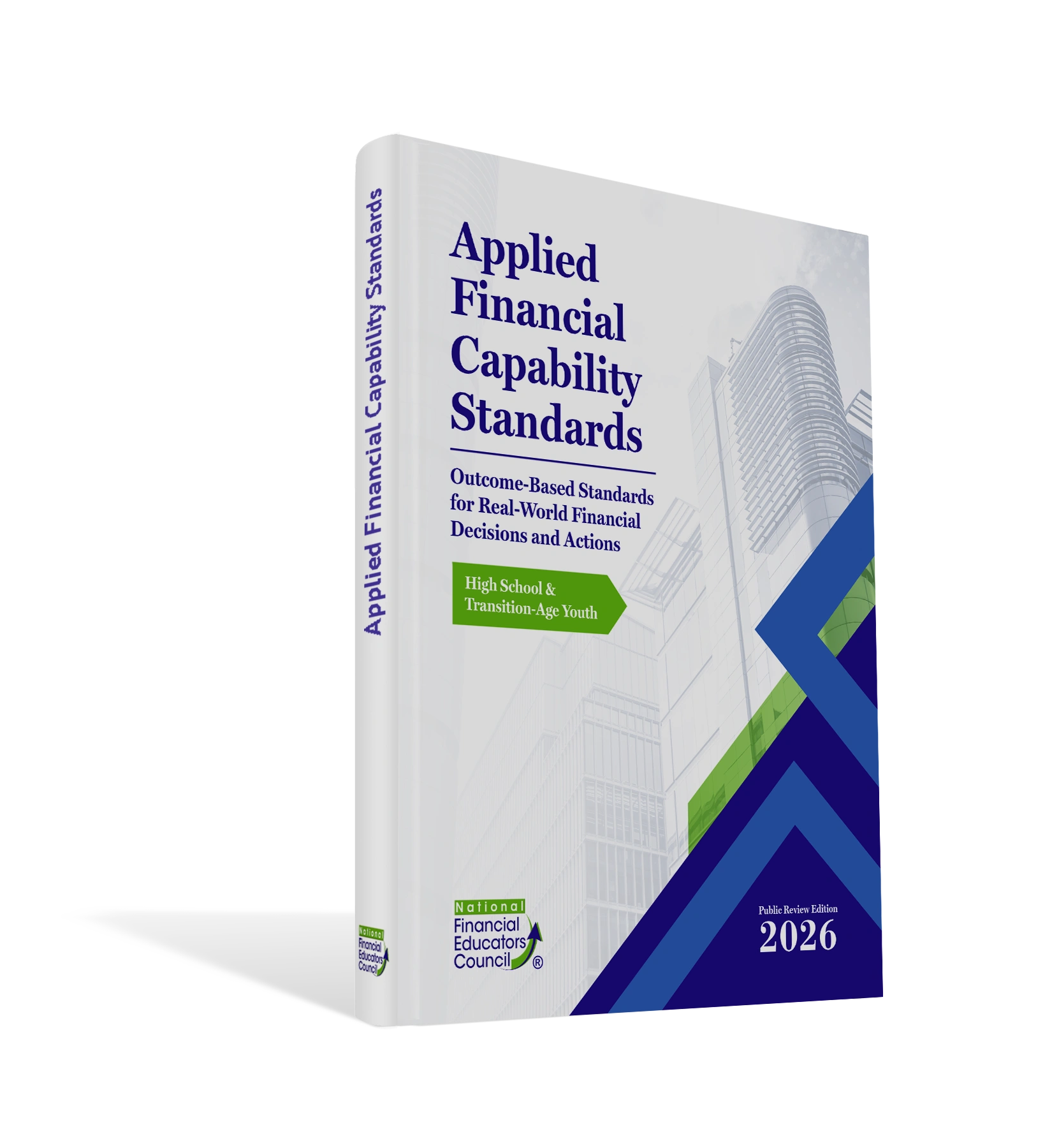
Standards Built Around Real Student Performance

The Applied Financial Capability Standards℠ are organized around the major financial responsibilities, decisions, and life events students may be facing now or are likely to encounter in the near term. Each area includes standards that translate financial knowledge into practical application, with students expected to make informed decisions, complete relevant tasks, establish useful systems, and take appropriate real-world action.

The framework includes 61 standards centered on real, measurable student outputs that can be evaluated through performance-based assessments. These standards result in practical plans, completed tasks, established systems, and other usable evidence of financial capability.

The standards are supported by more than 1,400 Enabling Learning Outcomes (ELOs) that provide educators with a clear, sequential roadmap for instruction and application. Each standard establishes clearly-defined performance expectations and observable evidence of what students can actually do.

This is a draft outline of the areas addressed by the standards. Supporting these standards are over 1,400 Enabling Learning Outcomes. 

We anticipate revisions to the standards and supporting language throughout the public review period as feedback is received and evaluated. 

Earning, Work, and Career Readiness

These standards prepare students to earn income, enter the workforce, keep employment, and make education or career decisions that affect future earning potential.

Near-Term Income Generation

  • Construct and Prioritize a Near-Term Income Generation Plan
  • Produce a Job-Ready Resume and Application Portfolio
  • Build and Maintain a Professional Digital Presence
  • Prepare Professional Interview Presentation and Materials
  • Produce Professional Job Search Communications
  • Demonstrate Interview Readiness Through Practice and Feedback
  • Execute and Manage the Job Application Process

Workplace Success and Job Retention

  • Prepare for Workplace Expectations, Rights, and Responsibilities
  • Demonstrate Workplace Professionalism, Reliability, and Communication
  • Apply Feedback, Conflict, and Workplace Challenges
  • Construct a Job Retention and Workplace Success Plan

Long-Term Career Planning and Workforce Strategy

  • Analyze Personal Career Fit and Long-Term Priorities
  • Research Career Pathways and Workforce Requirements
  • Compare Financial Outcomes, Labor Market Demand, and Career Risk
  • Construct, Test, and Maintain a Long-Term Career Strategy

Education and Skill Development

  • Evaluate Education, Training, and Skill Development Pathways
  • Analyze Education Costs, Benefits, and Return on Investment
  • Construct an Education Affordability Budget
  • Secure and Manage Education Funding
  • Construct an Education and Skill Development Plan

Money Management, Tax Responsibilities, Credit, and Financial Systems

These standards prepare students to manage money, save, use banking tools, handle first-job tax responsibilities, make credit and debt decisions, protect information, and maintain personal financial systems.

Savings

  • Establish a Savings Baseline and First-Income Savings Rules
  • Set a Starter Emergency Fund Target
  • Prioritize Savings Goals and Calculate Contribution Requirements
  • Construct, Test, and Maintain a Savings Plan

Banking Account Setup and Management

  • Compare Banking Institutions, Account Products, and Opening Requirements
  • Prepare, Open, and Secure Checking and Savings Accounts
  • Protect Account Access and Use Banking Tools Safely
  • Manage Checking, Savings, Fees, Statements, and Account Problems

Credit Profile

  • Review Credit File Status and Protect Credit Information
  • Evaluate Credit-Building Readiness and Select an Appropriate Strategy
  • Build, Manage, and Monitor Credit Responsibly
  • Review Credit Issues, Respond to Fraud, and Maintain Credit Readiness

Debt Readiness and Credit Card Decision-Making

  • Evaluate Borrowing Purpose, Affordability, Alternatives, and Risk
  • Analyze First Credit Card Readiness, Offers, Terms, and Options
  • Construct Responsible Borrowing, Application, and First-Card Use Rules

Tax Filing Readiness and First Income Tax Plan

  • Financial Organization, Security, and Support Systems
  • Construct and Maintain a Personal Finance Calendar and Reminder System
  • Organize, Secure, and Maintain Financial Records
  • Establish Verified Financial Contacts and Support Communication Practices
  • Manage Financial Communications, Issues, and Follow-Up Systems

Life Events and Major Financial Decisions

These standards prepare students for major near-term financial decisions connected to independent living, transportation, housing, insurance, and other real transition points.

Budget Planning for Future Independent Living

  • Prepare for Independent Living Goals, Support Changes, and Readiness
  • Construct and Evaluate a Future Independent Living Budget
  • Build Move-Out Savings and Emergency Reserve Targets
  • Stress-Test the Budget and Finalize the Independent Living Decision

Transportation Planning and Vehicle Decision-Making

  • Construct and Maintain a Transportation Strategy
  • Plan, Verify, and Manage a Vehicle Purchase Pathway
  • Plan, Verify, and Manage a Vehicle Lease Pathway

Rental Housing and Shared Living Readiness

  • Evaluate Housing Needs, Rental Readiness, Affordability, and Support Constraints
  • Search, Verify, and Compare Rental Housing Options
  • Prepare for Rental Applications and Review Lease Obligations Before Signing
  • Plan Move-In Costs, Utilities, Renter’s Insurance, and Housing Setup
  • Evaluate Shared Living Fit and Establish Roommate Responsibility Agreements
  • Finalize, Implement, and Maintain the Housing Readiness Plan

Health Insurance Planning

  • Confirm Current Coverage, Family Plan Access, and Coverage Transition Timing
  • Evaluate Coverage Pathways, Eligibility, Enrollment Deadlines, and Document Requirements
  • Estimate Healthcare Use, Medical Cost Exposure, and Coverage Protection Needs
  • Compare Plan Costs, Coverage Features, Provider Networks, and Prescription Access
  • Finalize and Maintain a Health Insurance Coverage Transition Plan

Standards Structure and Format 

The standards are organized in a nested structure that progresses from broad areas of applied financial capability to specific, measurable student outcomes. Each Standard Cluster groups related standards around a major area of near-term financial decision-making and includes a Cluster Terminal Learning Outcome (TLO) describing the overall result students should achieve, a Needs Analysis explaining the readiness gap the cluster addresses, and Safety & Privacy Guidelines identifying appropriate support, supervision, and protections for sensitive personal and financial information. Within each cluster, individual Standards define the major decisions, tasks, or competencies students should be able to demonstrate. Each standard includes a Standard Scope Statement, a Standard Performance Expectation, and Evidence of Readiness describing the observable evidence students will produce and the criteria used to evaluate performance.

Each standard is further divided into Learning Objectives that break the larger outcome into manageable components for instruction and student application. Each Learning Objective includes a Real-World Application describing the actual task, decision, or process students are preparing to complete, along with Enabling Learning Outcomes (ELOs) that define the specific, measurable abilities students must demonstrate. ELOs are organized into ELO Categories that group related skills, decisions, and tasks, with Individual ELOs identifying the precise actions, steps, and decisions students must successfully perform. This structure creates clear alignment from broad capability goals through instruction, real-world application, assessment, and program evaluation.

1. Standard Cluster

A grouping of related standards that together address one major area of near-term financial decision-making.

1(a). Cluster Terminal Learning Outcome (TLO)

A broad statement that describes the major outcome students should achieve by completing all standards within the cluster.

1(b).  Needs Analysis

A concise rationale explaining why the standard cluster is necessary, what student readiness gap it addresses, and how the cluster supports applied financial decision-making. 

1(b). Safety & Privacy Guidelines

Guidance regarding when students may need support, approval, or supervision from parents, guardians, educators, counselors, programs, or professionals, along with expectations for protecting sensitive personal and financial information. 

2. Standard

A specific, outcome-based standard within a cluster. Each standard defines one major decision, task, or competency students should be able to demonstrate.

2(a). Standard Scope Statement

A concise description of what the standard addresses, who it is designed for, and how it connects to the broader Standard Cluster.

2(b). Standard Performance Expectation

A statement that describes the major outcome students should achieve by the end of the standard.

2(c). Evidence of Readiness

A description of how students will demonstrate that they have achieved the Standard Performance Expectation. This section outlines the type of observable evidence students will produce and the key criteria used to evaluate their performance.

3. Learning Objective

A focused component within a standard that breaks the standard into manageable steps to guide instruction and student learning.

3(a). Real-World Application

Describes the real-world task, decision, or process students are preparing to complete. It connects the learning objective to the specific actions and decisions students must demonstrate through the enabling learning outcomes.

3(b). Enabling Learning Outcomes (ELOs)

Specific, measurable outcomes that describe what students must be able to do to achieve the Learning Objective.

3(c). ELO Categories

Organized groupings of related enabling learning outcomes that focus on key skills, decisions, or tasks.

3(d). Individual ELOs

The precise, measurable skills, steps, decisions, and actions students must demonstrate under each ELO Category.

Help Shape the Applied Financial Capability Standards℠

The NFEC is seeking input from educators, researchers, financial professionals, youth-serving organizations, policymakers, and other stakeholders with relevant experience. Your perspective can help strengthen the standards currently developed and ensure that they are rigorous, practical, and aligned with the financial decisions young people face.

With more than 1,400 Enabling Learning Outcomes (ELOs), 61 standards, and hundreds of learning objectives, we are seeking 20 to 30 qualified reviewers to evaluate the existing standards, identify gaps and opportunities for improvement, recommend revisions, and help strengthen the final framework before publication.

Contributors whose ideas are incorporated will be formally recognized in the published standards. This includes acknowledgment of your name, professional affiliation, and contribution – providing public recognition for helping shape the first national framework of applied financial capability standards for students. This work is non-compensated, but we greatly appreciate your time, expertise, and willingness to help strengthen these standards for educators and students nationwide.

Thank you for your interest in reviewing the NFEC Applied Financial Capability Standards℠. Please complete the brief application below. Your responses will help us understand your background and the perspective you bring to the review process.

Name(Required)
How many years of relevant professional, financial education, academic, or related experience do you have?(Required)
Max. file size: 1 GB.

Our Belief

Kids should not leave high school unprepared for the money and work decisions they will face almost immediately. Protecting students means teaching them how to earn money, manage it, avoid costly mistakes, and ask for help before small decisions become serious problems.

Earning, Work, and Career Readiness

  • Near-Term Income Generation. Students should know how to look for work, build a resume, prepare for interviews, communicate professionally, and apply for jobs in an organized way.

  • Workplace Success and Job Retention. Students should understand how to show up reliably, communicate respectfully, handle feedback, solve problems, and keep a job.

  • Long-Term Career Planning. Students should think ahead about careers that fit their goals, abilities, lifestyle needs, and future income.

  • Education and Skill Development. Students should compare education and training options, understand the costs, and avoid taking on debt without a clear plan.

Career Readiness

Money Management, Tax Responsibilities, Credit, and Financial Systems

  • Savings. Students should learn to save early, prepare for emergencies, and avoid being one unexpected bill away from crisis.

  • Banking. Students should know how to compare, open, protect, and manage checking and savings accounts safely.

  • Tax Filing Readiness. Students should understand paychecks, withholding, tax filing triggers, and basic recordkeeping once they begin earning income.

  • Credit Profile. Students should know how credit works, how to build it responsibly, and how to protect their personal information.

  • Debt Readiness. Students should understand the risks of credit cards and borrowing before offers start coming at them.

  • Financial Organization. Students should know how to keep records, track deadlines, set reminders, and identify trusted support when needed.

Financial Literacy Skills

Life Events and Major Financial Decisions

  • Independent Living Budget. Students should understand the real cost of moving out before they sign a lease, take on bills, or depend on unrealistic income.

  • Transportation. Students should compare transportation options and understand the full cost of getting to work, school, and daily responsibilities.

  • Rental Housing. Students should know how to research rentals, understand lease responsibilities, plan move-in costs, and avoid unsafe housing decisions.

  • Health Insurance. Students should understand how coverage works and how to stay insured after high school.

Major Financial Decisions