
Alabama Financial Literacy Standards and Mandates: Academic Alignment Review
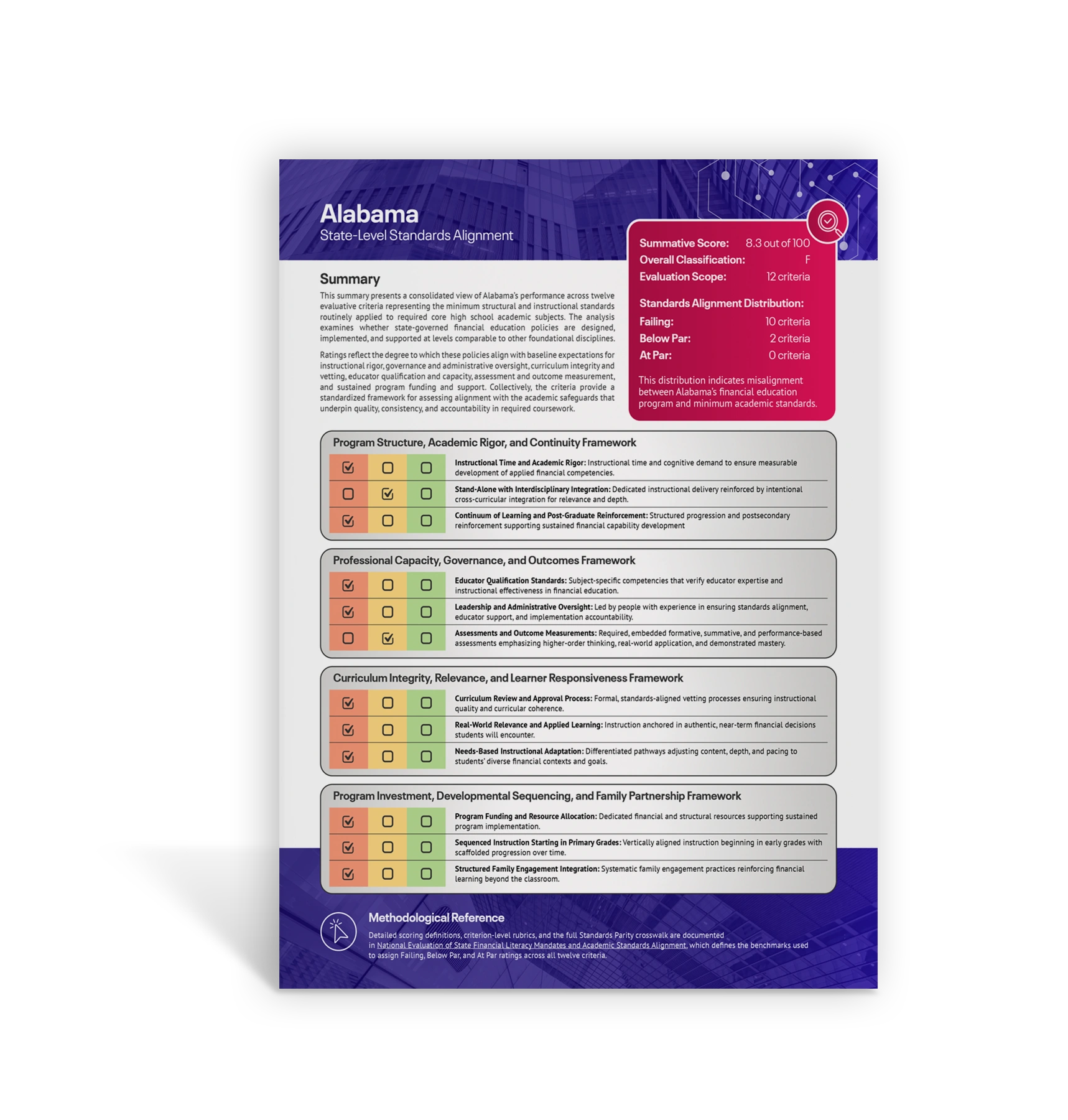
This page presents a standards-based evaluation of Alabama’s financial literacy requirements relative to the minimum structural, instructional, and accountability standards routinely applied to required core high school academic subjects such as mathematics, science, and English/language arts.
The analysis examines whether Alabama’s state-governed financial education policies are designed, implemented, and supported at levels comparable to other foundational disciplines. Findings reflect alignment with baseline expectations for instructional rigor, curriculum vetting, educator qualifications, assessment, governance, and sustained program support.
Standards Alignment Snapshot (Alabama)
This distribution indicates structural misalignment between Alabama’s financial education approach and the minimum standards applied to other required academic subjects.
Failing
Overall Classification
Evaluation Scope: 12 criteria
Standards Alignment Distribution
Alabama: Financial Literacy Standards and Mandates Overview
Alabama Financial Literacy Standards & Mandates
As of 2026, Alabama requires high school students to complete a personal financial literacy and money management course before graduation. This requirement applies to students entering ninth grade in the 2024-2025 school year and beyond. Coursework must include topics such as banking, money management, credit, insurance, taxes, savings, and investments. Alabama Code §16-40-12 establishes the statewide mandate. Source.
Although this law mandates exposure to personal finance, Alabama does not maintain a comprehensive PK-12 statewide personal finance standards framework aligned to the same rigor used for core subjects. Concepts may appear in Career Preparedness, CTE-aligned curriculum, and social studies coursework, but Alabama lacks defined grade-banded standards or measurable statewide competency outcomes.

Alabama Financial Literacy Programs in National Context: A 50-State Academic Alignment Analysis
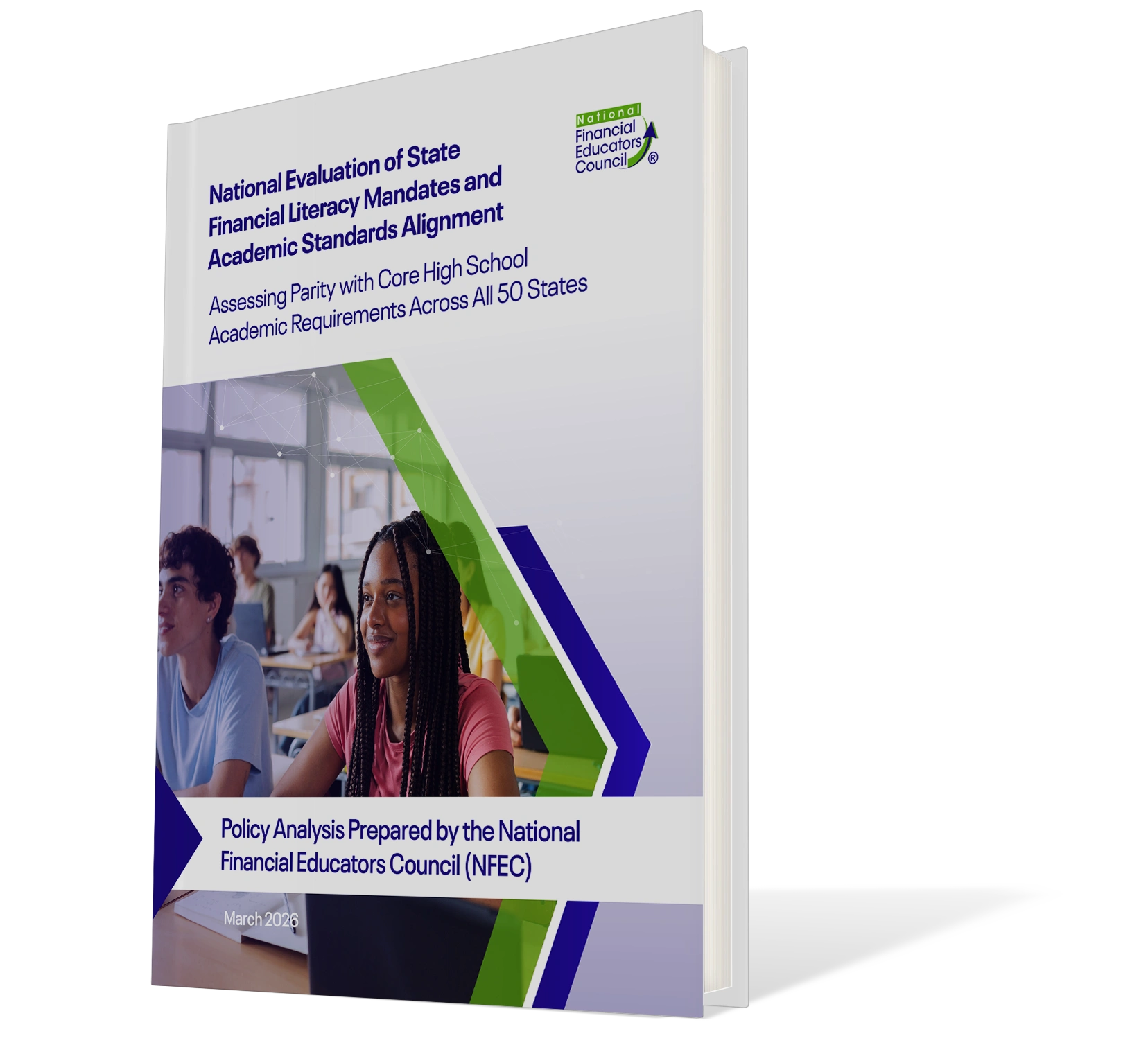
The National Evaluation of State Financial Literacy Mandates and Academic Standards Alignment provides the first standards-based, 50-state comparison of high school financial education, examining whether state mandates meet the minimum academic, governance, and accountability expectations applied to core subjects. Using a uniform twelve-criterion framework, the analysis evaluates instructional rigor, curriculum oversight, educator qualifications, assessment systems, funding, sequencing, and family engagement nationwide.
The findings reveal widespread underalignment. No state reaches parity with core academic standards, and even the highest-performing states fall below baseline expectations. The report enables direct state-by-state comparison, including how Alabama’s financial literacy standards compare with the other 49 states, and offers an evidence-based roadmap to strengthen financial education through standards parity, coherent implementation, and accountable governance.

Opportunities to Advance Financial Literacy Education Across Alabama
To address the gaps identified in Alabama’s financial education standards, the National Financial Educators Council (NFEC), in partnership with its Alabama Financial Educators Council Chapter, provides a coordinated set of advocacy and policy-support resources designed to elevate financial education to parity with other core academic subjects.
NFEC’s mission is to ensure that all learners graduate prepared to navigate real-world financial decisions by elevating financial education to the same level of quality, accountability, and instructional integrity as other required core academic subjects.
Standards and Policy Resources
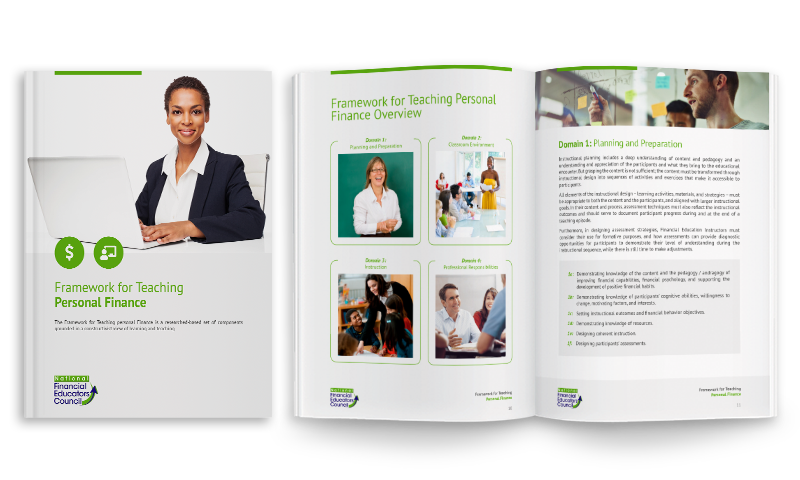
NFEC offers comprehensive financial literacy standards and policy guidance, including the Framework for Teaching Personal Finance, learner outcome standards, educator competency frameworks, and national research on financial education across all 50 states.
Advocacy Committee Engagement
Stakeholders are invited to join NFEC’s Advocacy Committee, which convenes educators, community leaders, and policy stakeholders to advance standards-based reform and align financial education with established academic expectations.

Video Review of Alabama’s Financial Literacy Standards
Thank you for joining me as we review Alabama’s financial literacy standards and mandates. When we review state standards, we look at two things. Number one, does it meet the minimum education standards required by other subjects, like your math, your science, your history? Does it meet those standards, the basic minimum standards? And number two, will it prepare people for near-term financial challenges they’ll face when they move out on their own? With Alabama’s, the answer for both is a resounding failure across the board. Let’s get into the details here. We’re going to be reviewing the bill first of all, and this bill starts off with something positive, right? It starts off with, they’re going to require students to complete personal financial literacy and money management course before graduation. That’s exciting. That sounds great. Now let’s get into the details here. And they’re also going to create an administration for financial literacy examination. And then we’re going to report the results to the State Department. All sounding good so far. Here’s what starts to go off course is because it can start in the ninth to twelfth grade. The students can take this. The problem there is if students take this in the ninth grade, by the time they need the information, that information is far gone and well past their memory date. Learning loss is significant, especially when a lot of information is crammed into one semester. This course, they are all requiring one semester, which is equivalent in Alabama to about seventy hours of instruction. But after you account for admin time, the reality is it’s about fifty hours after admin, you know, class not behaving. It’s about fifty, fifty-five hours depending on the quality of the class. So they have between ninth grade and before they graduate, they can take this now with a one semester course, the more closely it can be to their graduation date. the more they’re going to use the information in the near term, that means they can apply it in the near term and that reduces learning loss quite a bit. So again, they can take it between ninth and twelfth grade. They need it for graduating and then they get into listing some of the topics they want required to teach. Now, He says, bank accounts offered, managing accounts, checking account, basic principles of money, evaluating loan types, computing interest rates, It’s pretty standard. The thing I like about this, they left it wide open. So the politicians did not tell them exactly what they needed to teach. They left it pretty broad, which I think is good in these bills. Oftentimes I review bills where it tells them specifically what to teach. For instance, Massachusetts bill tells them to teach online stock trading. Florida’s bill tells them to teach what to do with inheritance money. Some random topics you’ll hear when the politicians are telling people what to teach. At least this is pretty broad. Computing interest rates on various mechanisms, not so important I don’t think, but at least they left it broad enough to where the administration or the teachers have some flexibility. Then it gets into the last page. The State Department of Education shall create an examination that focuses on the standards of approved financial literacy course. So it’s line item thirty four there. Now, we’ll get into that examination and what that entails. But at least from the bill perspective, it’s pretty wide open. They’re giving a lot of flexibility. It’s a one standard mandate to graduate some basic things. Doesn’t restrict them too much. Again, the main thing I don’t like there is the when they can take it between ninth and twelfth grade. and so forth. Let’s dive into actually what they’re doing on the administration level. This is how the bill is applied. This is from the Alabama State Department of Education. And it’s nearly impossible to find anything. Who’s ever handling their computer side? Things are very hard to find. You look up personal finance, you get outdated standards. You look up financial literacy, financial education, there’s absolutely no information. I went ahead, I made a call to them. And the Swedish people, Swedish Southern Hospitality, they took a lot of time. help me they couldn’t find anything they didn’t know who was in charge they didn’t even realize they had a personal finance department if they do i don’t know who it is they still have not contacted me because the person was on the phone fifteen minutes with me so sweet so nice they transferred me but They took time to try to find that. They couldn’t find anything themselves. So bad problems with the organization. That’s just unexcusable. So a teacher that comes in here, they’re gonna pull up old standards for teaching personal finance. The new ones aren’t even listed in a way that you can find them easily. When you go to Google, again, old standards. And I had to do a lot of digging, a lot of research on multiple pages of Google to find the latest standards, which are two thousand twenty three. There’s a lot of two thousand nineteen, two thousand twenty one. But the organization is horrible. The people in charge of this should pay attention. There’s going to be a lot of teachers out there teaching wrong and old standards, which is which is bad. Even a They have a budget probably a thousand times what we do. We keep our site a lot more organized, easier to find than they do. It’s just inexcusable at this level, and teachers are going to be confused, and it’s not good. I got to say a special thank you to that sweet person, Southern Hospitality at its finest, trying to help me, trying to direct me. She couldn’t find anything when I called the State Department of Education, but let’s get in. to the standards again it’s a it’s a uh one semester course about seventy hours fifty five ish teachable hours and before i get into the standards i did a count of the standards i’m just going to spin you through here there are a hundred and twenty three line items alone to teach in fifty five hours a hundred and twenty three line items and there’s multiple topics in each line item so there’s a lot of topics in each line item let me uh let me give you an example here so this would be page um Money management. So let’s look at money management. I’m just going to skip. I’ll go back to this here in greater detail, but let’s look at money management. Sixteen A. Evaluate the impact of taxes, government payments, employee benefits, budgeting decisions. Examples FICA, income tax, SNAP, Medicaid, unemployment insurance, farm subsidies, health insurance, retirement plan contributions. That’s one line item, right? It lists twenty things. What is that? Let’s say thirteen things there with a quick count. That’s a lot to cover. That’s impossible to cover. Let’s look at a couple pages down. We have savings. Twenty-two A, report and research the benefit of savings. Distinguish between savings, investing, and considering various characteristics of saving. Example, savings account, money market, certificates, deposits, IRAs, retirement accounts. That is a lot of information to cover. they want a teacher to cover a hundred and twenty three line items i did a rough count on that with multiple topics each i’m guessing over four hundred different areas in fifty five teachable hours That’s impossible in any basic, a fundamental principle of education is the ability to work toward higher thinking skill sets and also the ability to get the repetitions in a singular subject required, needed to deepen the knowledge of a topic. So topics need to be cut down extensively. Let me walk you through a few models here. Bloom’s hierarchy of a taxonomy of hierarchy of learning needs and Webb’s depth of knowledge. Base level, you’re understanding, you’re gaining knowledge, you’re recall reproduction, very low level, you’ll be able to pass a test. Now to work toward higher order thinking skill sets takes time, effort, and energy dedicated on a narrow focus. So if we’re gonna have them create their goals, let’s say, They need time to understand goals, understand the needs of what they’re looking to do in life, understand various types of goals. They’re going to need to analyze things that they want to do. They’re going to need to create their own goals. That takes time. And that’s just one aspect. And to cram one hundred and twenty three line items in there in that short a period of time is impossible. And also every teacher knows you need repetition in order to cement the learning without repetition and hearing about it in different ways and doing different activities, doing different projects, case method based learning, project based learning, visual learning, helping them develop reasons and motivations to want to learn that information. The education will be absolutely useless. To squeeze in a hundred and twenty three topics into fifty five hours or line items in a hundred fifty or fifty five hours is impossible at best. So whoever wrote these standards, they I don’t know if they have any idea what they’re doing there. They need to be completely rewritten. narrowed down extensively. I would narrow that down by at least seventy five percent and make it around life stage based things that they have coming up. Moving out on their own would be a good one. It incorporates a lot of areas of their life and it can narrow that focus. We’ll still teach credit budgeting and other aspects, but around a clear outcome based goal. So let’s dive into the standards. Um, yeah, let’s look at, um, uh, line item two and financial responsibility. Uh, we have described personal spending behaviors that contribute to building wealth. Um, That’s great to describe personal spending behaviors, but wouldn’t it be better if the students identified their own spending behaviors and habits and started to do personal reflection on their impact? Yes, we could still describe personal behaviors so they have an understanding of different types of behaviors and how people manage their money. But as a takeaway here, Shouldn’t they explore their spending behaviors? Very basic, very big missed opportunity there in terms of that. We look at the goals. I think I talked about this one before, line item three. You know, it says talk about create a plan to reach specific goals. Well, they’re talking about creating a plan, which is wonderful. higher order thinking skillset. But to create a plan takes time. It can’t be a five minute activity to be something meaningful. To write a thoughtful goal that we’re gonna have students follow and work toward, it takes time, especially when they’re new to money. This is a new concept for many of these youth. They don’t have goals many times, and let alone financial goals. So they need to do a few things. Understand what different types of goals they can create, short, long, and near term, short, long, and near-term needs. They can understand what a different goal might look like. Maybe it’s buying a home. Maybe it’s getting a job. What are those goals? It’s prioritizing those goals, then writing the goals. That is not a short activity. This activity alone would take up a few hours to do right. And they’re trying to squeeze in a hundred and twenty-two other line items into the class impossible. We have a One thing I like is three C, explain the advantage of designing a personal financial plan. I think it’s written poorly, but it’s about developing reasons, which is good, and there’s many different strategies we can use to help them develop reasons. We use a KWR strategy, what you know, what you wanna know, and the reasons to learn about that topic. We also do pros and cons and various methods that they can help to develop benefits. Also, group conversation’s good. hey what would you if you had all the money you wanted what would you want to do right um and you know pay travel help my family all those good things come out we can have group conversations and and things around that maybe not all the money in the world let’s cut that down to a million dollars what would you do there cut it down to a hundred thousand dollars what would you do there so we can help them to start to think about various goals and associate it with various money components line item four it just seems out of place is talking about um Certifications, expand employment opportunities. This is under financial responsibility. That’s more of a career thing for me. I just don’t see, it just doesn’t fit. We’re talking about spending behaviors, personal finance as a whole, goals. Now we jump to certification opportunities. It just doesn’t fit, seems completely out of place. Now it jumps back to planning to purchase a product. That should be more in the money management section, I would say, the more budgeting and savings section. This is just poorly organized. If I was a teacher, I’d have no idea what to do. The goal of standards, is to give teachers a pathway to group topics and lessons together that make sense the way our brain works if we’re talking about a family of things that make sense and working into the great together that should be taught together we shouldn’t go from financial goals to certification to purchasing products it makes absolutely no sense the structure of this and it’s confusing If I was a teacher, I would be confused. And what does that mean for students? They’re going to be extra confused because there’s major issues when you’re doing that. So let’s move ahead to the next area they have, which is consumer protection. Identify, explain ways to avoid identity theft, consumer protection laws, emotional costs of recovery from identity theft. locate and share credible source of updated information on consumer rights. Well, identity theft, I mean, without understanding credit, right? How am I gonna explain identity theft? So they did nothing to explain credit in here. How am I going to explain identity theft? If you get your identity stolen, it’s gonna impact your credit. What’s credit, right? Well, they haven’t talked about it. So it doesn’t make sense, again, when we structure standards, we like to do so in a logical format. So, hey, we’re talking about credit, credit building, maintaining credit, and now how to protect credit. We haven’t built a credit or maintained credit. What are we going to protect? What is a credit score? What do I care if my credit score is four hundred? It doesn’t make sense the way this is organized. Again, not very thoughtful in that process. Then we get into describe factors that impact. Let me get to the next slide here. Describe factors that impact consumer purchasing decisions throughout lifespan, how financial limits on financial resources affect choices people make, how they can benefit from cost benefit analysis before making a financial decision. Again, we haven’t talked about budgeting. Right? So purchasing, you know, we don’t need to consider a purchasing until we understand savings and budgeting. The end goal of money is to be able to save on a regular basis. Without me knowing that end goal, why do I care about the purchases, right? I need to establish an end goal for these students so they know how it fits into this realm. how they get more into decision making. Now they get to number twelve, they get into property tax, all sales and property tax. Now we’re buying a house. I mean, you know, didn’t have five factors that affect the total cost of goods and services including sales tax tips coupons discounts and unit price i think it’s good i mean it’s good but why do we throw property tax in there it’s out of the blue we haven’t even introduced buying a home anywhere in what i’ve seen i don’t know if it’s in the rest of this material but it’s just random unorganized so here i’m going to throw in property tax because it sounds good again if we’re going to eliminate from a hundred and twenty three things that might be one of the things we eliminate early If we get to line item fourteen here, money management. Describe how to set financial goals and analyze the cost benefit of spending decisions. Well, wait, we just started with that one, right? That was the first page was goals. Now we’re back to goals, right? We created a plan to create specific goals and now we’re coming back to goals later that’s in a completely different way. That doesn’t make a lot of sense. Oh, now we’re preparing a budget, preparing a monthly budget for individual or family given their income, savings, goals, and taxes. Well, I love this. I love the concept. That’s called case method approach, where he’s in a case study to get students to review, prepare a budget for a third party. I think that’s a great technique, a great strategy. It’s called case method, and they should mention that so the teacher can identify what type of education methodology they’re using. Then they get way off on the SNAP, Medicaid, all this stuff. It just goes crazy there. But why don’t they have them, at the end of this, create their own personal budget? They don’t have them create their own personal budget at all. They have them create a fictitious budget for a third party, which is a good beginning foundation. Then they should transition to a project-based learning activity where they’re creating a budget for themselves. And this is a problem of doing it between ninth and twelfth grade because ninth graders may not have any expenses or things like by twelfth grade they’ll have cell phones maybe a car or something they’ll have some expenses so they can create a budget but again taking it from that case method approach which is a good activity to actual project-based learning where they’re completing their own budget would make a lot of sense there and it would be a good thing to do let’s move on to here seventeen This is about income. We had something about income earlier, I think, but it was about income on your taxes, income tax, but I don’t think anything on how to get a job. They’re missing it here, too. It’s gather information on income benefits and deductions. Wonderful. What’s gross and net income? What’s the monetary value of employee benefits? Okay, all decent, I mean, whatever. but they don’t have a job yet. Why don’t we have them complete a resume, practice interview, search for local jobs, complete a job application, build their professional portfolio, create their LinkedIn. We’re skipping all that to cover something they don’t, need to know until they get a job, right? They need to get a job. Things need to be prioritized. When we’re trying to cram a lot into fifty-five teachable hours, things need to be prioritized. How to get a job should be ahead of how to evaluate your paycheck. You’re not going to have a paycheck to evaluate if you don’t have a resume, if you can’t interview, if you’re LinkedIn and other social media profiles show you partying and doing other things. We need to make sure that we take care of that first before getting all down this thing. Line item twenty. Okay, now we’re getting to credit report. But again, credit report and identity theft, they should be really grouped together because the main impact on identity theft, yes, you can get bank accounts taken and money taken and all that. But another major negative thing of identity theft is credit. So they’re having them describe effective methods for improving credit, describe consequences. Why don’t we have them create a plan to build and maintain a positive credit rating? Why don’t we have them establish their bank accounts so they set up automated bill pay so they won’t be at risk to pay bills late, which will impact their credit rating? Again, they’re jumping over some basic things to get to some things that aren’t so important. Savings. Again, I think savings and budgeting should be together. Again, this should read like a story so things are organized in like-minded things and it’s just a random grouping of, oh, here’s goals here, here’s goals there, here’s a piece of income here, here’s a piece of income here, here’s a spending thing here, oh, here’s budget here, here’s savings, it’s all random. No teacher will be able to follow. The students are going to be completely lost. And the way we learn by compartmentalizing, everybody’s going to be confused. I don’t need to get in the rest. They spend a lot of time on investing. Again, if we’re limited time, I love teaching investing to youth, but only when we have their near-term needs met. And the other thing that is… problem there’s no orientation there’s no big picture of what they’re doing and they mentioned several times that they had a standardized test that was impossible to find when i called in nobody had that nobody knows any information nobody could tell me about the curriculum nothing online so they’re from the administration side very subpar job uh one of the worst i’ve seen uh from the bill side okay they left it pretty wide open for uh flexibility from the teacher administrative but judging from the quality of what they put together from the admin side, they needed more guidance there. So let’s get into the rating. Again, all I’m looking at is to make sure it meets minimum education standards. We have twelve points that identify minimum education standards required by other subject matter, right? These aren’t anything special. That’s what other subject matter has at their disposal. So is it delivered in a standalone class? Yes. Is it integrated into other subjects? No. That integration is key because we need repetition. A cornerstone of learning, repetition, especially when you’re covering several hundred topics, a hundred and twenty-three line items, it’s impossible to achieve. They get to, and there’s basically three markers. Good. Bad. Okay. They get okay there. Assigned enough time and rigor? Absolutely not. They’re way off. The rigor will be especially low because they cram too much information in. We’re proponents of a four-year financial education. And to get that in, it’s even tough to squeeze it into four full years. they’re trying to squeeze in several year program into one semester it’s impossible it’s going to really take the rigor down remember to establish enough rigor in in active based learning and analysis and creation you need time because you need time to help them understand basic concepts apply what they’ve learned analyze and create with with so many subjects you can’t get there Ongoing education, nothing was mentioned. Again, every other subject, they have continuing education. You do algebra, then you go to algebra two, geometry, right? There’s a continuation of that. With this, there’s absolutely nothing. And with personal finance, we have a beautiful opportunity because We have their contact information. After they graduate, we can follow up with them with timely education that is going to meet their needs at that time. So as they’re moving out on their own, we can do special education on that so we can communicate with them on an ongoing basis. For other subjects, obviously you have college or other schools. Relevant content that prepares students for near-term life events? Absolutely not. Big misses there. We’re talking about investing and all this stuff. I love to teach it, but only when I know a kid will make a good decision when it comes to buying a car, when they know how to move out on their own, when they know how to stay out or minimize college debt, when they avoid credit card debt that so many kids get into when they turn eighteen because they get a flood of credit card offers in the mail, when they know what accounts to open, when they know how to manage their bank accounts. These are the basics. They make it so complex. It can be built around life stages very simply, but they failed there. Adopt proven curriculum that encourages higher order thinking skill sets. Absolutely not. In fact, from the standards, they’re encouraging lower order thinking skill sets. Nobody had an idea there at the Department of Education what curriculum to use. No testing was to be found. Again, the people there were very sweet, very southern hospitality. very kind people they spent extra time with me but nobody even know who ran the program customization of lesson plans based on student needs absolutely not all of their subjects you have remedial math you know and then they build you up to getting back into the mainstream math with personal finance here’s one crash course get through it and pass it and you need to there’s no adjustment based on their prior knowledge what they’re bringing into the class No adjustment based on their socioeconomic status, which is key. And big misses across the board there. Courses led by highly qualified instructors. Nope, no mention of teacher training. No teacher training requirements at all. But every other class, you need to have quality teachers. Every research out there points to the quality of the teachers having the biggest impact on the class. Way more than the curriculum, way more than the standards, it’s the quality of the teacher. All those other things help, but the quality of the teacher is fine, is the primary source. and we don’t have that. We don’t have specialized training for them. When we do training for schools and so forth, we get inundated with teachers having questions because they don’t know, right? They don’t know about their own finances. They’re not confident. They don’t know how to teach it. If you’re a math teacher, you went to elementary, high school, college, you got your master’s maybe, and then you started teaching math under, you know, supervised math teaching, and now you’re a math teacher. With personal finance, nope. Hey, economics teacher, go teach math, or go teach personal finance. Hey, math teacher, go teach personal finance. They never taught it, right? It makes absolutely no sense. Program developed and managed by experienced leaders. From this, absolutely not. And from the fact that the Department of Education had no idea who was in charge or nobody that was distinguished as the personal finance admin person, absolutely not. That’s a big miss and it’s sad. And the reason I get frustrated is because these kids are being hurt because of the inattention and lack of care for this class. um learner assessment focus learner outcomes focus and assessed they say they’re supposed to have it right i haven’t seen anything i haven’t i’m in i’m going to give them i’m going to give them this just because it’s in the bill and i’m going to follow up if they don’t have it i’m going to i’m going to take this uh higher because they’re supposed to have that implemented already the bill states they need to have this um students during the ninth grade before graduation. So in the twenty twenty four twenty twenty five school year. OK, so I’m doing this right before twenty twenty five. So actually no, here, no later than June thirtieth, twenty twenty four, the State Department of Education shall create an examination that focuses on the standards of the approved financial literacy course. I’m going to follow up there. But even if they if they don’t have it, they should get a red X. I may change that based off what I find out. here once somebody gets back with me but even if they don’t the max they would get is okay simply because a pre and post test tell me nothing it tells me content knowledge gains and in the near term people know how to take a test you can remember things for a near term they’re not even considering learning loss and how quickly people forget information when they’re not implementing what they have learned. So they’re not including that. So a pre and post test is one aspect. I like to understand since you took this course, have you changed behaviors to make you save more? Since you took this course, are you more confident in managing money? Since you took this course, have you established your bank accounts? These are closer indicators of longer-term outcomes. I also like long-term outcome measurements. I don’t know why schools aren’t doing it more, where they’re measuring people after they graduate to see if they’ve actually benefited students in the long term. But through behavior surveys, sentiment surveys, system surveys, we can give us a decent indicator of potential growth. Funding, they don’t have any dedicated funding to that. From what I read, it comes from their career and technical education, so it looks like they do have some money coming in. But whenever you’re fighting with an existing department for money, it’s tough to get, but they do not have any established fund for financial literacy. That’s why they’re getting an okay there. start in elementary school saw nothing about that and encourage parental involvement saw nothing there so a failure across the board this is embarrassing now you may seem like i’m beating up in alabama this is average right this is this is the average mandated program other agencies have given uh alabama an a rating for their personal finance course what are they looking at Well, just not having a trained teacher in there, that would make it a not qualified. They would never get an A rating without a qualified teacher. And again, we just look at two things. Does it meet minimum education standards of other subjects? And are students prepared to meet near term? challenges on their finances when they move out on their own the answer for both of those is a resounding no doesn’t even come or anywhere close to meeting minimum education standards and absolutely no kid will graduate prepared in fact they’re going to graduate confused frustrated disappointed and lacking the skills they need this is a huge disappointment Alabama, you need to do better. The kids deserve better. Parents in that community, let’s raise up, let’s elevate these standards. Advocates in that community, let’s do better for Alabama. Again, the Southern Hospitality, I love. The people there are great. I have many friends from Alabama, people that have gone through our training, and just always seem very nice people, good people. We need to change so these kids are protected, so they are able to graduate self-sufficient and contributing members of society.
Alabama Financial Educators Council – Alabama Financial Literacy Standards & Mandates
Alabama Code §16-40-12 – Instruction in Personal Financial Literacy and Money Management
Alabama State Department of Education – Career Preparedness Course Standards
Alabama CTE Personal Finance COS
Alabama Daily News – Financial Literacy Course Proposal
Financial literacy certification
How to teach financial literacy
History of Alabama’s Financial Literacy Legislation, Standards, and Mandates
Alabama has led in financial literacy mandates. In 2012, the State Board of Education approved the Career Preparedness course, combining personal finance with career and technology skills. This one-credit course became a graduation requirement starting with the class of 2017, positioning Alabama among early adopters guaranteeing financial literacy exposure.
In May 2023, Governor Kay Ivey signed House Bill 164 (HB164), sponsored by Rep. Andy Whitt, strengthening the mandate with a dedicated personal financial literacy and money management course (or equivalent) starting in 2024-2025 (class of 2028 onward). The law also requires a standardized assessment, with results reported statewide (passing not needed for graduation).
As of December 31, 2025, Alabama provides a semester-equivalent course focusing on budgeting, credit, debt, and investing. Standards include some lower-grade elements, with no major new mandates in 2024-2025; efforts center on implementation and updated guidelines.