Personal Finance Standards and Best Practices for Teaching
In many fields, providing teaching guidelines is common practice. Such areas include – for example – medicine, law, finance, accounting, and education. However, until recently, personal finance education has lacked a comprehensive set of standards to guide its educators, counselors, and coaches. Then the National Financial Educators Council (NFEC) stepped in to fill this gap.
In collaboration with the nationally-recognized Danielson Group of educational consultants, the NFEC developed The Framework for Teaching Personal Finance. This document represents the first full set of common core standard personal finance guidelines defining the knowledge and skills financial educators and coaches must gain to be competent, effective professionals. The benefits of laying forth these personal finance benchmarks and guides include:
Improved program quality
Clear criteria for teacher performance and self-assessment instruments
Professional development framework
A common lexicon of terms and language to improve communication
Assurance that education providers are held to top personal finance standards of practice
Performance measures and teacher preparation tools
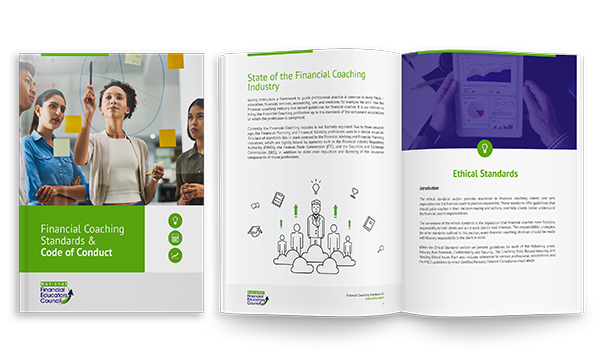
In a second set of common core standard personal finance guidelines, the NFEC drew upon the policies of several reputable organizations including the Certified Financial Planner Board, the American Psychological Association, and the International Coaches’ Federation to design the Financial Coaching Standards and Code of Conduct. These personal finance guidelines are aimed specifically at coaches, counselors, and consultants of money management to ensure their effectiveness and dedication to clients’ best interests.
The NFEC developed these two sets of personal finance standards in tandem with the creation of its financial education curriculum for kids, teens, and adults. The guidelines now are available to the general public, with the purpose of providing educators and learners alike with financial literacy statistics and standards for improving people’s financial capabilities. The overarching goal is to improve instructional quality and enhance its impact on people’s actual financial literacy.
The personal finance standards were funded by the NFEC’s Social Enterprise Fund, a pool of money set aside to provide the financial education industry with up-to-date best practices for teaching and coaching, and to offer organizations resources to start and/or expand financial education programming.
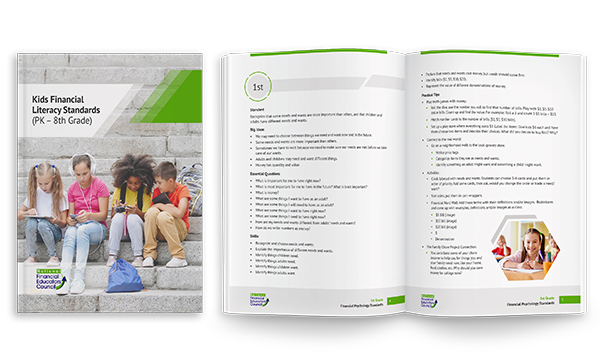
The frameworks also set forth the topic areas that should be taught, in alignment with students’ ages and cognitive abilities, as recommended in a review conducted by the Brookings Institution. During development, the expert team found that existing financial literacy standards did not break down content areas by cognitive stage. That’s why the NFEC conducted diligent research to break down its Framework and Standards based on empirical evidence. Current research evidence supported breaking down the big ideas, essential questions, and content of the standards into four groups: PK-2nd grade, 3rd-5th grade, 6th-8th grade, and teen/adult.
NFEC Sets the Stage for Personal Finance Standards
When you think about most professional careers – such as medicine, law, education, financial services, or accounting – you automatically understand that there are stringent standards to guide the preparation and licensing of professionals in those fields. But until recently, there were no personal finance standards governing how the credentials for financial education were awarded. Fortunately, the National Financial Educators Council (NFEC) has bridged this gap. The NFEC establishes four types of financial literacy standards to inform the quality of financial education programming and instructor qualification. These common core standard personal finance guidelines set a high bar to help improve the quality of both instructional methods and educational materials.
Benefits of Standards
The NFEC sets benchmarks for the financial education and coaching industry that will assist providers to become more effective and competent in helping individuals work toward financial wellness. The NFEC standards for professionals and learners offer the following benefits:
Framework to improve the quality of programming
Clear performance evaluation criteria & self-assessment tools
Framework for seeking professional development
Common language as a resource to improve communication
Public assurance that providers are held to the highest standards of practice
Tools for teacher preparation & performance measures
Standards for Financial Educators
Financial Education Standards for Instructors
To guide financial educator training and preparation, the Framework for Teaching Personal Finance sets forth benchmarks for teachers of financial education. The NFEC, in collaboration with an expert team, drew upon Charlotte Danielson’s reputable Framework for Teaching and adapted those guidelines specifically to fit financial educators.
Standards for Financial Coaches
To define the qualifications of financial coaches, consultants, and counselors, the NFEC’s Financial Coaching Standards and Code of Conduct requires coaches to maintain fiduciary responsibility to clients. These personal finance standards also define the cross-disciplinary knowledge base – from psychology, counseling, personal finance, and coaching strategy – that a well-qualified coach must possess.
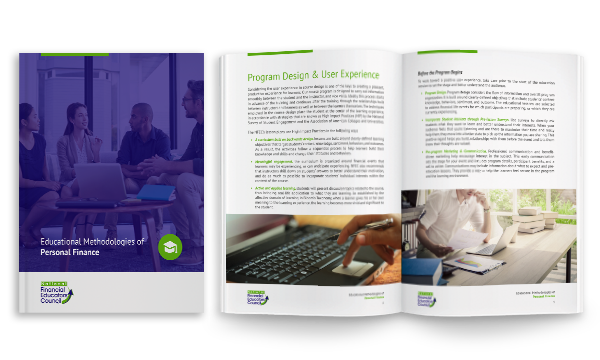
Standards for Learner & Educational Methodology Best Practices
Standards for Learning
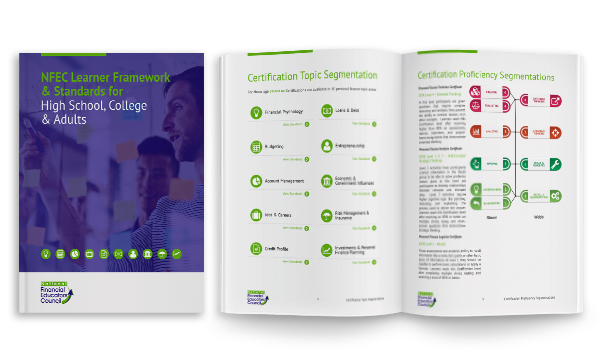
To enhance the impact and quality of financial literacy instruction, the NFEC developed the Financial Literacy Framework & Standards, which define the knowledge learners should gain across 10 key topic areas. The framework lays out learning targets for both students and educators.
Standards for Educational Methodology
In terms of optimal educational methods, the NFEC’s National Financial Capability Strategy describes research-based principles for financial education that encourage positive behavior change among learners to help them reach stronger financial positions. These pedagogical standards incorporate knowledge, behavior, and systems establishment.
In many fields, providing teaching guidelines is common practice. Such areas include – for example – medicine, law, finance, accounting, and education. However, until recently, personal finance education has lacked a comprehensive set of standards to guide its educators, counselors, and coaches. Then the National Financial Educators Council (NFEC) stepped in to fill this gap.
In collaboration with the nationally-recognized Danielson Group of educational consultants, the NFEC developed The Framework for Teaching Personal Finance. This document represents the first full set of common core standard personal finance guidelines defining the knowledge and skills financial educators and coaches must gain to be competent, effective professionals. The benefits of laying forth these personal finance benchmarks and guides include:
Improved program quality
Clear criteria for teacher performance and self-assessment instruments
Professional development framework
A common lexicon of terms and language to improve communication
Assurance that education providers are held to top personal finance standards of practice
Performance measures and teacher preparation tools
In a second set of common core standard personal finance guidelines, the NFEC drew upon the policies of several reputable organizations including the Certified Financial Planner Board, the American Psychological Association, and the International Coaches’ Federation to design the Financial Coaching Standards and Code of Conduct. These personal finance guidelines are aimed specifically at coaches, counselors, and consultants of money management to ensure their effectiveness and dedication to clients’ best interests.
The NFEC developed these two sets of personal finance standards in tandem with the creation of its financial education curriculum for kids, teens, and adults. The guidelines now are available to the general public, with the purpose of providing educators and learners alike with financial literacy statistics and standards for improving people’s financial capabilities. The overarching goal is to improve instructional quality and enhance its impact on people’s actual financial literacy.
The personal finance standards were funded by the NFEC’s Social Enterprise Fund, a pool of money set aside to provide the financial education industry with up-to-date best practices for teaching and coaching, and to offer organizations resources to start and/or expand financial education programming.
The frameworks also set forth the topic areas that should be taught, in alignment with students’ ages and cognitive abilities, as recommended in a review conducted by the Brookings Institution. During development, the expert team found that existing financial literacy standards did not break down content areas by cognitive stage. That’s why the NFEC conducted diligent research to break down its Framework and Standards based on empirical evidence. Current research evidence supported breaking down the big ideas, essential questions, and content of the standards into four groups: PK-2nd grade, 3rd-5th grade, 6th-8th grade, and teen/adult.
Wisconsin’s revised financial literacy education standards.
Tennessee Department of Education financial literacy standards.