Adult Financial Literacy Test & Surveys
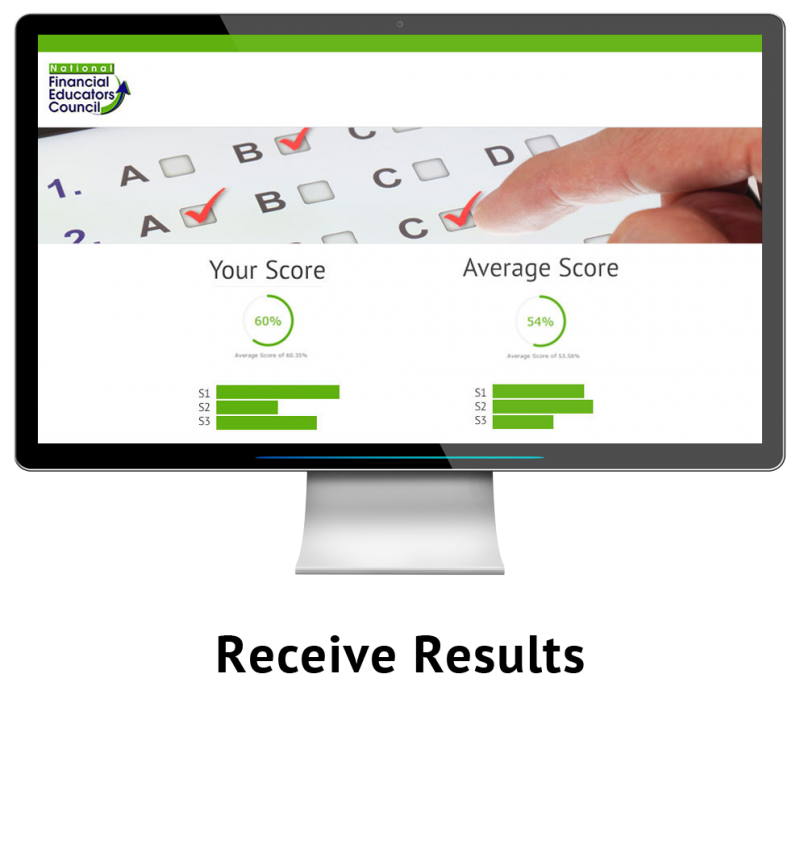
Adult Financial Literacy Tests & Surveys are provided complimentary to individuals and organizations seeking: pre-and post-testing, personal-assessment, and instructional resources.* Your personal results are available immediately after completing the test or survey.
Visit the Financial Literacy Test & Survey Center to access over 30 evaluation tools for all ages and to compare your results.
*Tests and surveys provided may be used only on the NFEC website. Printing the tests or surveys is prohibited. Commercial use, sale, or any other use that violates the terms and conditions and copyright is prohibited. Read complete terms and conditions of use.
Understanding the Stages of Change model will help you understand how to market to and instruct the targeted audience. This survey will help you determine a person’s wiliness to change. Certified Financial Education Instructors – refer to the testing and measurement section of your professional development course to evaluate the data.
Precontemplation. People at this stage have no intent to take action in the near future. Many are unaware even that their behavior is problematic.
Contemplation. Those in the contemplation stage are beginning to recognize that their behavior may be causing problems. They’ve begun looking at the benefits and drawbacks of their continued actions, and are considering the possibility of change.
Preparation. People who have reached the preparation stage have developed intentions to act. Procrastination can delay their movement into the next phase indefinitely.
Action. By the action stage people have made some modifications to their behaviors and lifestyles. Follow-up education can be helpful to keep momentum.
Maintenance. Those who reach the maintenance stage have changed their behaviors and have a plan to maintain them. Preventing relapse into past negative financial behavior is essential.
Termination. When people reach the termination stage, positive behavior change is in place and they’ve moved beyond any temptation to relapse into the negative choices of the past.
Stages of Change Model
The stages of change providing the underlying framework for the NFEC’s measurement strategies are derived from the Transtheoretical Model of Behavior Change developed by April, 2015mes Prochaska and his colleagues in the late 1970s [1]. According to this theory people move through the following stages in the process of making behavioral change:
- Precontemplation
- Contemplation
- Preparation
- Action
- Maintenance
- Termination
Here we will describe the Stages of Change and the strategies the NFEC has identified for presenting materials at each stage.
Precontemplation. People at this stage have no intent to take action in the near future. Many are unaware even that their behavior is problematic. For adults, the NFEC uses long-term awareness strategies to help move them to the next stage. For kids, being in this stage is less of a detriment. The NFEC has found a good introduction can be enough to excite their natural curiosity to the next stage.
Contemplation. Those in the contemplation stage are beginning to recognize that their behavior may be causing problems. They’ve begun looking at the benefits and drawbacks of their continued actions, and are considering the possibility of change. At this point the right educator can influence people into the next level toward change. The NFEC educator training leverages Neuro-linguistic Programming (NLP; described in Chapter IV) and curriculum driven strongly by benefits/consequences to influence participants toward taking action.
Preparation. People who have reached the preparation stage have developed intentions to act. At this stage, guidance and knowledge provide the impetus to move participants forward. Since many people simply lack direction, the NFEC materials offer step-by-step instruction aimed at instilling confidence in their skills as they work toward personal financial goals.
Action. By the action stage people have made some modifications to their behaviors and lifestyles. Once participants reach this stage, continued reinforcement for their efforts through ongoing training and support is critical. Follow-up training can be helpful to keep momentum.
Maintenance. Those who reach the maintenance stage have changed their behaviors and have a plan to maintain them. Getting people to this stage is the primary goal of the NFEC materials. Here the main focus of the educator is to help participants stay on course and avoid becoming overconfident. Preventing relapse into past negative financial behavior is essential.
Termination. When people reach the termination stage, positive behavior change is in place and they’ve moved beyond any temptation to relapse into the negative choices of the past. At this stage the instruction may be considered a success.
[1] Prochaska JO & DiClemente CC (1984). The Transtheoretical Approach: Towards a systematic eclectic framework. Homewood, IL: Dow Jones Irwin.