
Policy and Standards Framework for High School Financial Literacy Education
This Framework equips policymakers, school leaders, and stakeholders to implement high-quality high school financial literacy programs that meet the same rigorous expectations as other core subjects. Our aim is to make financial education academically credible, practically useful, and measurably effective so graduates leave school ready to make sound near-term financial decisions and build long-term financial capability.
Foundations for Financial Wellness
High school is the last proactive opportunity to prevent near-term financial harm and set graduates on a path to durable financial wellness. If the goal is to prepare young people to earn income, manage money, and make informed financial choices, coursework must be rigorous, standards-aligned, and focused on higher-order thinking and long-term retention. Teachers should be well-qualified and trained to motivate diverse learners. Assessments must measure more than recall – evaluating students’ ability to analyze, apply, and transfer financial knowledge to real-life decisions.
Elevate Financial Education Mandates to Meet Standards of Other Core Subjects
This micro training walks you through defining success and measuring it across the learner journey. You’ll learn how to identify key learning metrics – from content knowledge and motivation to behavior changes and real-world outcomes – and when to collect them (pre-, mid-, and post-program and long-term follow-up). It shows how to select the right mix of qualitative and quantitative tools – pre/post tests, self-assessments, journaling, behavior logs, interviews, and outcome tracking – and explains why evaluating beyond knowledge (i.e., capturing shifts in mindset, habits, and real-life application) is essential.
Setting financial education standards on an equivalent basis with other subject areas could make a powerful difference in learning outcomes that would have a major impact on all Americans’ lives.
Financial education should be held to (at least) the same standards as other subjects in the typical school curriculum. The basic premise of these standards is that financial literacy be treated the same as any other topic taught in schools – that is, the topic of financial literacy should be held at least to the same standards of rigor, pedagogy, and measurement as any other subject matter.
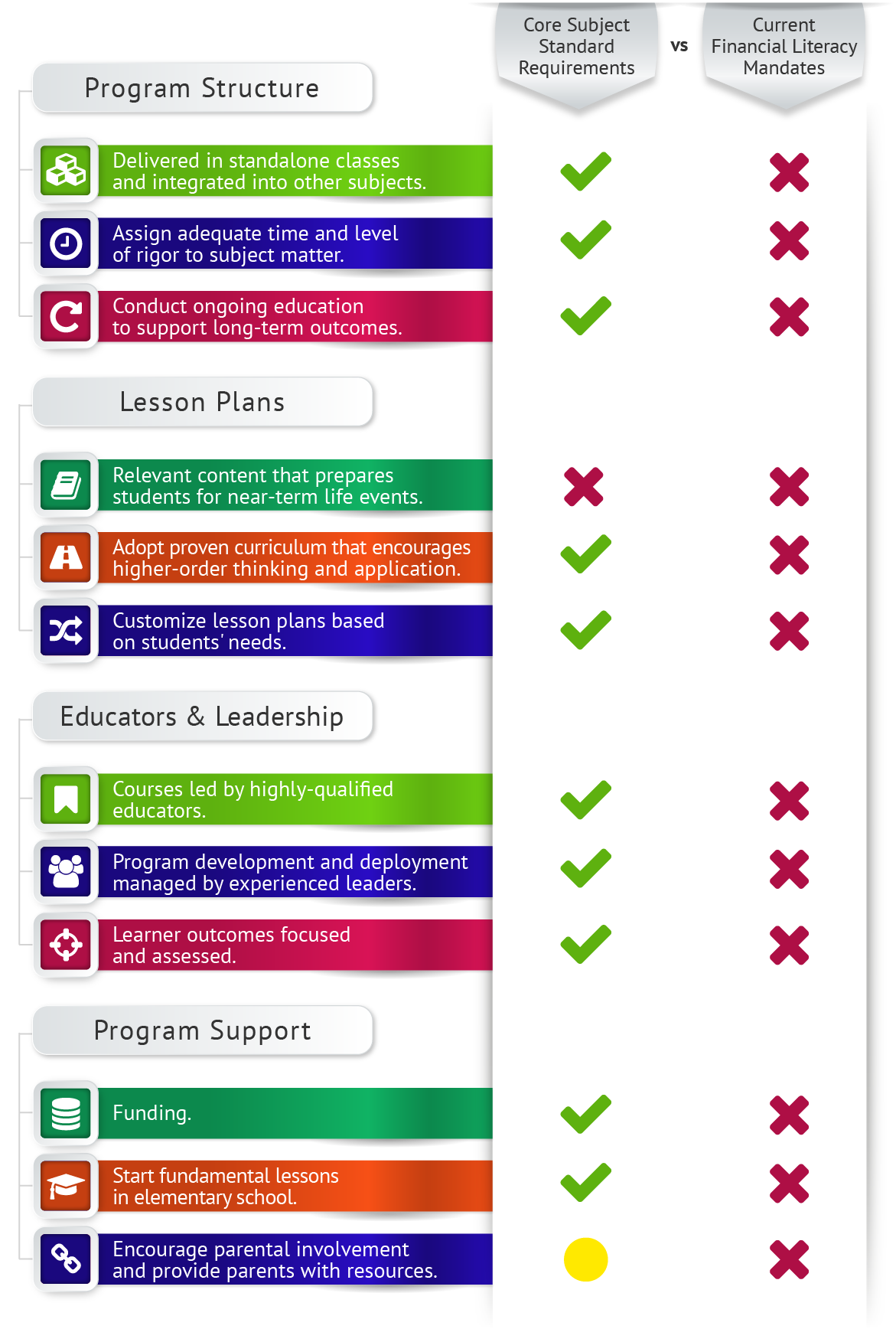
Other subjects taught require specific educator qualifications, measured outcomes, quality standards for curriculum materials and educational methods, scaffolding, parental involvement, and ongoing education options. Financial literacy deserves the same treatment.
Every Student Should Graduate Prepared for Near-Term Financial Decisions
Telling your story with clarity and credibility is essential when it comes to proving the value of your programming. This section introduces a fully-designed Case Study Template that allows you to easily document and communicate your outcomes. Whether you’re looking to impress stakeholders, attract new partners, or simply reflect on what’s working, this template provides a structured, professional format to highlight your efforts.
You’ll be able to plug in details about your program’s goals, participants, instructional hours, activities, results, and testimonials – all in one organized report. This format not only helps you summarize your work efficiently, but also elevates your professional image and supports ongoing growth.
The goal is to make it easy for you to transform your program data into powerful, persuasive documentation – without starting from scratch.
Report Details & Download
This report is designed to help policymakers implement financial education programs that have a measurable impact on students’ near- and long-term financial health. High school-level coursework is particularly crucial, as it represents the last proactive opportunity to prevent immediate financial problems and set graduates on a path toward greater financial wellness.

Bullet Point of Criteria
We urge policymakers to implement higher standards for financial education mandates, ensuring that all students graduate with the knowledge and skills needed for financial independence and long-term success.
Through our 12-point review process, the NFEC evaluates state financial education mandates to ensure they meet rigorous academic standards—on par with core subjects—and effectively prepare students for the real-world financial challenges they will face immediately after graduation.

Consultation Opportunity for Policymakers and School Administrators
If your state is committed to producing graduates who can make competent near-term financial decisions and to aligning financial education programming with the standards expected of core subjects, we can help.
We offer a targeted State Mandate Review & Gap Analysis that evaluates whether current policies require qualified instructors, standards-aligned curriculum, scaffolded learning, parental engagement, ongoing professional development, and assessments. From that analysis we deliver clear, actionable recommendations, draft policy language, and create an implementation roadmap that includes pilot design, teacher professional development, validated assessment tools, and accountability metrics.
Policy and Standards Framework for High School Financial Literacy Education
Designed to empower policymakers, educational institutions, and various stakeholders to optimize the effectiveness of financial education initiatives while adhering to the same rigorous educational standards demanded by other foundational disciplines.
Two Core Objectives of NFEC’s Policy Standards
1) Elevate Financial Education Mandates to Meet Standards of Other Core Subjects
Setting financial education standards on an equivalent basis with other subject areas could make a powerful difference in learning outcomes that would have a major impact on all Americans’ lives.
Financial education should be held to (at least) the same standards as other subjects in the typical school curriculum. The basic premise of these standards is that financial literacy be treated the same as any other topic taught in schools – that is, the topic of financial literacy should be held at least to the same standards of rigor, pedagogy, and measurement as any other subject matter.
Other subjects taught require specific educator qualifications, measured outcomes, quality standards for curriculum materials and educational methods, scaffolding, parental involvement, and ongoing education options. Financial literacy deserves the same treatment.
2) Every Student Should Graduate Prepared for Near-Term Financial Decisions
The NFEC calls for standards in high school financial education that at minimum require lessons based on near-term life events to ensure that our youth have the skills necessary to avoid common financial pitfalls that can disrupt their financial health.
Emerging research demonstrates that even seemingly minor financial missteps made early in life can have far-reaching and severe implications. While the immediate consequences of small financial mistakes may be manageable, their cumulative impact over time can be severe. For instance, credit card debt accrued during youth can lead to ongoing interest payments and a damaged credit history, making it difficult to secure favorable loan terms or even find suitable housing.
In addition to the tangible financial implications, small financial mistakes can take a toll on individuals’ mental well-being. The stress, anxiety, and feelings of helplessness associated with mounting debt, financial insecurity, or inability to meet financial obligations can have long-lasting emotional consequences.
All Current State Mandated Financial Literacy Programs Fail to Meet Basic Educational Standards
Contribute Your Knowledge
We welcome contributors for future iterations of our Policy and Framework for High School Financial Literacy Education. Share any suggestions or insights you have by contacting us.
Your voice matters, so don’t hesitate to contact us with your valuable input. We deeply value and appreciate all contributions, and if we utilize your ideas, we will acknowledge you as a valued contributor. Thank you for helping us make a difference!