
Framework for Teaching Personal Finance℠
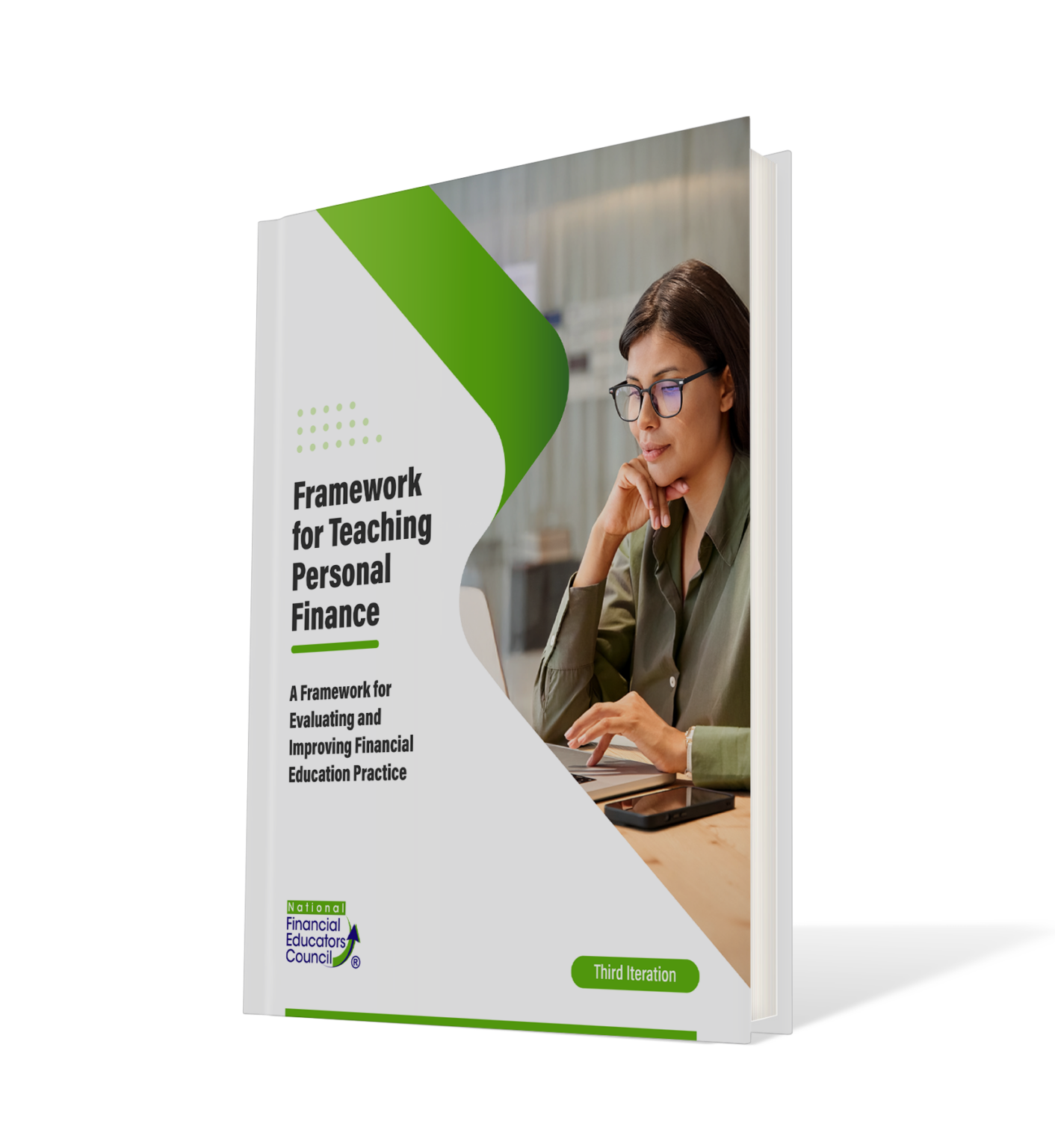
Effective financial education requires more than subject-matter expertise. Educators must be able to engage learners, explain complex financial concepts, facilitate practical learning experiences, and develop the capabilities needed to make informed financial decisions. The Framework for Teaching Personal Finance℠ establishes clear, structured criteria for evaluating and improving these essential teaching practices.
Developed by the National Financial Educators Council (NFEC) in collaboration with consultants from the Danielson Group, the Framework adapts Charlotte Danielson’s widely recognized Framework for Teaching to the specialized demands of financial education. It includes 22 components across four domains: Planning and Preparation, Learning Environments, Learning Experiences, and Principled Teaching. Four performance levels provide consistent criteria for identifying instructional strengths, addressing weaknesses, and guiding professional development.
The Framework supports educator preparation, self-assessment, classroom observation, performance evaluation, and continuous improvement. Its ultimate purpose is to strengthen teaching effectiveness so learners develop practical financial capabilities they can apply to real-world decisions and responsibilities.
NFEC’s Framework for Teaching Personal Finance
At the core of NFEC’s standards is the Framework for Teaching Personal Finance, an instructional model adapted from the Danielson Framework used widely in teacher evaluation and professional development. The framework defines instructional quality across four integrated domains:



Together, these domains elevate financial education to the same instructional rigor expected of core academic subjects.
Danielson Group Collaboration
The Framework for Teaching is backed by evidence-based research and widely accepted by educators, administrators, policymakers, and academics. It defines the skill sets distinguished educators should possess and performance levels that define educator capabilities. The Framework for Teaching has been adopted as a model approved in more than 20 states making it the most widely-used teaching model in the US.
Working directly with the Danielson Group consultants, the NFEC modified Charlotte Danielson’s Framework for Teaching. The Framework for Teaching is the most widely accepted standards for educators in the US. This collaboration yielded the first and only national standards for financial educators – the Framework for Teaching Personal Finance.
The Framework for Teaching Personal Finance identifies the responsibilities of financial educators proven by empirical studies and theoretical research to produce the highest gains in participant test scores, and provides clear benchmarks to enhance educators’ ongoing professional development.
The Framework is a research-based set of components aligned with InTASC standards and grounded in a constructivist view of learning and teaching. This Framework breaks down teaching financial literacy into 22 components recognized as best practices in the industry. To date the NFEC is the only organization to clearly define the knowledge, performance expectations, and skill sets in which financial educators should demonstrate competency in teaching financial literacy.
Professional Standards and Teaching Effectiveness for Financial Educators
Effective financial education requires educators who possess the professional competencies and teaching skills needed to develop learners’ applied financial capabilities. The NFEC established two complementary resources to strengthen educator preparation, instructional quality, and professional accountability.
The Framework for Teaching Personal Finance℠ provides criteria for evaluating and improving instructional effectiveness, while the National Financial Educator Standards℠ define the competencies educators must demonstrate. Together, these resources establish a comprehensive foundation for professional development, educator evaluation, and continuous improvement in financial education.
Framework for Teaching Personal Finance
The Framework for Teaching Personal Finance℠ establishes clear criteria for evaluating and improving financial education instruction. It provides a common professional language for instructional planning, educator preparation, observation, performance evaluation, and professional development.
Designed for financial educators and organizations that train, support, or evaluate them, the Framework applies across schools, colleges, workplaces, nonprofits, community programs, and virtual settings. The term “participant” includes both students and adult learners.
Evaluation must reflect the educator’s assigned topics, intended outcomes, participant needs, and instructional conditions. Financial subject-matter expectations should match the complexity of assigned instruction, with demonstrated competence and teaching effectiveness taking priority over credentials alone.
The Framework includes 22 components across four domains: Planning and Preparation, Learning Environments, Learning Experiences, and Principled Teaching. These updated domain titles align with the Danielson Group’s current terminology. Each component defines professional responsibilities and establishes measurable criteria for effective practice.
National Financial Educator Standards
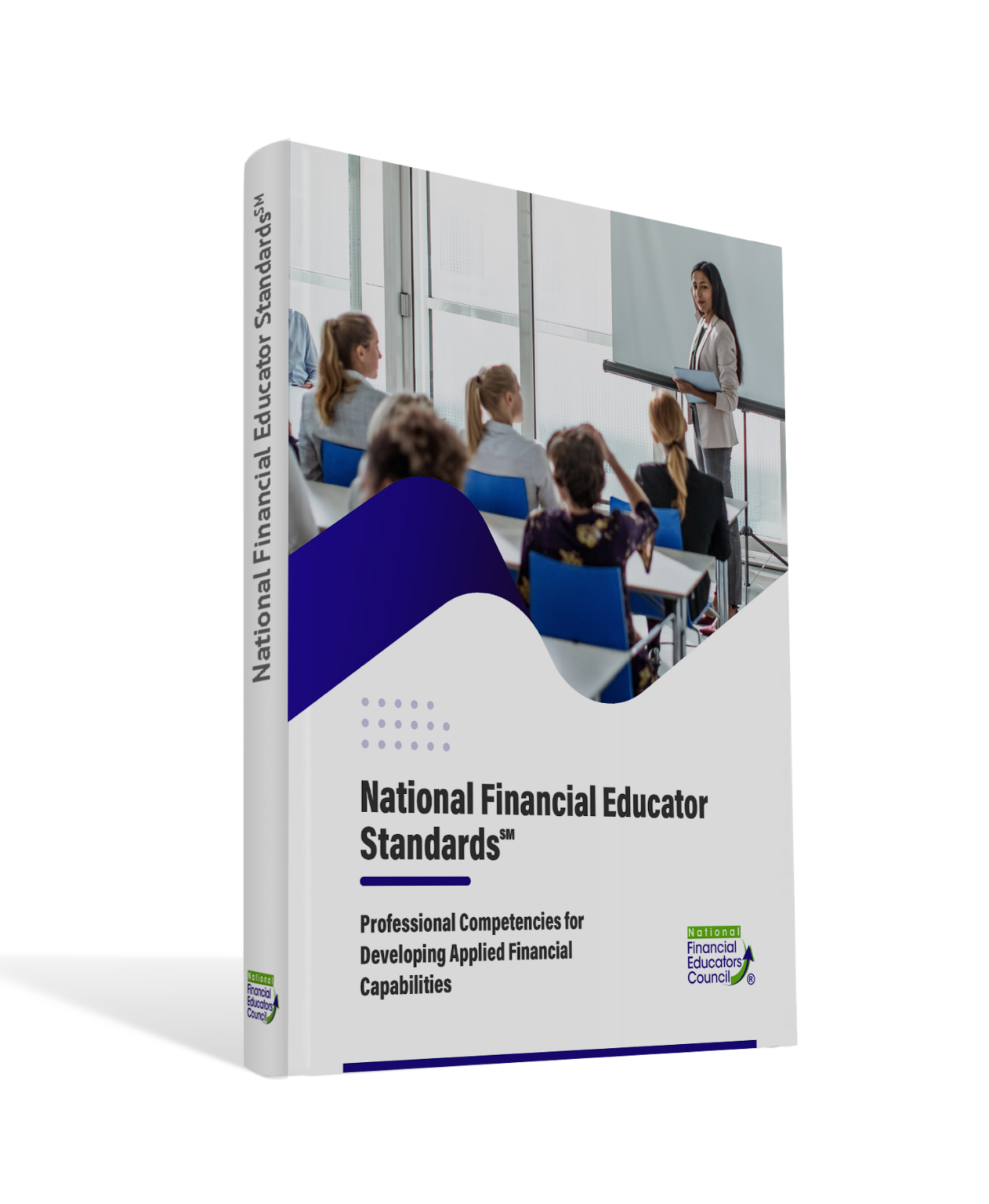
The National Financial Educator Standards℠ establish the professional competencies required to deliver effective financial education. They define what educators must know and demonstrate to prepare learners to make informed financial decisions, complete practical tasks, and apply financial capabilities in real-world situations.
The Standards prioritize demonstrated competence and measurable results over credentials, training completion, or simply delivering financial concepts. They establish expectations for effective instruction, professional accountability, learner protection, and the development of applied financial capabilities.
The Standards include 56 standards across 10 domains covering foundational practice, financial psychology, teaching methods, subject-matter proficiency, instructional planning, delivery, assessment, program results, learner privacy, and professional ethics.
Competency expectations reflect educators’ assigned responsibilities, instructional objectives, and learner needs. Subject-matter proficiency must match the complexity of topics taught. The Standards provide a consistent foundation for educator preparation, competency evaluation, professional development, and continuous improvement.
How the Framework and Standards Work Together
The NFEC’s National Financial Educator Standards℠ and Framework for Teaching Personal Finance℠ work together to improve financial education quality. The Standards define the professional competencies educators must demonstrate, while the Framework provides performance rubrics to evaluate teaching effectiveness, identify improvement opportunities, and guide professional development.
For example, the Standards require educators to demonstrate financial subject-matter proficiency, design applied learning activities, and develop performance-based assessments. The Framework evaluates how effectively educators explain concepts, engage learners, provide feedback, and adapt instruction. Together, they distinguish gaps in professional competence from areas needing improvement in teaching practice.
Organizations can use either resource independently or together for educator preparation, qualification, evaluation, and continuous improvement. The Standards complement rather than replace the Framework.

| Comparison Area | Framework for Teaching Personal Finance℠ | NFEC National Financial Educator Standards℠ |
|---|---|---|
| Primary Purpose | Describe and evaluate the quality of instructional practice. | Establish the professional competencies required for responsible and effective financial education. |
| Central Question | How effectively does the educator apply relevant capabilities in professional teaching practice? | What professional capabilities must an educator demonstrate for their assigned responsibilities? |
| Scope | Teaching practices organized across Planning and Preparation, Learning Environments, Learning Experiences, and Principled Teaching. | Competencies covering financial subject expertise, financial psychology, teaching methods, instructional design and delivery, assessment, outcome evaluation, learner protection, and professional accountability. |
| Evaluation Approach | Four-level performance rubrics describing the quality of instructional practice. | Competency Indicators assessed through appropriate demonstrations and professional evidence. |
| Primary Uses | Instructional observation, performance evaluation, feedback, professional reflection, and teaching improvement. | Educator preparation, qualification expectations, competency evaluation, and professional development. |
IACET Accreditation and the Development of the Framework
As an IACET Accredited Provider, the National Financial Educators Council has demonstrated compliance with the ANSI/IACET Standard for Continuing Education and Training. This accreditation requires rigorous practices for educator qualifications, instructional design, learning outcomes, assessment, program evaluation, and continuous improvement.
The NFEC’s accreditation experience, collaboration with consultants from the Danielson Group, and expertise of team members involved in instructional design, educator training, assessment, and accreditation compliance helped shape the Framework for Teaching Personal Finance℠. These contributions supported the development of structured performance criteria for evaluating instructional effectiveness, identifying areas for improvement, and strengthening professional teaching practices.
This foundation connects established educational quality principles with the specialized teaching practices financial educators need to deliver effective instruction, engage learners, and develop applied financial capabilities.
Complimentary Copies of the Framework for Teaching Personal Finance
Complimentary copies of the Framework are provided to academia, media, researchers and others that are seeking to use the materials for highlighting the importance of having qualified educators teach our nations citizens.
Page References
[1] Annamaria Lusardi and Olivia S. Mitchell, NBER Working Paper No. 17078 (May 2011), Baby Boomer retirement security: The roles of planning, financial literacy, and housing wealth. https://ideas.repec.org/p/crp/wpaper/54.html [2] Bennett et al., BMC Geriatrics, 12:30 (2012), Correlates of health and financial literacy in older adults without dementia. https://bmcgeriatr.biomedcentral.com/articles/10.1186/1471-2318-12-30Framework for Teaching Personal Finance References
[1] Annamaria Lusardi and Olivia S. Mitchell, NBER Working Paper No. 17078 (May 2011), Baby Boomer retirement security: The roles of planning, financial literacy, and housing wealth. [2] Bennett et al., BMC Geriatrics, 12:30 (2012), Correlates of health and financial literacy in older adults without dementia. [3] Max Nisen, Business Insider (Sep. 16, 2013), Impact of Teachers on Lifetime Earnings. [4] Pamela D. Tucker and James H. Stronge, Association for Supervision and Curriculum Development (2005), Linking Teacher Evaluation and Student Learning. [5] William J. Webster and Robert L. Mendro, Dallas Public Schools (1997), The Dallas Value-Added Accountability System Report. [6] W. L. Sanders, S. P. Wright and S. P. Horn, Journal of Personnel Evaluation in Education, Vol. 11 (1997), Teacher and classroom context effects on student achievement: Implications for teacher evaluation. [7] R. J. Marzano, D. J. Pickering and J. E. Pollock, Association for Supervision and Curriculum Development, Alexandria, VA (2001), Classroom instruction that works: Research-based strategies for increasing student achievement [8] W. L. Sanders, Financial Literacy and Education Committee (2006), Taking Ownership of the Future. [9] Ben Johnson, Principal, blog article (undated), Student Commitment Depends on Teacher Commitment. [10] Randal C. Archibold, New York Times article (November 18, 1999), Students’ Success Depends on Teachers Most, Poll Says. [11] Kenneth Leithwood, Karen Seashore Louis, Stephen Anderson and Kyla Wahlstrom, Wallace Foundation, Review of Research (undated), How leadership influences student learning. [12] Corinne Baron-Donovan, Richard L. Wiener, Karen Gross and Susan Block-Lieb, Association for Financial Counseling and Planning Education (2005), Financial Literacy Teacher Training: A Multiple-Measure Evaluation. [13] Richard Cordray, Director of the Consumer Financial Protection Bureau, Federal Reserve Bank of Chicago, Visa Inc. Financial Literacy and Education Summit, Chicago, IL (April 17, 2013), from prepared remarks. [14] Harrison Jacobs, Business Insider article (October 11, 2013), Here’s How to Raise Teachers’ Salaries without Spending a Dime.
Financial Educator Certification
Effective educators help learners achieve better outcomes. Numerous studies have shown that students of highly-qualified educators accomplish more positive outcomes than those taught by less-qualified instructors. For example, students of qualified educators may expect higher lifetime earnings and greater security at retirement [1] as well as improved mental and physical health and well-being. [2]
To ensure educators are qualified to teach personal finance the NFEC designed the Certified Financial Education Instructor course to align with the Framework for Teaching Personal Finance.