Personal Finance Guidelines and Standards for Practitioners

Most professional-level fields provide standards for their licensed or certified practitioners. Finance, education, law, medicine, and accounting, for instance, all have such standards in place. Yet until presently there were few or no personal finance guidelines to regulate the ways in which financial education instructors were trained and prepared, or which educational methodologies represented best practice. Recently, the National Financial Educators Council took the task of developing such standards into hand. The NFEC has written financial literacy standards and guidelines for educators and educational materials that improve resource materials, set evaluation and professional development frameworks, and propose standard language to improve communication in the field..

Benefits of Standards

Standards for Financial Educators

Financial Literacy Guidelines for Teachers

Solid research has demonstrated the knowledge and experiential bases financial educators should have in place prior to attaining certification. These guidelines are laid out in the Framework for Teaching Personal Finance.

Financial Literacy Educators Standards

Personal Finance Guidelines for Coaches

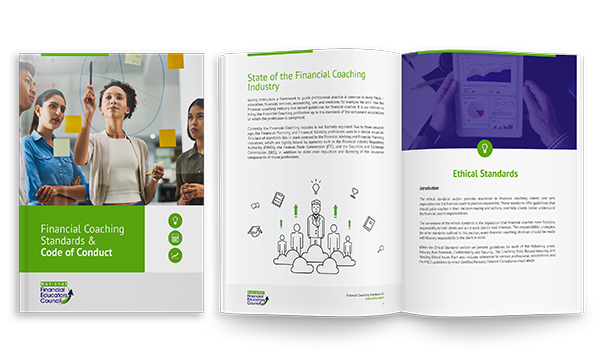
Financial coaches deal with issues related to people’s money, an emotional topic for most individuals. The NFEC’s Financial Coaching Standards and Code of Conduct presents the cross-disciplinary understanding coaches must gain to effectively address their client’s best interests.
Financial Literacy Standards for Coaches


Standards for Learner & Educational Methodology Best Practices

Learning Targets

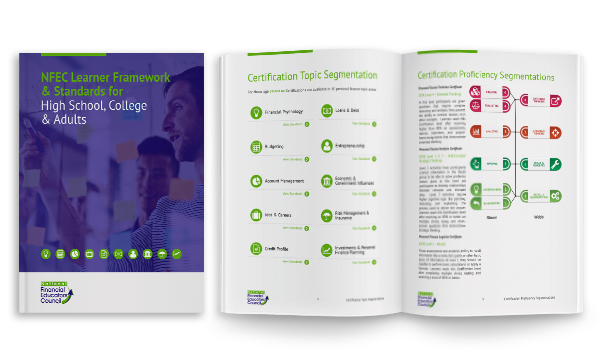
The NFEC has defined the 10 core topic areas about which participants in financial literacy instruction should learn. The Financial Literacy Framework & Standards sets learning targets to enhance the quality and effects of personal finance education.
Learner Financial Literacy Standards

Approaches to Financial Literacy Education

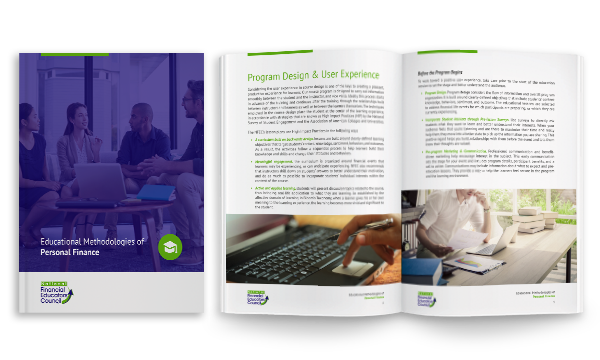
The NFEC’s National Financial Capability Strategy defines positive behavior change, money management knowledge, and systematization as the optimal personal finance guidelines for educational approaches. These standards take into account the differences among individuals’ financial habits, emotional connections, and situations.
Educational Methodologies of Personal Finance Financial Literacy Curriculum PDF Download

NFEC Spearheads First Comprehensive Personal Finance Guidelines

The National Financial Educators Council (NFEC) has developed the first documented personal finance guidelines setting forth the professional practices and content knowledge that define a competent, effective financial educator. In addition, the NFEC shares criteria for financial coach, counselor, and consultant best practices; and offers a guide for curriculum development and educational methodology to achieve top-level learner outcomes.

Standards for Financial Educators. The NFEC’s financial literacy best practices for instructors are presented in the Framework for Teaching Personal Finance. These standards assist financial education providers to become effective, competent, and well-versed in professional best practices. These benchmarks have the benefits of improving program quality, offering clear criteria to evaluate teacher and learner performance, and providing evidence-based tools for teacher preparation and self-assessment.

Standards for Financial Coaches/Consultants. To offer personal finance guidelines for coaches, counselors, and consultants, the NFEC wrote the Financial Coaching Standards and Code of Conduct. Because financial counselors deal with people’s money – an emotionally-charged topic – effective coaching demands more than just content knowledge about money management. It requires a multidisciplinary approach that combines coaching, counseling, and psychological techniques. The NFEC drew upon the policies developed by reputable organizations such as the American Counseling Association, the National Best Practices for Teaching Standards, and the Certified Financial Planner Board to develop this document.

Standards for Learners. The NFEC’s Financial Literacy Framework & Standards is designed to enhance the impact and quality of financial literacy instruction. These personal finance guidelines define what people need to know across 10 core areas of financial subject matter in order to be financially literate. They set performance goals for learners, and also give students clear targets for which to strive. When both educators and learners have solid objectives in sight, a financial education program is in excellent position to achieve positive results. This manual from the Council on Economic Education describes how to administer a test to measure financial literacy in students.

Standards for Educational Methodology. The NFEC’s instructional design team, while developing curriculum for pre-kindergarten children through adults, set personal finance guidelines for breaking down lessons into age-appropriate segments according to current financial literacy research evidence. They found that existing financial literacy programs often failed to align lessons with students’ cognitive capabilities at a given age. Therefore, they separated the NFEC curriculum into four distinct categories (grades PK-2; grades 3-5; grades 6-8; and teen/adult). Each group is further broken down into ‘beginner,’ ‘intermediate,’ and ‘advanced’ segments as postulated by Webb’s Depth of Knowledge framework.

The NFEC is strongly invested in providing educators and learners with financial literacy guidelines for improving people’s financial capabilities, and plans to update its standards each year as the field evolves.

Finance guidelines that might be acceptable to set aside.
CNBC on when a financial literacy course might be a good idea.