North Dakota Financial Literacy Standards and Mandates: Academic Alignment Review
This page offers a standards-based assessment of North Dakota’s financial literacy requirements in relation to the minimum structural, instructional, and accountability expectations commonly applied to core high school subjects such as mathematics, science, and English/language arts.
The analysis evaluates whether North Dakota’s state-directed financial education policies are developed, implemented, and supported at levels comparable to those of other foundational academic disciplines. The findings consider alignment with baseline expectations for instructional rigor, curriculum review processes, educator qualifications, assessment practices, governance structures, and ongoing program support.
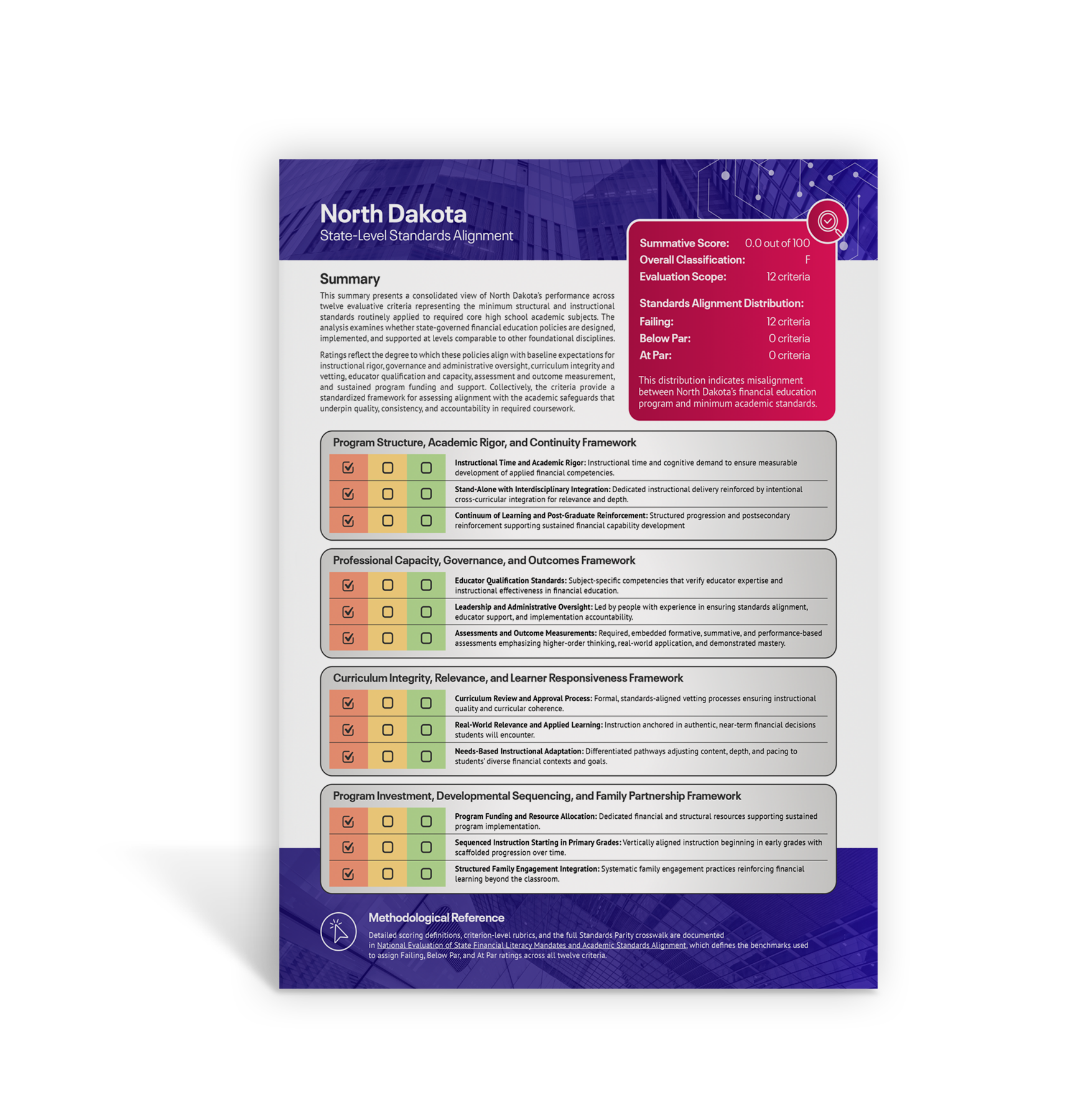
Standards Alignment Snapshot (North Dakota)
This distribution indicates structural misalignment between North Dakota’s financial education approach and the minimum standards applied to other required academic subjects.
Failing
Overall Classification
Evaluation Scope: 12 criteria
Standards Alignment Distribution
North Dakota: Financial Literacy Standards and Mandates Overview
As of 2026, North Dakota does not yet require a standalone personal finance or financial literacy course as a uniform statewide graduation requirement. Instead, North Dakota’s current high school graduation requirements include financial literacy concepts delivered either through a Problems of Democracy course or an Economics course, and the decision about which course students take is left to the local school district. Source.
North Dakota law mandates that every public high school must provide instruction in financial literacy as part of the standard curriculum, and personal finance concepts are integrated into social studies/economics content rather than a separate course. Source.
In 2025 the Legislature passed House Bill 1533 amending state code to clarify that students must complete at least a half-unit of financial literacy instruction, or that personal finance be integrated into approved courses such as economics or problems of democracy. The bill’s effective requirements began after April 24, 2025 and allow districts to satisfy financial literacy graduation requirements in multiple ways, not strictly via a separate credit. Source.

North Dakota Financial Literacy Programs in National Context: A 50-State Academic Alignment Analysis
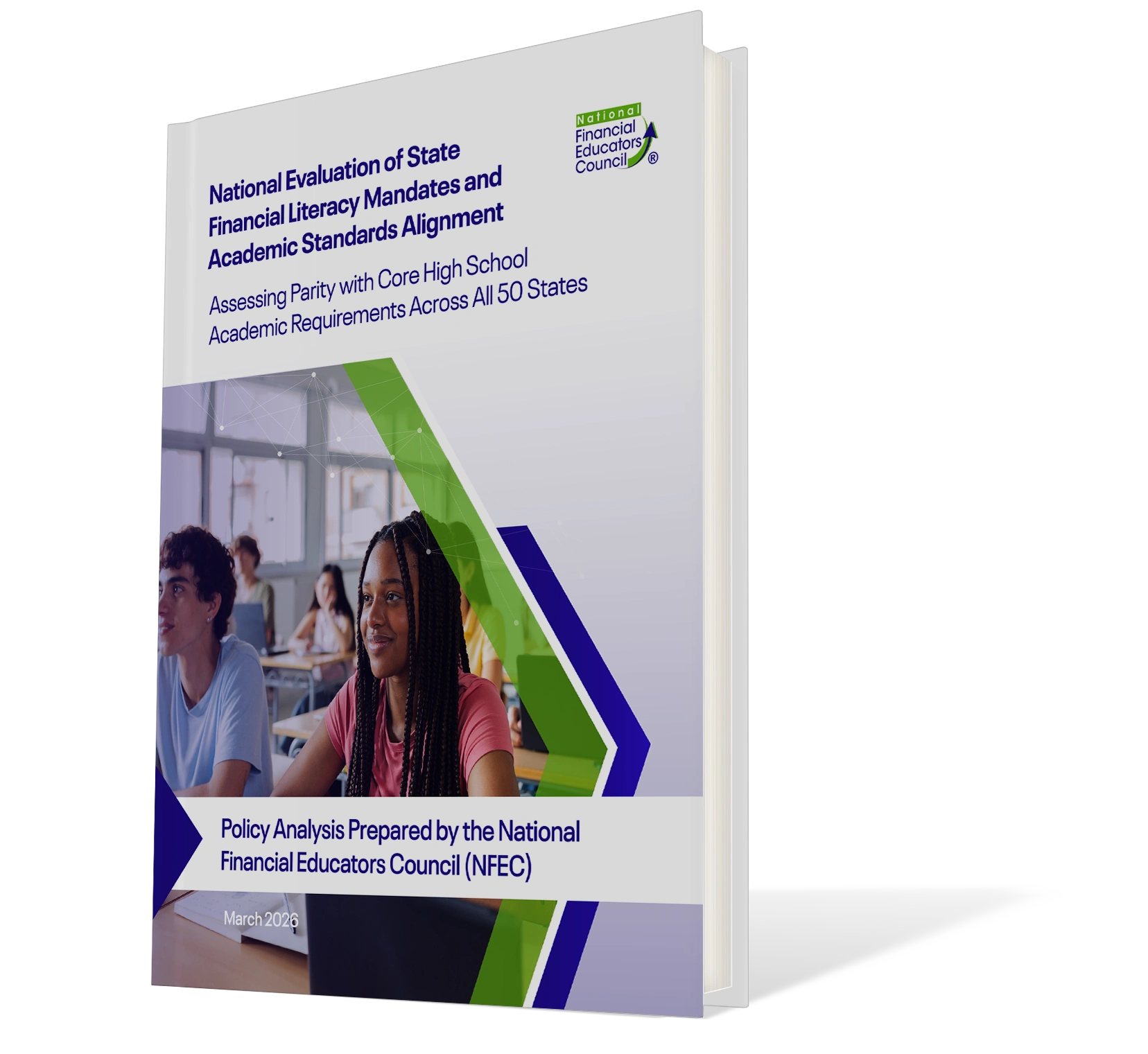
The National Evaluation of State Financial Literacy Mandates and Academic Standards Alignment provides the first standards-based, 50-state comparison of high school financial education, examining whether state mandates meet the minimum academic, governance, and accountability expectations applied to core subjects. Using a uniform 12-criterion framework, the analysis evaluates instructional rigor, curriculum oversight, educator qualifications, assessment systems, funding, sequencing, and family engagement nationwide.
The findings reveal widespread underalignment. No state reaches parity with core academic standards, and even the highest-performing states fall below baseline expectations. The report enables direct state-by-state comparison, including how North Dakota’s financial literacy standards compare with the other 49 states, and offers an evidence-based roadmap to strengthen financial education through standards parity, coherent implementation, and accountable governance.

Opportunities to Advance Financial Literacy Education Across North Dakota
To address the gaps identified in North Dakota’s financial education standards, the National Financial Educators Council (NFEC), in partnership with its North Dakota Financial Educators Council Chapter, provides a coordinated set of advocacy and policy support resources designed to elevate financial education to parity with other core academic subjects.
NFEC’s mission is to ensure that all learners graduate prepared to navigate real-world financial decisions by elevating financial education to the same level of quality, accountability, and instructional integrity as other required core academic subjects.