
Nebraska Financial Literacy Standards and Mandates: Academic Alignment Review
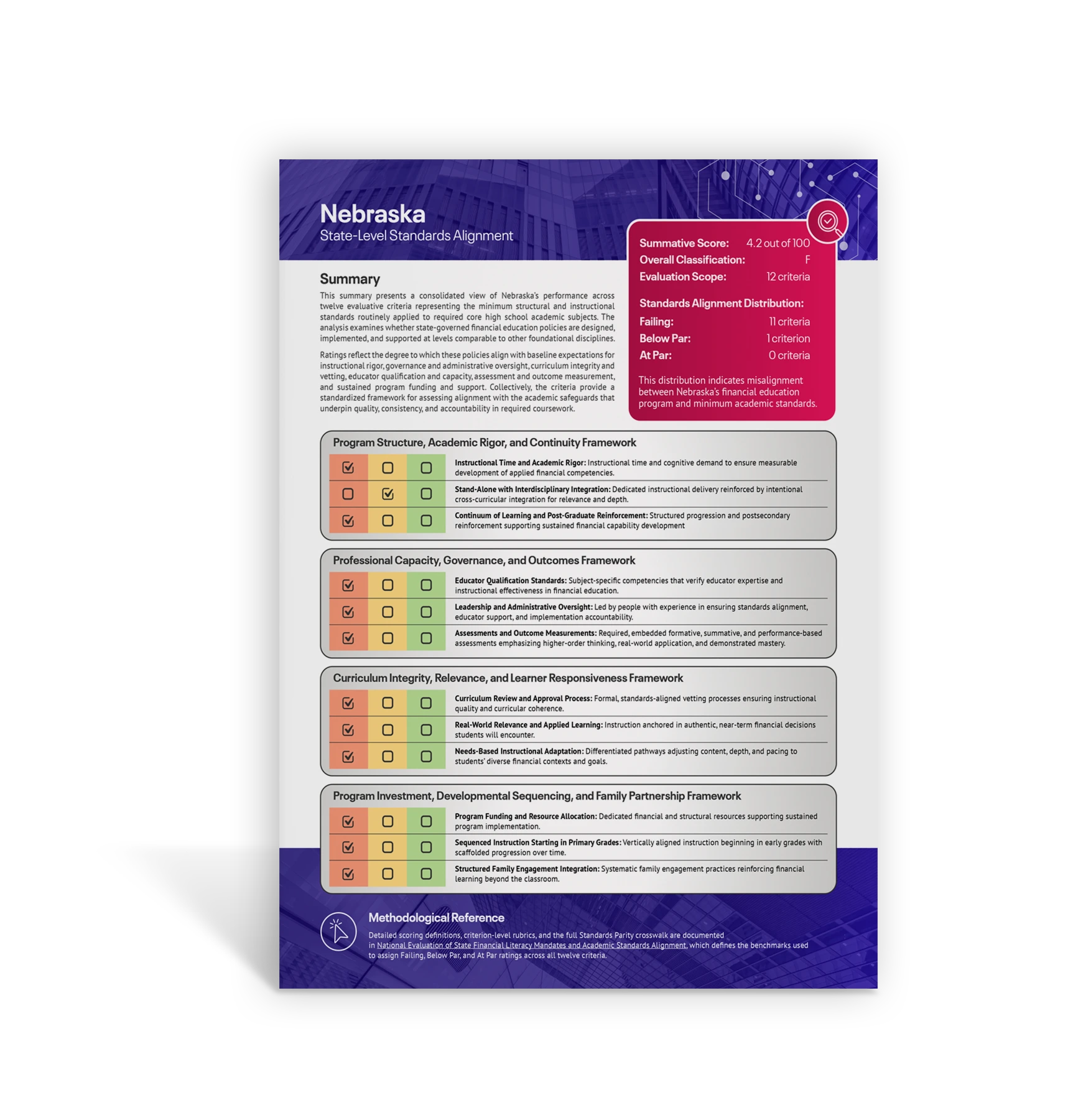
This page presents a standards-based evaluation of Nebraska’s financial literacy requirements relative to the minimum structural, instructional, and accountability standards routinely applied to required core high school academic subjects such as mathematics, science, and English/language arts.
The analysis examines whether Nebraska’s state-governed financial education policies are designed, implemented, and supported at levels comparable to other foundational disciplines. Findings reflect alignment with baseline expectations for instructional rigor, curriculum vetting, educator qualifications, assessment, governance, and sustained program support.
Standards Alignment Snapshot (Nebraska)
This distribution indicates structural misalignment between Nebraska’s financial education approach and the minimum standards applied to other required academic subjects.
Failing
Overall Classification
Evaluation Scope: 12 criteria
Standards Alignment Distribution
Nebraska: Financial Literacy Standards and Mandates Overview
As of 2026, Nebraska requires all high school students to complete a personal finance or financial literacy course as part of graduation requirements. Under the Nebraska Financial Literacy Act (Legislative Bill 452, 2021) and revisions to graduation statute Neb. Rev. Stat. §79-729, beginning in the 2023-24 school year, each student must complete at least one five-credit (half-year) course in personal finance or financial literacy before graduating from high school. This half-credit is part of the minimum credit requirements for graduation in Nebraska public schools. Source.
The Nebraska Financial Literacy Act (LB452, 2021) requires school districts to incorporate financial literacy instruction into K-12 curricula and submit an annual status report to their local board of education, detailing student progress in financial literacy courses and other locally determined measures. Even with this reporting mandate, significant gaps negatively impact student outcomes. Source.

Nebraska Financial Literacy Programs in National Context: A 50-State Academic Alignment Analysis
The National Evaluation of State Financial Literacy Mandates and Academic Standards Alignment provides the first standards-based, 50-state comparison of high school financial education, examining whether state mandates meet the minimum academic, governance, and accountability expectations applied to core subjects. Using a uniform 12-criterion framework, the analysis evaluates instructional rigor, curriculum oversight, educator qualifications, assessment systems, funding, sequencing, and family engagement nationwide.
The findings reveal widespread underalignment. No state reaches parity with core academic standards, and even the highest-performing states fall below baseline expectations. The report enables direct state-by-state comparison, including how Nebraska’s financial literacy standards compare with the other 49 states, and offers an evidence-based roadmap to strengthen financial education through standards parity, coherent implementation, and accountable governance.


Opportunities to Advance Financial Literacy Education Across Nebraska
To address the gaps identified in Nebraska’s financial education standards, the National Financial Educators Council (NFEC), in partnership with its Nebraska Financial Educators Council Chapter, provides a coordinated set of advocacy and policy support resources designed to elevate financial education to parity with other core academic subjects.
NFEC’s mission is to ensure that all learners graduate prepared to navigate real-world financial decisions by elevating financial education to the same level of quality, accountability, and instructional integrity as other required core academic subjects.