
Missouri Financial Literacy Standards and Mandates: Academic Alignment Review
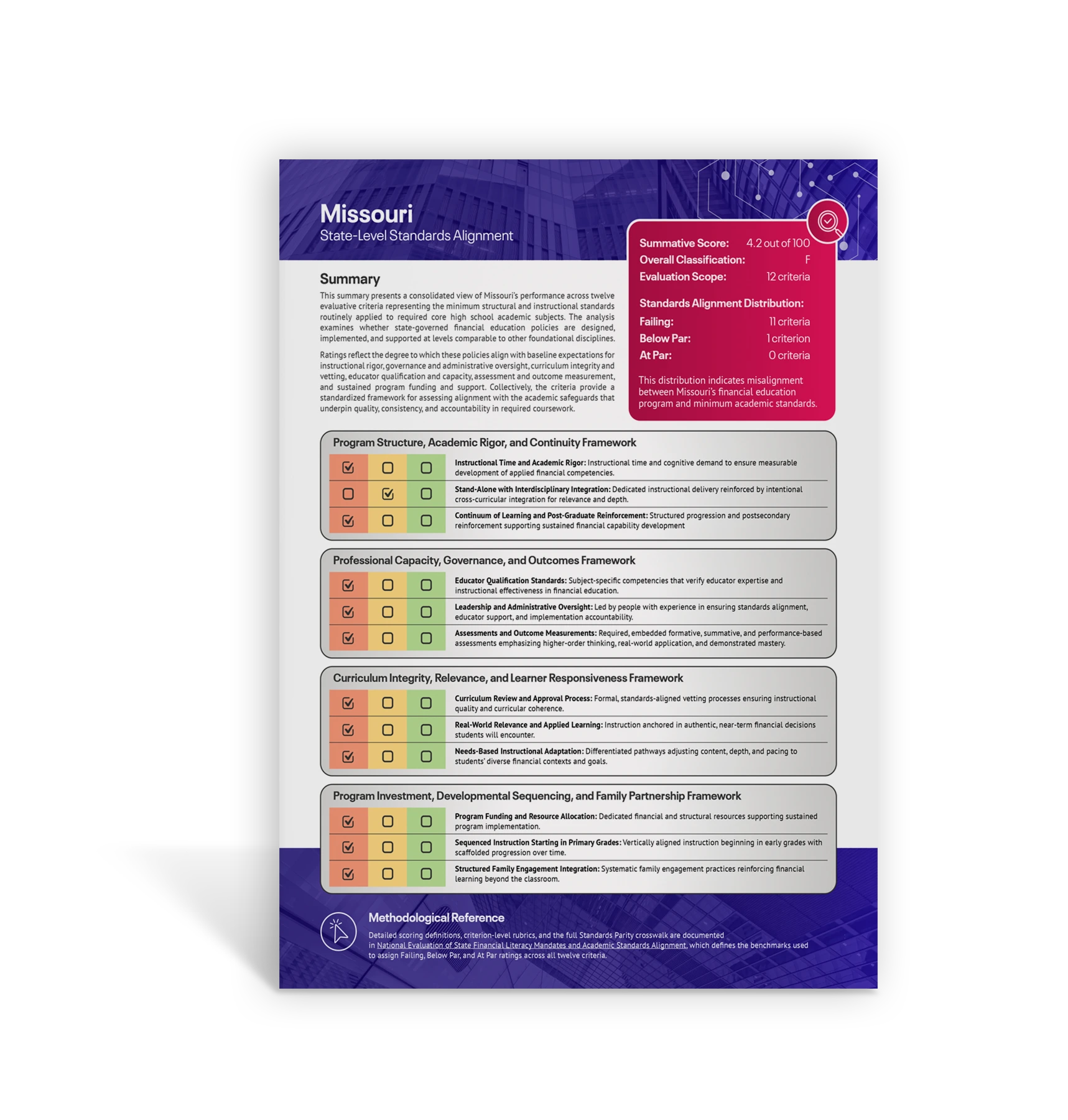
This page offers a standards-based assessment of Missouri’s financial literacy requirements in relation to the minimum structural, instructional, and accountability expectations commonly applied to core high school subjects such as mathematics, science, and English/language arts.
The analysis evaluates whether Missouri’s state-directed financial education policies are developed, implemented, and supported at levels comparable to those of other foundational academic disciplines. The findings consider alignment with baseline expectations for instructional rigor, curriculum review processes, educator qualifications, assessment practices, governance structures, and ongoing program support.
Standards Alignment Snapshot (Missouri)
This distribution indicates structural misalignment between Missouri’s financial education approach and the minimum standards applied to other required academic subjects.
Failing
Overall Classification
Evaluation Scope: 12 criteria
Standards Alignment Distribution
Missouri: Financial Literacy Standards and Mandates Overview
As of 2026, Missouri requires high school students to complete a one-semester, 0.5-credit personal finance course for graduation. Missouri’s graduation requirement for personal finance was established by the Missouri State Board of Education and implemented for the 2019-2020 school year, mandating that students earn one-half credit (equivalent to a semester) in personal finance as part of their diploma requirements.
The personal finance credit may be earned through a standalone course, or students may receive the credit through embedded coursework in subjects such as social studies or practical arts if aligned with the state’s Personal Finance Course Level Expectations and competencies. Missouri also provides a state-level Personal Finance Assessment that students may be required to take depending on district decisions; students who “test out” by scoring 90% or higher on the assessment may receive credit without taking the standalone course. Source.
While Missouri has a long-standing requirement for personal finance coursework and associated competency expectations, the statute and state policy do not include statewide educator qualification standards specific to personal finance instruction, do not require uniform adoption of vetted curricula in all districts, and do not mandate performance-based statewide accountability tied to student financial competency.

Missouri Financial Literacy Programs in National Context: A 50-State Academic Alignment Analysis
The National Evaluation of State Financial Literacy Mandates and Academic Standards Alignment provides the first standards-based, 50-state comparison of high school financial education, examining whether state mandates meet the minimum academic, governance, and accountability expectations applied to core subjects. Using a uniform 12-criterion framework, the analysis evaluates instructional rigor, curriculum oversight, educator qualifications, assessment systems, funding, sequencing, and family engagement nationwide.
The findings reveal widespread underalignment. No state reaches parity with core academic standards, and even the highest-performing states fall below baseline expectations. The report enables direct state-by-state comparison, including how Missouri’s financial literacy standards compare with the other 49 states, and offers an evidence-based roadmap to strengthen financial education through standards parity, coherent implementation, and accountable governance.


Opportunities to Advance Financial Literacy Education Across Missouri
To address the gaps identified in Missouri’s financial education standards, the National Financial Educators Council (NFEC), in partnership with its Missouri Financial Educators Council Chapter, provides a coordinated set of advocacy and policy support resources designed to elevate financial education to parity with other core academic subjects.
NFEC’s mission is to ensure that all learners graduate prepared to navigate real-world financial decisions by elevating financial education to the same level of quality, accountability, and instructional integrity as other required core academic subjects.
Standards and Policy Resources
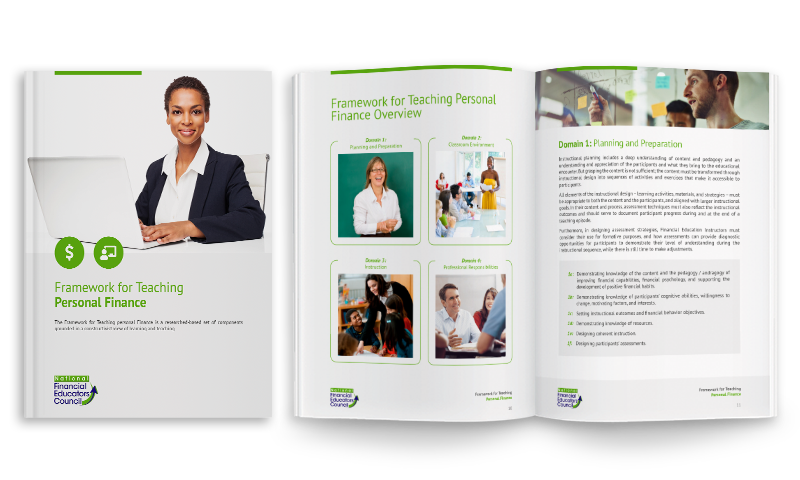
NFEC offers comprehensive financial literacy standards and policy guidance, including the Framework for Teaching Personal Finance, learner outcome standards, educator competency frameworks, and national research on financial education across all 50 states.
Advocacy Committee Engagement
Stakeholders are invited to join NFEC’s Advocacy Committee, which convenes educators, community leaders, and policy stakeholders to advance standards-based reform and align financial education with established academic expectations.

Video Review of Missouri’s Financial Literacy Standards
Watch the video reviewing Missouri’s financial literacy standards presented by the NFEC’s CEO Vince Shorb.
Thank you for joining as I review Missouri’s standards and mandates for their financial literacy program. This is at the high school level. I’m gonna get into details here today. And just like I do on the other state reviews, I review them based on two core criteria. Criteria one, reviewing them compared to the standard set for other core subjects required in a high school. Things like math, science, so it doesn’t meet those minimum education standards required by other core high school subjects. Second, does a personal finance program help students make competent near-term financial decisions? Those are the two criteria I look at and Since I’m very critical on these standards, most standards, in fact, every standard I reviewed so far, I’m on my nineteenth, twentieth review. They haven’t come remotely close to meeting those two criteria. So I am critical, but I am appreciative of those who’ve helped to advance financial literacy, at least get something in place for our high school students, which is a start. Now it’s time to elevate those standards to ensure our kids are graduating with the abilities to become self-sufficient contributing members of society. Let’s dive into this review. And as always, I review the bill and legislation first, and then I go into how the schools are executing that mandate on an administration level. So first, we’ll look at Senate Bill And here they have a new bill and that’s getting voted through now, but I’m going to start here. I’ll cover the new bill, which is bill Senate bill five Oh three. It’s still going through approval, but let’s start with Senate bill seven ninety. It says there’s a regular course instruction in the area. Personal finance shall be offered in all public schools in the state of Missouri. It shall begin not later than the ninth grade and continue for each year of high school. That’s a little misleading because down below it says it’s offered in grades nine, ten, eleven, and twelve. They just have to take a half of a semester. So not a full year, a half of year personal finance, which is still good, but it’s not, it makes it sound like it’s required each year, but all they need to take between grades nine and twelve is a half semester. of personal finance education, which is not a lot. The other thing I don’t like about this bill right off the bat, it’s giving students freedom to take it between ninth and twelfth grade. If we only have a short period of time, which is about fifty, sixty teachable hours when it comes to this program, if we only have a short period of time, it’s much more impactful if it’s in the later years, eleventh and twelfth grade, because they’ll be able to apply what they’ve learned in the near term as opposed to taking as a freshman and trying to remember all those years we have significant amount of learning loss that occurs. So I would even say it would be ideal if it’s in the twelfth grade before they’re making key financial decisions. The topics covered in the personal finance course shall include but not necessarily limited to For those that watch other videos, you know I don’t like when legislatures tell the administration what they should teach. Instead, they should have the administration build out standards and define what is critically needed to students. And they list a bunch of random topics. Banking, checking, savings account, credit cards, interest rates, pensions, retirement savings, social security, property, life insurance, and the stock market. Most of the stuff they won’t need anytime soon. Social Security, you know, retirement savings. I think it’s good to open people’s eyes to it, but when you only have fifty, sixty teachable hours, it gets in the way of things they need in their near term. What do you do when the flood of credit card offers come in the mail when you turn eighteen? How do you pay for college? Do you go to college? Does it make sense financially for you? How do you move out on your own, pay your bills? We need to focus there because that’s where people get in trouble. If they make mistakes there, they’ll never be able to invest. There’s a lot of people in that situation that are never able to even consider these subjects because they’re broke, they don’t have money, they’re in student loan debt, they’re in other debt as well. So a problem there. Let’s see. There’s going to be they offer assistance to developing personal finance courses. So the secondary education department is supposed to provide assistance if the district needs assistance in developing a program. I think that’s a little off. because the reality should be there should be a proven program in place that is vetted and used. So again, they’re putting a lot of the responsibility on the school districts, where I think just like your math, science, and other courses, they’re vetting out and ensuring that the key things are done. The teachers are trained. There’s clear outcomes. There’s proven material. Nothing’s mentioned there. In fact, they’re putting the responsibility on the school districts there. Let’s jump ahead to Senate Bill five oh three. This has not passed as of yet. It is going through committee, but I think there’s some improvements here. They’re still making the same mistakes on the old bill, but I think there are some improvements here. Number one, it says the Department of Elementary and Secondary Education shall convene a workgroup to develop recommended academic performance standards relating to one half unit of credit of personal finance required by the State Board of Education. So I like this, that they’re requiring performance standards. That was missing from that bill. I think outcome standards are always key. They should be including things like pre and post test results, behavior change results, sentiment and confidence results if they’ve established actual systems and processes. So hopefully they do that. They listed some people, you know, educators of personal finance, representatives from tech education. departments of elementary education, banking industry, entrepreneurs, so forth. I think that’s good, but I think the key thing that they need, they need to have people with expertise and standard development. We’ll get into the standards they have now. They’re not quite done to par with typical standards you would see on a quality level program. So we’ll get into that. I think that is the missing piece. And this was originally slated for the two thousand uh twenty three two thousand twenty four school year they’ll need to amend that because we are already past that date you know how it is going through legislation things take a while so from the legislative side uh it’s all right they’re not giving clear outcome instruction they’re putting a lot of the responsibility on school districts there’s no mention of teacher training they’re finally adding some performance outcomes now it’s not in place already and there’s no vetting of material plus they list random topics from a legislative standpoint not too good there but A lot can change with the implementation. And one thing I liked, Missouri did an excellent job of organizing things on one page. So many states, when I’m reviewing, it’s so hard to find information. They don’t have things put together. I think there’s only two or three states, Iowa being one of them, Missouri, and there’s one other state that had everything nicely organized on one page. We have the standards. We have the practice tests. We have the blueprints. everything is laid out on one page which makes it easy i also want to commend them i called they got me answers right away typically when i call these these departments first off i never hear back second off they don’t know who to send me to this person the answer knew exactly who to submit to she was actually at the conference they sent me to another person that was able to directly answer my question email me right away So it’s run nicely. And this is very rare. You might think, oh, that’s just standard business. That’s how they should. I agree it’s how they should, but they do it. So I commend them on being organized and well-run. Again, you may think that’s average and what should be expected, but they are doing it. So kudos to them for keeping this easy. Other states, they have old information everywhere. It’s hard to find. It’s just a mess. So this made life easy for me here. And they develop these blueprints. We’ll get into this. And basically, it’s just an outline of what’s covered in the topics in the subject matter, how heavily it’s weighted. I think it’s good for the blueprint. Now, in looking at the standard, I want you to remember this. Range of emphasis, twenty six to thirty four percent here for a lot of more the investment insurance and the higher level things. So, I want that to be a point of reference because later you’re going to see they don’t have a lot that covers those topics, but this should be a blueprint. I think it could be much more detailed. I like actual, real blueprints that list outcomes that we should be expecting of students, but for a quick and dirty one, this is fine. Let’s move on to… The personal finance course level expectations. This is from the Missouri Department in Elementary Secondary Education, summer of two thousand seventeen. We’re going to be going through these standards and how they’re implementing this in detail. And I’m going to roll through some of the ones that I think can use some improvement. But one of the key things I took out of reviewing this is they’re teaching concepts but they can really personalize a lot of these and when you personalize these concepts it makes it so that students gain a lot more from that for instance in this one uh wants and needs um in choice and decision making so you know we have a evaluate role of choice and decision making apply rational decision making process to satisfy wants well They’re missing a piece. And I think this could be greatly enhanced if they just add, identify things you want, right? Now the kids listing things that they want, now they can actually apply rational decision making. We can have them research, see how much those things cost and prioritize those things. But without that, Statement. Again, standards are a guide for educators, right? Without that statement, I can just explain, you know, or have students evaluate the role of choice and decision-making. It’s kind of a concept rather than an actionable item that they can do to improve their finances. And what am I applying a rational decision-making process to satisfy wants to? Am I just doing some random thing? But if they just added, identify the things that you want. And I’m simplifying that a bit. That would make a big difference. Same thing with choices and decision making. Explain how today’s choices have future consequences. Explain the casual relationship between choice and opportunity costs. Analyze how choices can result in unintended consequences. We can make that more personalized by having them identify some things Some goals and things that they have for themselves, some potential pitfalls along the path, what they need to accomplish along the way. So with personal finance, I think it’s different than a lot of other topics simply because we can actually have them implement real world activities that are reflective of that individual person. it’s not like we’re teaching concepts like math science or whatever this we can personalize and personal finance needs to be personal otherwise it loses all context for somebody The income one, I have a lot of problems here, but if you read through those. Evaluate how career choices impact income, I get it. Analyze relationship between education and skill, good to know. Describe how wages and salaries determine labor market, okay. Analyze change in economic condition, I think is important. Describe how entrepreneurs see problems and opportunities, okay, fine. We get to compensation, how they’re paid, what’s in their paycheck, gross and net income taxes, but what is this missing? about completing a resume completing a job application practicing interviews none of this is beneficial unless they know how to get a job right these are the basic things i don’t in in this isn’t just missouri this is the majority of of states they don’t have these kids completing resumes practicing completing applications encouraging them to start work early very very simple things um uh also it’s uh um later i’ll get that to the test questions that are reflective here but we break down career planning i think it’s important they’re exploring jobs and uh let’s see if they have Evaluate career choices, impact, income, and quality of life. That’s good, but again, it needs to be specific for them. If they’re going to research career paths that they may be interested in, that’s going to take this from just a lecture to a project-based learning assignment. If we work up higher order thinking skill sets to where they’re doing some… analysis, creation, and researching things that they’re interested in to see what type of income potential, now they’re crafting a plan for their life. So it’s a huge missed opportunity here to really explore careers that they are interested in. The way it’s written now is, evaluate how career choices impact income and quality of life. I can do that in a lecture or simple activity. If I just change that, have students explore career opportunities that they may be interested in and evaluate potential earnings based on their career choices. It changes the whole nature of that. In addition, again, my big pet peeve, have them complete their resume. No student should graduate without a resume, without knowing how to interview, without knowing how to complete an application. I also think things like getting their LinkedIn profile online, starting to network to find potential references for them are all critical things how to dress how to act i did a mock interview for a group the kids didn’t even know how to shake hand look you in the eye so we have big problems missing there um from the uh buying goods and services you know the creating budget let’s let’s talk on that one my biggest problem is here they have some good things right but It’s all in random order, it doesn’t make sense. So if we read it from top to bottom, differentiate income and expenses, analyze spending habits, create a budget, explain how budgeting for charitable giving has tax benefits, prioritize expenses and payment due dates. Well, first off, this is budgeting. Let’s look at item D, explain how budgeting for charitable giving may have tax benefits. budgeting for charitable giving does not have tax benefits right it’s donating has tax benefits budgeting for charitable giving does not so it doesn’t make any sense how it’s written and plus this should be moved to the tax section as well so let’s look at the order of the other four um differentiate between income expense i think that’s good baseline right but i think everything should start with Reason development. A core quality of any education program should be reasons for students to learn. It should always start with that. Why would you want to have a budget? How can that benefit you? Differentiate between income and expenses. Then it goes to analyze spending habits to recognize current spending and saving trends. If I’m doing this in order, which most teachers you’re going to, the standards should be breaking this down into basic concepts to get more advanced as you work down this sheet, this topic, these letters. That’s how it starts. Basic concept first and get more advanced, and then finally conclude with the most advanced things you want them to do. Otherwise, teachers may just do this in this order, which would be completely disastrous because you can’t analyze spending habits without creating your budget. Right? So differentiate income reasons, differentiate, you know, things on the budget, create a budget, include saving goals, emergency funding, fix a variable expense. I think all that’s, that’s good. Analyze spending habits with your, and I think if they use the kids’ current budget, and most of them, if we’re doing this in eleventh or twelfth grade, again, another benefit of working with higher grade levels is because they’re going to have some expenses, cell phones, something else. And then prioritize expenses and due dates. That’s a logical order that works. Otherwise, it’s just a random list of stuff that they’re supposed to teach. People that write standards are supposed to make it in a very easy format to them to do so. Let’s look at this next one. I’ll kind of move on quick here. Selecting financial institutions. Compare services, fine. Calculate account balances, fine. Analyze cost and benefits of using an account, okay. Explain FDIC and CUA, okay. Okay, I get that. I think they’re missing two things. How to open account, what accounts to open. First, why would you want to open accounts, bank accounts? What accounts to open, right? How to open that account, what you need. A lot of kids that we work with, they’re nervous to go into the bank because they don’t know what they need. They don’t want to feel dumb, right? And they’re used to doing things online and things. So what do you need? How to manage your accounts. I don’t know if they get to management later. They don’t. I don’t see it here. How to manage your accounts, set up automated bill pay and other things to protect their credit. So again, a lot’s missing. These are basic things. As an adult, you need a few things. You need your checking savings account. You need a way to, I’m a big believer in automated bill pay because it protects people’s credit, helps people track where money’s going. And we can have kids set this up while they’re in school when they’re able to apply things that they’ll actually need in the real world. It’s a positive thing. Next reason for saving, I’m not gonna get too much into that, but I think this should definitely be in the budgeting section. I don’t know why they’re separating savings and budgeting. The entire goal of a budget is to be able to save on a regular basis. So savings and budgeting need to be more closely tied because they talked about savings briefly in that budget section. So this, if I’m a teacher just going through these standards, i’m getting to savings you know two weeks after i i did budgeting where they’re saving it doesn’t make any sense uh from a from a perspective of of helping them go and sequentially connect the way the mind works we’re connecting subjects that we know have like-minded relation and now we just have two three four weeks separated between this this uh the savings which all comes down to budgeting right it all comes down to but if you’re able to budget have an income control your expenses now you’re able to save so let’s get into one more which is you know now we’re getting into as I mentioned earlier that that you see explain the purpose and function of cost of a mortgage again they’re not gonna need it in the near term they’re gonna forget about it by the time they need to interest on credit I think is good let’s get to this credit section using credit here so Evaluate factors of credit worthiness. Explain the purpose of credit records. Identify ways to avoid credit problems. Analyze what credit scores may be used for. Evaluate how to verify accuracy. Explain the importance of verifying one’s credit report. Explain the value of consumer credit protection laws. Explain responsibilities associated with the use of credit. Great. Why do they not have, create a plan on how to build a positive credit rating? That’s missing. Another big one, what are the major pitfalls that young people get into that negatively impact their credit rating? I guess there’s ways, never mind, that one’s there. Identify ways to avoid and are correct credit problems. I think that should be very focused on youth and where they have it. Rental problems, late pays, high debt load. Obviously, I did have that take back my last statement, but why is there nothing on how to build a positive credit rating? and the rest gets into some investing things and so forth. Again, the investing thing is great. If we have four years of financial education, I want to get people in it. With a semester, I want to focus on things that will inspire them, compounding interest, a broad overview of these things. A kid will not remember the various assets. penny stocks, they’re not gonna remember that stuff when the time comes, but if you give them a broad overview that motivates them through, I love that compounding interest activity, where they’re seeing how money can grow with very little, those are good things, and if we had, ideally if we had all the time in the world, we would do a lot on investing, but we have fifty, sixty hours in Missouri, so that’s not a lot of time, and in fact, this is a lot of things to cover. I didn’t do a count, but let me just do a quick count. Honestly, this is gonna be a big problem here. So we have five, ten, twenty, twenty-five, thirty, thirty-five, forty, forty-five, fifty, fifty-five, sixty, sixty-five, seventy. I’m gonna say eighty things. That’s quick and dirty. Check me there. Eighty things that they need to cover in fifty hours. There’s a big problem with that. And the big problem is you’re never gonna get people to higher-order thinking skill sets, and this is very important. Higher-order thinking skill sets, creation, evaluation, having them implement what they learned, that needs time and focus on a topic. So we need to apply teaching strategies that include project-based learning, reality-based things that they’re doing, like completing their own budget. Because they have eighty subjects, and again, I might be off plus or minus ten or so, in fifty to sixty hours, they’re never going to be able to cover anything at the amount of depth needed to work them toward those higher order thinking skill sets. So, this is, the problem is, They’re more susceptible to learning loss. When you’re trying to cram eighty topics into that amount of time, there’s going to be very little time to remember. They’re going to be studying for the test. They’re not applying it and they’re not doing those higher order thinking skill sets like creating the budget, you know, analyzing their plan, all those things that are going to help them remember on a deeper level and apply it. So you can’t cover that many topics. If I was designing this, I would cut that down by about seventy percent and focus on the core things we need them to do. I would focus them on life events, moving out of their own, protecting their credit, making early decisions when it comes to education loans if they’re going down that path, getting a job. Those are the core things they need in a timely manner. They also have some practice tests here. Again, I think, you know, questions like this. Which payment method is most often used when purchasing a home loan? Who cares? It doesn’t matter. Their realtor is going to tell them. You know, they don’t need it now. They’re not going to be buying a home anytime soon. And with this course, they probably won’t be able to buy it for a very long time. Which feature of using a local bank or financial institution is advantage for account holders? Again, kind of dumb question. It’s not a short lobby hour. It’s not advantage, right? So let’s see. Which guarantees sufficient funds for payment in an existing bank account? Okay. don’t know i don’t even know i don’t i don’t care i know that i don’t know this one either this is interesting tyler’s unable to visit a bank during business hours uh so he must drop the check into a night depository what the heck’s a night depository anybody know um you know so again this is not practical questions need to be practical in addition On the standards, I never saw anything about a depository, night depository. What is it? The test questions need to match what is in the standards, and it’s missing. Again, major problems there with the test questions. I just scanned through that. As I was scanning through, many stuck out as not being needed. Again, this last one, I don’t even know. i would not know the answer that i’ve never heard of a night depository before so that’s fine so let’s get into something here i’m going to share my screen and really give them a rating based on these areas so again we rate financial education programs based on their abilities to meet minimum education standards required by other other subjects Um, let me see here. Let me just. So again, we rate subjects based on meeting minimum education standards and other subjects. So what I have here is a list of twelve minimum education standards required by other subject matter. We’ll see how well Missouri does after going through this. Delivered in a standalone class and integrated into other subjects. It is a and there’s green check, which means good. Red X, bad. Yellow circle, which means okay. And they get okay there simply because it is in a standalone subject, but it’s not integrated into other coursework. I think that’s a key and easy thing that every mandated course can add to include some in math and other areas as well, economics and so forth. so a okay there assigned adequate time and rigor absolute fail on time a semester is is is a half a year is not enough in addition it’s not rigorous enough we have eighty topics to cover in fifty to sixty hours definitely instructional hours that’s definitely not a lot of time try cramming that into fifty to sixty hours of educational time that takes out some time for um you know administration and working with students and so forth so not a lot so the rigor is very low no mention of ongoing education to support long-term outcomes this is something very easy to do because we know where the students are at if somebody is going through this as a junior well maybe we’re giving them additional information or encouraging them through newsletters emails other things you may be looking into colleges or so forth or if they’re seniors hey how to plan moving out on your own in those next things so we can stay with them longer than the actual class this is especially critical when we’re starting in the ninth grade and giving them that much flexibility relevant content that prepare students for near-term life events absolutely not I think a lot of it’s wasted on on areas that are They’re not going to need, especially if they mess up their near-term financial situations, right? They’re not going to get there. And we need to make sure that kids are protected. The key thing with youth is protecting them from pitfalls. And that’s what we need to put the focus on, especially when we have limited time. Now, if we had four years, wonderful. Let’s add in those other things. Adopt proven curriculum that encourages higher order thinking skill sets. A fail, they don’t even mention it. They don’t even mention curriculum standards or anything like that, which is bad. And they just mentioned, the bill just mentioned a handful of topics they must teach, right? Not very good. Customize lesson plans based on student needs. No mention there, and this is critical. When you are working with people in lower socioeconomic districts, what you’re going to find is they have a lot more knowledge on budgeting. What you’re going to find is they have a lot more knowledge on delayed gratification, but they have little hope for the future. I’ve worked both sides of the, I worked high income earners, low income, low socioeconomic. That’s what I found time and time and time again. On the other side of the tracks, right, you have the families of higher economic status. They’re going to have no idea how to budget. They’re going to have no idea of delayed gratification. Some might, right, but a lot don’t because the parents hand them the credit card, but they’ll have a ton of hope for the future. right so we need to address our education based on socioeconomic levels some tweaks need to be made it’s well known and it just needs to be addressed and i don’t think i’ve had a school address that yet with their standards and it needs to be addressed it’s a critical missing piece you just can’t teach everybody the same thing and this could also be addressed by having highly qualified educators major fail Through everything I read, nothing mentioned training the educators. Every study out there points to the quality of the educator has the most impact on student outcomes. Every study I’ve seen. So I can give a highly qualified educator horrible curriculum and they’re going to make that class great i can give a poor or underperforming teacher the best curriculum and that class won’t be good the outcomes for students won’t be good educators are key to this we need to focus the energy there otherwise the students will receive absolutely no benefits programs managed deployed by managed experience leaders you know i mean i The standards are horrible. They’re so bad. They’re missing so many pieces. It’s way too much. But on the same token, I can tell people put effort and try it and put effort to that. Many states, they don’t go through this effort of developing standards. So I give them that. Also, I found them very professional. They had answers. They were responsive. It shows they care because they have an updated website. They knew where information was. They have people that care. So from from that perspective, I’m going to give them a yellow circle there. If if the standards were if and again, I don’t know who if the leaders of that are uh you know ensuring that this i don’t know who’s ahead of what right so if they’re not the head of of of writing these standards and these other things that tested these okay i’ll give them better mark but um just for their professionalism alone i’ll give them uh okay mark uh but as far in terms of uh the quality of standards the quality of tests Outcomes, there’s a long way to go there. But again, they were very professional, productive, very organized, responsive. I give them kudos. Most states aren’t like that, so great job there. Learner outcome focus and assess. Now they have an assessment. However, I don’t think it’s assessing anything of quality. It’s just a pre and post test, right? So I don’t care if somebody knows the content so much. What I want to see is people adjusting their behaviors, gaining confidence in knowing where to access the information when they need with confidence. So maybe they don’t remember what a good credit score is. They know where to get that information. In addition, I’d rather have them apply information. So asking them what they applied. Did they set up their bank account? Did they set up their automated bill pay? Do they have a budget in place? Do they have a calendar that outlines when they should check their credit and other things? That’s going to produce more tangible results in terms of student outcomes than a pre and post test, so a fail there. Funding, I believe they are, from what I read, they are drawing it from another department. I believe it is the social studies department. So they don’t have direct funding. I’m gonna give them a yellow circle there simply because It’s always a fight. Financial education is trying to claw and pull funds from other areas. I like when states mandate a separate fund for financial literacy, and that requires individual funding for it. Otherwise, these financial literacy programs are trying to pull money from well-seeded, highly regarded people with deep network, right? Your economics, your social studies, they don’t want to give up that money. They want it for their departments. So it’s always trouble, so yellow circle there. Lessons in elementary school didn’t see it should be included parental involvement a big miss there as well. So Not too good That’s what we have here, Missouri We could do better and I think our kids deserve better. I think it’s the most important subject we can teach our kids and it’s time now to elevate those standards now and We do have outlined for them in our policy and framework for legislatures. This outlines core, again, minimum education standards that are required of other topics that should be required of personal finance. It also outlines the near-term life events we need to protect our kids against because if they fall into those pitfalls, we can teach them about investing all we want, spend a quarter of that year on or a quarter of that semester on that investing. If they do not, avoid those pitfalls they won’t be investing anytime soon so this is there to help i just don’t come with problems trying to rag on people what i do is i really want to elevate these standards so our kids are protected i want the best for our kids I think it’s a subject that benefits one hundred percent of students. No other subject can say that. One hundred percent of subjects in high school or I should say one hundred percent of students benefit from financial literacy. No other subject in high school can say that. So let’s do better, Missouri. Let’s elevate these standards so our kids graduate happy, self-sufficient, ready to take on life, living their dreams, able to, in a position, take risks to go after the things that they love and want most. I know you want it for our kids. I know the parents, the students, you want it for your family and loved ones. Teachers, I know you want this for the students as well. politicians. I know deep at heart you want this as well. I know it’s hard to get the funding and things, but we need to work together to really advance standards in Missouri so these kids can have a shot at really achieving the American dream.
Missouri Financial Educators Council
Missouri Department of Elementary and Secondary Education
Missouri Personal Finance Course
Teaching financial literacy in schools
History of Missouri’s Financial Literacy Legislation, Standards, and Mandates
Missouri was among the early adopters of a financial literacy graduation requirement, first establishing a half-credit personal finance requirement for high school graduation starting around the 2019-2020 school year after updates to state Board of Education requirements.
The state has maintained this requirement into 2026 and provides Personal Finance Course Level Expectations and competencies that districts may use to guide instruction. Missouri also offers an optional Personal Finance End-of-Course Assessment to help districts evaluate student achievement aligned with state personal finance standards.
Although Missouri has ensured that students must complete personal finance education before graduating, unlike core subjects, the state does not impose educator qualification standards specific to this content area, standardized vetted curricula adoption, or performance-based graduation competency verification.
Missouri requires students to complete a one-semester course on personal finance to graduate. While this mandate represents a positive step toward ensuring that students acquire essential financial knowledge, it falls short of meeting the minimum educational standards established for other core high school subjects. As a result, students who complete the proposed coursework may not be adequately prepared to face near-term financial challenges.
While our review is critical, we want to express our gratitude to everyone dedicated to advancing legislation aimed at teaching financial literacy. Thank you for your time and effort in developing this policy to its current stage. Our critique stems from a place of constructive feedback to improve existing mandates and enhance bills to ensure that they make a significant and lasting impact on our youth. We are committed to fostering a future where financial literacy is not just taught but provides meaning and impact for the generations to come.