
Kids Financial Literacy Standards, Teaching Tips, & Practical Application: for Educators and Parents
The kids financial literacy standards guide sets forth learning goals and education targets for people teaching kids about personal finance, including learning levels, educational standards, games, activities, and teaching tips.
When educators and parents have clear goals, the financial literacy for kids instruction becomes better positioned to maximize positive outcomes. This guide provides the best framework for teaching kids about personal finance.
The National Financial Literacy Standards for Kids were commissioned to serve organizations, individual educators, and parents. The goal is to provide all stakeholders with guidelines and strategies to help kids pick up essential financial knowledge and develop positive financial behaviors.
How to Use Kids Financial Literacy Standards & Download Complete Guide
This guide was developed to provide support and guidance for parents and teachers. The document does more than set standards for the industry – it also provides tips, activities, skill sets, games, and more that can help you work toward meeting these age-based benchmarks. The guide is broken down by age groups and provides:
Why the NFEC Developed Kids Financial Literacy Standards
The NFEC team uncovered two critical issues with existing industry guidelines when developing our kids financial literacy curriculum: current industry standards did not align with student’s cognitive abilities to evaluate key concepts; and existing lessons presented concepts children would be unable to grasp at the recommended ages.
To address this problem, the NFEC worked with over 100 experts from the child development space, elementary school education, personal finance professions, and the learning development field to create new standards that benefit students, educators, and parents alike.
By separating money management for kids material based on cognitive abilities and thinking skill sets, the NFEC empowers instructors and parents to scaffold lessons appropriately and ensures that students can complete the lessons successfully at each level.
Kids Financial Literacy Topics
The NFEC breaks down its kids financial literacy standards into five core topic areas to address in financial literacy instruction for teens and children:
Educational Principles that Guided Development
To guide these educational standards and ensure that methods for teaching children about money are age-appropriate, the NFEC consulted pedagogical theories including Webb’s Depth of Knowledge Theory, Core Knowledge Theory, and Piaget’s Theory of Cognitive Development. Taken together, these models offer a conceptual frame for effectively teaching kids about money in a way that meets them at their current developmental level. As the Foundation for Economic Education suggests, it’s never too early or too late to start teaching kids about money Need to Teach Your Kids about Personal Finance? Here Are Some Fun and Engaging Ways to Start – Foundation for Economic Education (fee.org).
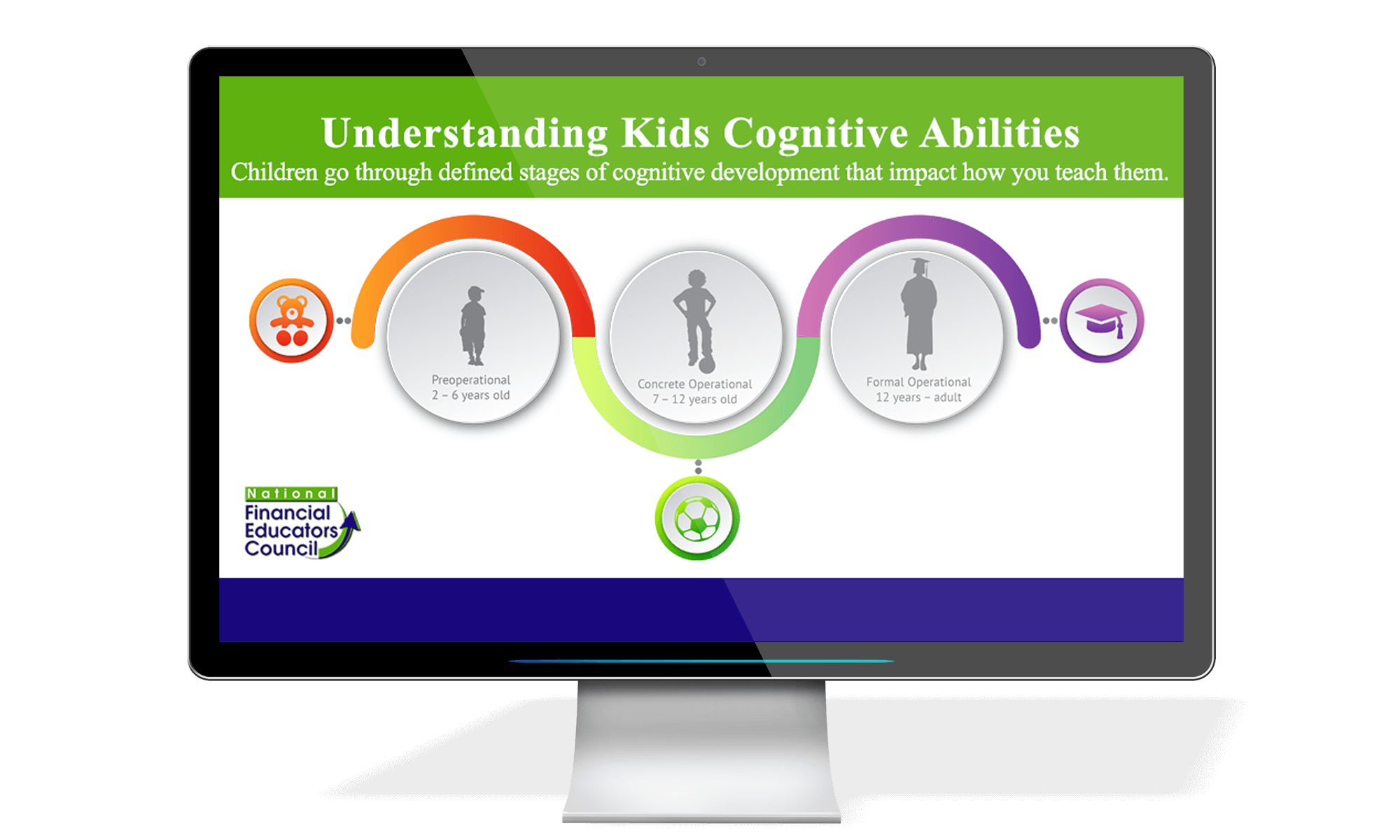
The personal finance assessments were developed using Piaget’s Theory of Cognitive Development as a model and children’s understanding of key concepts – separating material based on cognitive abilities (pre-operational ages 2 to7, concrete operational ages 7 to 11, and formal operational for those older than age 11).
Above age 11, the learning barometers were separated based on students’ math abilities and understanding. In the 7th and 8th grades (ages 11 to 14), students are learning skills that are essential to making fundamental personal finance calculations, including negative numbers, rates, decimals, and basic statistics needed to solve personal finance problems.