
Kansas Financial Literacy Standards and Mandates: Academic Alignment Review
This page presents a standards-based evaluation of Kansas’s financial literacy requirements relative to the minimum structural, instructional, and accountability standards routinely applied to required core high school academic subjects such as mathematics, science, and English/language arts.
The analysis examines whether Kansas’s state-governed financial education policies are designed, implemented, and supported at levels comparable to other foundational disciplines. Findings reflect alignment with baseline expectations for instructional rigor, curriculum vetting, educator qualifications, assessment, governance, and sustained program support.
Standards Alignment Snapshot (Kansas)
This distribution indicates structural misalignment between Kansas’s financial education approach and the minimum standards applied to other required academic subjects.
Failing
Overall Classification
Evaluation Scope: 12 criteria
Standards Alignment Distribution

Kansas: Financial Literacy Standards and Mandates Overview
Kansas is implementing a standalone one-half credit personal finance course as a graduation requirement beginning with students who enter ninth grade in 2023-2024, with full implementation by the Class of 2027. The Kansas State Board of Education updated the graduation regulation (KAR 91-31-35) to require students to complete a 0.5-unit financial literacy course before graduating from high school.
According to the official Kansas State Department of Education (KSDE), it is a distinct half-credit course (0.5 unit) with the specific course code 22990: Financial Literacy (Employability and Life Skills). The course description explicitly presents it as a dedicated financial literacy course focused on key topics like earning income, spending, saving, investing, managing credit, and managing risk.
The Kansas State Board of Education is directed by statute to develop and assist in implementing personal financial literacy programs and curriculum standards within existing subject-matter curricular areas. Source.

Kansas Financial Literacy Programs in National Context: A 50-State Academic Alignment Analysis
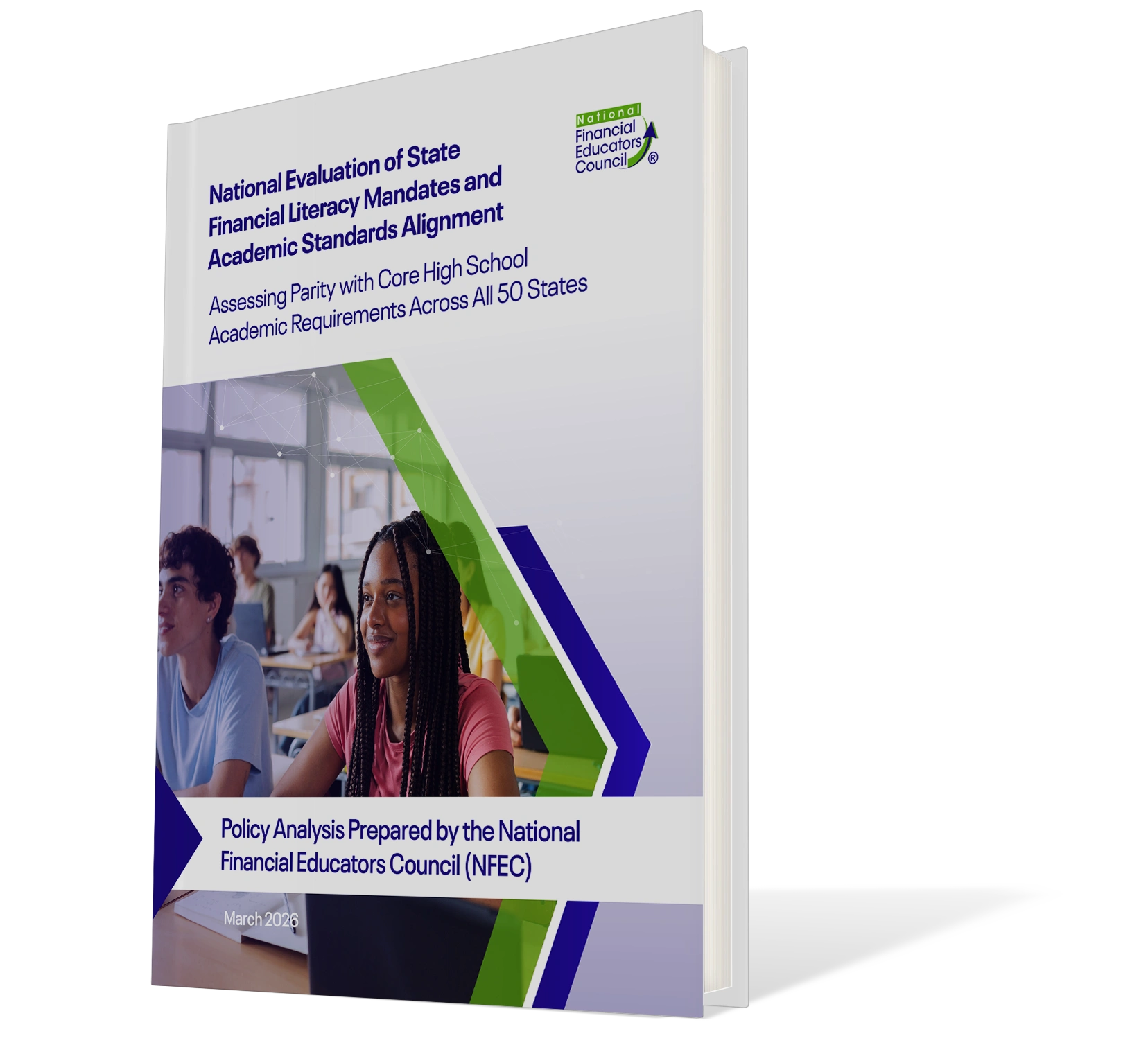
The National Evaluation of State Financial Literacy Mandates and Academic Standards Alignment presents the first comprehensive, standards-driven comparison of high school financial education across all 50 states. It investigates whether state requirements align with the baseline expectations for academics, governance, and accountability that are typically applied to core subject areas. Applying a consistent 12-criterion model, the study assesses instructional depth, curriculum supervision, teacher preparedness, assessment structures, funding, course sequencing, and family involvement on a nationwide scale.
Results from the analysis indicate a broad pattern of misalignment. No state achieves equivalence with established core academic standards, and even the top-performing states do not meet minimum benchmarks. The report supports clear state-by-state comparisons – including how Kansas’s financial literacy standards measure up against those of the other 49 states – and provides a research-based framework for improving financial education through stronger standards alignment, cohesive implementation, and transparent accountability.

Opportunities to Advance Financial Literacy Education Across Kansas
To address the gaps identified in Kansas’s financial education standards, the National Financial Educators Council (NFEC), in partnership with its Kansas Financial Educators Council Chapter, provides a coordinated set of advocacy and policy support resources designed to elevate financial education to parity with other core academic subjects.
NFEC’s mission is to ensure that all learners graduate prepared to navigate real-world financial decisions by elevating financial education to the same level of quality, accountability, and instructional integrity as other required core academic subjects.