
Iowa Financial Literacy Standards and Mandates: Academic Alignment Review
This page offers a standards-based assessment of Iowa’s financial literacy requirements in relation to the minimum structural, instructional, and accountability expectations commonly applied to core high school subjects such as mathematics, science, and English/language arts.
The analysis evaluates whether Iowa’s state-directed financial education policies are developed, implemented, and supported at levels comparable to those of other foundational academic disciplines. The findings consider alignment with baseline expectations for instructional rigor, curriculum review processes, educator qualifications, assessment practices, governance structures, and ongoing program support.
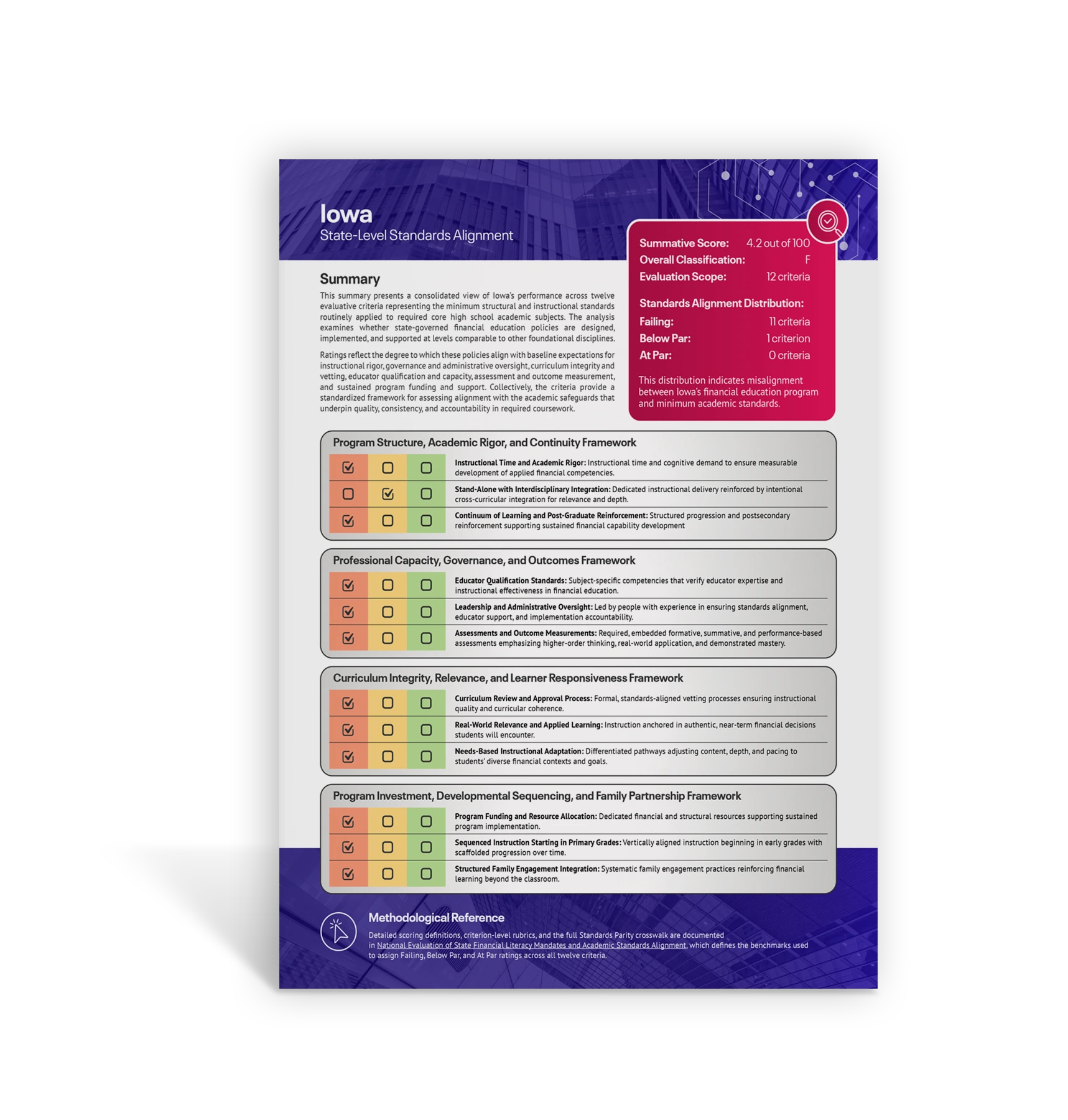
Standards Alignment Snapshot (Iowa)
This distribution indicates structural misalignment between Iowa’s financial education approach and the minimum standards applied to other required academic subjects.
Failing
Overall Classification
Evaluation Scope: 12 criteria
Standards Alignment Distribution
Iowa: Financial Literacy Standards and Mandates Overview
As of 2026, Iowa requires a standalone personal finance course for high school graduation. Iowa enacted a statewide graduation requirement mandating that students complete a one-semester personal finance course prior to earning a diploma. This requirement applies to students in grades 9-12 and is codified in Iowa law. Source.
Iowa’s statute establishes required instructional coverage in areas such as income, money management, budgeting, credit, debt, saving, investing, insurance, and financial decision-making. While the course is required statewide, the law does not establish educator qualification requirements, require vetted curricula, mandate performance-based assessments, or include statewide outcome reporting tied to student financial competency. Source.

Iowa Financial Literacy Programs in National Context: A 50-State Academic Alignment Analysis
The National Evaluation of State Financial Literacy Mandates and Academic Standards Alignment presents the first comprehensive, standards-driven comparison of high school financial education across all 50 states. It investigates whether state requirements align with the baseline expectations for academics, governance, and accountability that are typically applied to core subject areas. Applying a consistent 12-criterion model, the study assesses instructional depth, curriculum supervision, teacher preparedness, assessment structures, funding, course sequencing, and family involvement on a nationwide scale.
Results from the analysis indicate a broad pattern of misalignment. No state achieves equivalence with established core academic standards, and even the top-performing states do not meet minimum benchmarks. The report supports clear state-by-state comparisons – including how Iowa’s financial literacy standards measure up against those of the other 49 states – and provides a research-based framework for improving financial education through stronger standards alignment, cohesive implementation, and transparent accountability.


Opportunities to Advance Financial Literacy Education Across Iowa
To address the gaps identified in Iowa’s financial education standards, the National Financial Educators Council (NFEC), in partnership with its Iowa Financial Educators Council Chapter, provides a coordinated set of advocacy and policy support resources designed to elevate financial education to parity with other core academic subjects.
NFEC’s mission is to ensure that all learners graduate prepared to navigate real-world financial decisions by elevating financial education to the same level of quality, accountability, and instructional integrity as other required core academic subjects.
Standards and Policy Resources
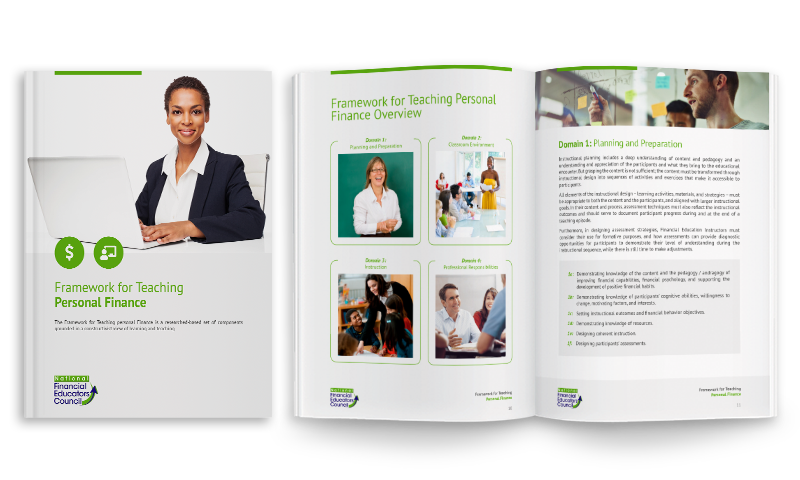
NFEC offers comprehensive financial literacy standards and policy guidance, including the Framework for Teaching Personal Finance, learner outcome standards, educator competency frameworks, and national research on financial education across all 50 states.
Advocacy Committee Engagement
Stakeholders are invited to join NFEC’s Advocacy Committee, which convenes educators, community leaders, and policy stakeholders to advance standards-based reform and align financial education with established academic expectations.

Video Review of Iowa’s Financial Literacy Standards
Watch the video reviewing Iowa’s financial literacy standards presented by the NFEC’s CEO Vince Shorb.
Thank you for joining as I review Iowa’s financial literacy mandates and standards. When we review these standards, we look at two key things. One is, does it meet the minimum education requirements of other core subjects like math, English, science? Does it meet those minimum education requirements, those research-based education principles? Is there alignment rooted in traditional education methodologies? Second thing we look at, Do students graduate prepared to make near-term financial decisions? Things like moving out on your own, what to do when all the credit card offers come, how to decide on college. Does it help them address those near-term financial challenges? Now, not to spoil the ending, but sadly, Iowa’s fail across the board. very poorly done, a lot of problems with that. I’ll get into specific details. I always like to thank those that have actually gone through the process to go through the legislation, go through the administration. It’s a challenging process, but now that there’s at least a half semester mandated and required to take, now it’s time to elevate those standards my hope is this will serve as a guide to ensure that all the students in Iowa graduate prepared and confident to take on financial challenges that come with life. Now let’s dive in to the bill first. Now there’s a few components we look at. We look at what happens on the legislative side and then we look at what happens from the school administration side. So typically politicians tell the schools here’s what you have to do and school’s role is to improve prove that, shape that so it actually delivers outcomes. We’ll get into this. As you can see, it does require students to take a half unit of personal financial literacy, which is about sixty hours or fifty teachable hours. And really with fifty teachable hours, it’s kind of tough to learn. That’s not even a work week for most people, right? Fifty hours in total teachable time. Now let’s dive into what the bill says And if we look down here, section twenty, it really just lists out and it gets a list of ten different, I’m sorry, nine different bullet points. All it lists are things that must be taught. So it says, at a minimum, it must address the following. and then it lists a bunch of random topics or random selection that aren’t even well organized. Now, from the legislative side, I think it’s horrible when politicians just list random topics that don’t apply. I’ll touch on a few. But from the school administration side, their role is to improve this so it makes sense and so teachers can implement. We’ll review that in a second. But from a legislative side, If we look at line item one, savings, including emergency fund purchases and wealth building. Okay, that kind of fits, maybe. Then it gets into a very advanced topic, investments, diversification, liquidity, CDs, money markets. That’s way too advanced for students in high school. They’re not going to be able to apply that in the near term. Now, section three, wealth building, tax favor plans, individual retirement accounts. Again, very advanced. So two of the three are very advanced. Now we get into credit and debt, some basic things that’s there. But look, the next one is consumer awareness of the power of marketing and buying decisions, including zero percent offers, marketing methods, personal selling. It lists how to build credit in here and how to build credit score. Wouldn’t that fit better in line item four that’s titled Credit and Debt? So it just goes to show you, and this is a common theme throughout this review, things are just so disorganized, it makes absolute no sense. For an educator, it makes it very tough. But again, the role of the school administration is to help to craft these so it makes sense. We look later, financial responsibility, wealth building, there we get into budget, negotiation, again, some random things. Then you get insurance, risk management, income and career. And then they go on to list a bunch of items. Sorry, I was behind on my slide. A bunch of items that have nothing to do with insurance or risk management. They just save those topics. And then a bunch of things focus on income and career. So if I’m a teacher, all I have to do is say, you know, to manage your risk, insurance can help. And I would fulfill that obligation that they say here. And it should be separate, right? Income and career is completely different than insurance or risk management. I don’t know why they grouped it that way. And now below on number eight, different types of insurance coverage. Shouldn’t that be down there? Again, I don’t know who did this. And then in number nine, just some ridiculous things. Like they’re wanting to teach, you know, seventeen, eighteen year olds about reverse mortgages. For those who don’t know, reverse mortgages are for older people that are getting payments based on their equity in their home. So they’re not going to need it for fifty or sixty years. And they’re doing some training on some advanced topics there that’s not needed. Overall, from a perspective of the legislative side, Weird, it’s just a random list of unorganized topics. I’ll bet you I could put these topics in the chat GPT and say organize these in a way that makes sense where things relate together and it would do a better job. Absolute failure here. And they say nothing about teacher training. They say nothing about other requirements. All it says is a half unit and personal finance. And it has to at minimum address the following topics, at minimum. Remember that later because this is important. I’m going to show you how the school has failed, the admin has failed to do that. The one positive thing from the administrative side, They had everything in an easy to find format. Iowa Department of Financial Education, Financial Literacy Instruction, they had everything easy and organized. Typically when I’m researching these various bills and the standards, I’m searching all over the place. Texas was horrible. They had so many things outdated from five and eight years ago, it was hard to decipher, but thank you, Iowa. You made my research easy. So whoever designed a page with all the key things there, thank you for that it made life easier so that’s that might be the end of my compliments here what we’ll see they get into overview i do like this they gave an overview of of what it is and you know just saying hey what what bill was um it required a half year to gra half a semester to graduate um and just some details you know nothing nothing too major there but again gave gave some details now The financial literacy guidance, this basically just copied what was in the bill, right? So this thing put out by the Ohio Department of Education, it just copied exactly what was said in the bill. Now, I think this is a huge missed opportunity because they did no reorganization, no helping to teachers to define this, it’s just listing what’s in the bill. And the bill is super confusing, especially how topics are arranged. it makes no rhyme or sense nothing matches together and if you’re teaching class it’s really important to enhance learning by combining those topics that are related together how the brain works is like a computer we’re filing things into logical order and if we’re just kind of teaching insurance here then income here then reverse mortgage is here it doesn’t make sense for the brain people aren’t going to learn and does a bad problem in addition what do they list sixty seventy items here to cover in fifty teaching hours it’s not possible to make to get all these things taught so a big issue with that I’m going to spend a lot of time on the actual So I like the fact that they started with a framework and standards. So this is very good. I’ll highlight some of the problems too, but at least they have the right idea. You start with a framework and standards that help teachers and provide them that guidance in the processes on what a class should look like. And they also use a framework that I’m very fond of. They had a lot of mistakes there, but it was a good thing. But on this first page, one thing I want to point out that I do like is they’re looking at overall trying to give people real life skills. I like these civic literacy, employability skills, financial literacy, health literacy, technology literacy. I think that is all needed in today’s age now. I did look at their employability skills section, too. I’m not gonna cover it here, but I think that is part of financial literacy, really. Now, they had forty different things that they’re going to teach, and creating a resume, practicing interviewing, knowing how to interview wasn’t covered. It was more soft skills once you have the job. but how could you teach employability skills without having every student leave with a resume, knowing how to complete a job application, knowing how to gather references, knowing how to practice interviewing. If you don’t have a good resume, if you don’t know how to interview, you’re never gonna get a job. I think what they were teaching in that class was good. It was about teamwork, how to communicate with the boss. All that stuff’s good, but they missed the most obvious thing, which was actually getting the job. So I do like their thought. I think there’s way off on the implementation. So, a problem there. But the rest of this will focus on the financial literacy component because that really is what we’re here about. But again, I consider income a part of financial literacy. Just for the sake of time, I’m not gonna go into that employment literacy. Besides the fact they’re missing a key component. Now, in terms of financial literacy, I want you to focus on the bold text here. Each student in Iowa schools will learn financial literacy concepts. enabling them to succeed in a complex global environment. I don’t think that’s a good mission statement. First off, I don’t care if they learn financial literacy concepts. I care that they feel more confident making financial decisions, have a plan and path, have basic knowledge, have adjusted their behaviors to reach their goals. So I don’t like this mission statement. I think anytime you set a mission statement, it needs to be very clear and concise. That gives a teacher and those teaching this an overall vision of what they’re trying to accomplish. But, you know, it is what it is. Minor detail. But now we get into the real meat of the matter. In here they have one, two, three, four, six pages of standards that are going to be outlined. Now, one thing very critical, in these six pages of what they’re, in these standards or what they’re teaching, they’re telling the teachers need to be taught in the different levels. So the quadrants down below, let me explain those first. The quadrants relate to Bloom’s or Webb’s Depth of Knowledge. It’s basically a learning hierarchy. So at the lowest level, you have remembering, understanding, recall, reproduction. Those things are easily forgotten, right? It’s like memorizing what does ROI mean, right? At the highest level, we’re creating and analyzing. And these quadrants really define, so it starts here at Quadrant A. It’s written kind of weird. You go Quadrant A, Recall, Reproduction. This next level, you’re looking more application. Here, it should be more complex items. And then up here, it should be the highest order thinking skill set. So it kind of goes in this order, which is kind of strange. Academia just throws some weird things on. I think it’s just easier to go in this standard order, but I know this is how it’s written oftentimes, but again. So they have at least a framework there. The problem is when I went through these six pages, reviewed all of the standards, the line items, it did not cover what was required by the state. So the state said very clearly. At minimum, they must address the following and list off all those topics. I remember reverse mortgages, emergency fund, diversification. See, they missed about the thirty percent. So if I’m auditing their application of what they’re told to do and what they get funding for, they would completely fail the audit just because they have not met the only thing it tells them to do. At minimum, address the following. And they fail to do that about on thirty percent of the topic. So a major miss there. I don’t know how they could have missed that when they’re told. Now, personally, I don’t agree with what the legislation told them to teach, right? I don’t agree with it. But they missed some key things. They missed emergency fund, right? How do you miss emergency fund? That’s a key component. So some issues there with that. But let me break down. These standards here, and I’m going to go through this pretty quick, then we’ll go through a rating and see where Iowa ranks compares to its peers. So first off, essential concept or skill, demonstrate financial responsibility and planning skills to achieve financial goals for a lifetime of financial health. Well, a lifetime of financial health, nobody has that. Maybe if you’re a trust fund baby or a wealthy kid, maybe. But nobody has a lifetime of financial health. So we need to adjust that. In addition, what is covered here, develop long-term financial goals and understand need versus want, It has nothing to do with planning skills or demonstrate financial responsibility. So it’s really random. They have this, this overarching concept. That should be the focus. If that’s your overarching concept, every, uh, one of those bullet points should relate to the overarching concept. Doesn’t even come remotely close, even work. Now let’s just break down. So developing short and long-term financial goals, understand the concept of setting goals, evaluate the role of goals play in financial success. describe the impact of goal setting on personal finance success. That’s the same thing as what’s mentioned above. So, okay, that’s good information, right? Understand need versus want. Okay, need versus want. Develop a plan to achieve their most important needs and wants. Explore individual decision to make consumer opinion in advertising. Where does this come from? All right, okay, that might fit. But now let’s look at the quadrants. Quadrant A. Define a spending plan and list key points to consider. Well, nothing was mentioned above about developing a spending plan. This is just new information. All these quadrants should directly relate to the bullet points that are mentioned. So nothing is aligned here. The primary topic, that line and bullet at the top, the bullet points below, those six bullet points below, and then the quadrants, nothing matches. Let me read through these. Quadrant A, define a spending plan. Quadrant B, explain why a spending plan will or will not help you. Quadrant C, prepare a list of short-term goals. Okay, there we go. We have short-term goals. Finally, I came across something I recognized from the bullet points that we’re supposed to be taught. And budget to achieve those goals. Well, budget wasn’t mentioned there. Now they get a little more to long-term goals. Okay, one kind of has some things that have overlap, but it mentions nothing about other things. This is the worst one, Quadrant D, using lifestyle choice, develop short and long-term goals. Okay, that’s good. But then the last sentence there, write a justification for the use of credit and how you will use it and how you plan to repay it. Nothing about credit was mentioned anywhere in there, right? This is the first time we hear about it in quadrant D. Everything needs to be scaled here. So if I’m writing this and let’s say the goal is to, it should be built around goals. So define the concept of short and long-term goals and how that can benefit your life. That’d be quadrant A for me. Quadrant B would be, Start to organize your goals and compare those goals with others in your classroom and make modifications where necessary. Quadrant C would be analyze your goals and start to develop a understanding of what that would cost to achieve. That would be Quadrant C and I’m making this up real quick. Quadrant G would be create goals with timeline and specific things that you’re going to accomplish and when. So action-based, they’re creating the one before they’re analyzing, prior to that they’re starting to apply and compare, and first they’re defining. That’s scalable. A teacher can easily understand, I just built a story. The story starts with defining reasons and goals. Okay, now that I have that knowledge of skill, now I can start to compare and contrast and work toward higher-order thinking skill sets. Now that I passed Quadrant B, now I can start to organize my goals based off what it will cost and what it will take to achieve those. And then Quadrant D, I’m actually creating that plan. It scales. There’s a story. It makes it easy. This is just a random list of things. I don’t know who wrote these. If any of my, we worked with over two hundred people, content experts, so forth, when we wrote standards for educators, learners, coaches, education methodologies, frameworks for schools to implement financial education programs. If anybody on my team or people we contracted with came back with this, They want to be working here. They’d be immediately gone. This is beyond remedial. I don’t want to insult anybody that did it, but I have to. All I care about is the kids. I don’t care about people’s feelings that wrote this. It is so bad. It’s so bad. It’s laughable if it didn’t impact our kids’ lives like it did. There are major misses across the board. They’re not following the guidelines of what the state requires, and nothing matches. It’s all random things put together. Let’s move on. so let’s go to the next one and i wish this was only uh one there but so we’re going to be looking at now we could talk about spending plans well in the last section that was in quadrant b so if i’m a teacher and i’m teaching this they’re gonna never hear about spending plans oh now i’m teaching it shouldn’t this that’s that that uh uh you know i think this quadrant a would work well for this next section, which is spending plans, right? Define a spending plan. I don’t know if they just messed up their Excel or what, but something’s extremely wrong. So let’s look here. We have things about budget and so, main point, manage money effectively by developing a spending plan and selecting appropriate financial instruments, right? that last quadrants were completely off. This is where those quadrants should be. We have a developer realistic spending plan, talking about budgeting, right? We have income, various sources of income, okay? Then we get into financial instruments. All these things are random things. It should not be under the one heading. These should be all separate types of things. Now, financial instruments and recognize the impact of fees and charges, that can be grouped together. That’s all under account management. But budgeting, budgeting the income can fit, but I like to separate those because there are different things we do with income than budgeting. Income is one aspect of budgeting. I think budgeting is more focused on spending, planning expenses. But let’s look at the quadrants. Define a spending plan. Well, we just did that in the last section. So now we did that twice. Okay. Explain why a spending plan will not help you. Okay. Well, now then compare three different, quadrant C, compare three different spending plans to see what’s most realistic. Then using a present income to develop a realistic spending plan. I mean, They’re missing pieces, and there’s no mention of financial instruments in any of that. So none of the quadrants relate to the other six areas or seven bullet points you see at the bottom half. They’re missing that. This should be a separate quadrant for just the top two. Again, major, major basic errors that you wouldn’t see. This might be an intern professor writing these. I don’t know. Let’s look at the next section. Make informed, responsible decision about repaying debt and remain credit worthy. Well, remember in that first one, first page, it said, you know, something about debt. I’m not going to, anyways, maybe it’s the second one. Oh, the quadrant D in the second one talked about going into debt, but we’re not, we haven’t even taught that in the class yet. So here, I’m not going to get too much of that. Credit management, different types of debt. Responsibility as a borrower is okay. I mean, whatever. It’s kind of not organized well, but we continue with that same theme. We have identity theft at top. Evaluate and identify appropriate risk management options, including types of insurance, non-insurance, and identity protection. Well, identity theft, yeah, I guess it’s a risk management strategy, but when it comes to insurance, we mention nothing about risk. There’s no mention of risk here. It just gets into different types of insurance, right? And even in the quadrants, I’m doing a quick scan here, doesn’t mention anything about risk. Nothing about risk. You have to understand risk before you can understand insurance. If you don’t understand risk, why the heck would you have insurance, right? So a big miss there. Again, moving through this, just all over the place. This is mostly investment options. Again, they’re not talking about the majority of things that were required for them to teach. You don’t see reverse mortgages. You don’t see buying a home. You don’t see those things. Quadrant A’s talk about short and long-term goals. Look. Explain short and long-term goals. Somebody had to mix up that Excel. I’m hoping to God that’s the case because if not, they’re so bad at their job, they should be fired immediately. Again, we’re getting a savings plan. This part isn’t about savings plans. It’s about investments. So in the last section they put here is they didn’t find it even important enough to give any quadrants. all of these there has to be consistency these are visual learning cues so when you’re preparing documents like this everything has to match and be consistent in the formats delivered but here it’s just a bunch of random stuff that obviously they don’t care too much about so overall the administration has done nothing to improve what the legislation told them to. They’ve only made it worse. They’re missing items. And again, whoever put together those standards, it’s so poorly done, it needs to be completely redone. Those need to be thrown away and redone from scratch. The core is you need to combine like items together. So there’s a path that, It helps the teacher and learner understand step one, step two, step three, step four. I’m building my skill set step by step so I can understand and get to those higher order thinking skill sets that align with it. If I’m talking about goals and I’m throwing in some random thing about credit, it doesn’t make sense to anybody. So let’s give them some ratings here. You can probably guess they’re not gonna achieve too high of a rating, but I always do, again, I don’t wanna beat up on anybody too much, but all I care about is the kids. The kids are gonna get no value from this training. If you have a great instructor that will take the much needed time to decipher this and combine things and organize things in a format, fine, but if it’s not, done that way by a highly qualified educator we’re going to have problems so delivered in a standalone class and integrated into other subjects it’s a standalone class right so good job but it’s not integrated into other subjects i think there’s a big miss there because it’s very easily integrated into things like math and other areas especially when you only have one semester not enough time and that leads me to adequate time and rigor Absolutely not. And the thing that will hurt this even more, and not, well, fifty hours to cover fifty, sixty, seventy topics is not enough. Additionally, it’s so confusing, it’s not going to be effective use of time. Now, if I have highly organized lesson plans that build on skill sets, I can more readily and easily convey that information in a way that learners will better understand. That’s going to be a better use, but not enough time, not enough rigor. Ongoing education to support long-term outcomes, nothing mentioned at all there. That’s a big missed opportunity. And with financial education, we know the stage of life, so we can follow them. Those kids are going to college. We can prepare them for evaluating their college loan decision, et cetera. Relevant content that prepares students for near-term life events, absolutely not. It’s random, just ridiculous content, reverse mortgages, things that aren’t, the legislature’s told administrators to do and they missed, they failed to do so, major miss there. proven curriculum that works toward higher order thinking skill sets. When I saw the framework they did first, I was excited. I’m like, great, somebody’s taking a rigor framework and applying it to financial literacy, but seeing how poorly it was done, how it didn’t even match the bullet points, horrible. customized lesson plans based on student needs big miss there as well and this is so important because people of different socioeconomic status we need to teach differently i started teaching in orange county california and la and santa ana those were kind of my areas i taught that’s where i lived On one side of Warner Avenue was the Santa Ana School District, very poor, sharing books, you know, everybody, you know, most paid lunches, you know, government paid lunches. The other side was Orange County rich, right, wealthy. So in Santa Ana, these young people had no hope for the future, but they knew a lot more about budgeting, delayed gratification, had those skill sets. on the wealthier side they had a ton of hope for the future but they lacked basic financial knowledge so the kids in the lower income area were actually much better with their finances it’s just they lacked that hope so we need to adjust our teaching styles to accommodate um and i did see that was interesting because one day or on the same day i would teach both areas or on on a few different days separated by uh hours i teach uh different areas it was interesting to see that back to pack Course led by highly qualified educators? Absolutely not. There’s no teacher training required on anything. And every, All research points to having highly qualified and competent teachers deliver the training. What’s even worse, when you give underqualified teachers garbage, like what we saw with the standards, and I’ll say garbage, it’s that bad. Probably one of the worst I’ve seen. They had good framework, but they completely blew it. When you give them that, it’s gonna make the class so hard, so difficult, and bad. Program development deployed by management and experienced leaders, obviously not. Anybody that would approve those framework and standards, there’s absolutely no way they have any experience teaching personal finance education. Very little mention of behaviors, sentiment, other factors that are important. And the same thing goes into the measurements. no mention measurements i’m sure there’s a post test but better indicators of people adopting these habits include completion of real world activities helping them improve behaviors helping them improve their sentiment simple questions like since you started the course have you changed in your financial behaviors to be more positive And you can grade that, right? So there’s some easy questions we can do to actually determine if there’s a benefit or if it’s just a fifty hours worth of wasted time for these kids. And sadly, I’m thinking it will lean toward that latter part, fifty hours of wasted time. funding although there was no explicit mention there it is in the social studies uh component i’m guessing they’re pulling from that i’ll give them a yellow circle here but um really i like when it has its own funding because these other the social studies and those departments are very ingrained they they have a lot of power in into diversify monies into other subjects where it’s outside kind of their core, it’s often a battle, right? Nobody wants to give in with their budgets. So it’s a battle, so I’ll give them that because there is funding in that department. But I like to see, for those that get green checks, money set aside just for the financial literacy programming. Lessons to start in elementary schools, encourage parental involvement. Absolutely not. What do they get? Horrible. Really bad. Now, this isn’t the worst. We’ve had worse. Massachusetts, for example, scored a zero. Absolute zero. They were having kids learn online stock trading before they learned about debt. And they didn’t even teach them about debt, but they taught them about online stock trading. So we had someone’s lower scores. I think this is an eight point three on our system. Of our top twenty, I think this is in the bottom. I’ve reviewed twenty state standards up to this point. And this would be in the bottom, let’s say, bottom eight, let me say between six and eight, bottom six to eight. of that pack. So a lot of problems there, and we can do better, right? This is a subject that is so important for our youth. We need to do better. Now, we do have guidance for those educators, for those school administrators. We want to help. I just don’t want to beat people up. I want to offer them some support and help. Obviously, we would make recommendations with your staff on who’s doing this, right, whether they need training or need to go, but we have a policy and framework guide for legislatures and school administrators on how to deploy quality programs that actually make a difference. All of those standards that I mentioned, all these things are just minimum education standards required by other subjects. They all have trained educators, they all have funding, they have vetted curriculum, but for financial literacy, they say, oh, we don’t need that, we’ll just put in some random thing and in fifty hours we’ll give them something to check off the list, make the politicians look good, let parents know, hey, we’re teaching our kids about money, and they’re absolutely not. So two things, parents, You are the responsible for your kids’ financial education. Iowa schools, they’re doing absolutely zero to help. In fact, they may do more harm than good with how it’s taught and the quality of the instructor. Second, Iowa, you need to do better. This is an embarrassment. You’re an educational institution funded by taxpayer dollars. So for taxpayers, you should be upset. For parents, you should be upset. For all the kids in school, you should be upset. Again, I don’t want to beat people up, but I do want what’s best for the kids. I do want what’s best for the kids. Other agencies rate Iowa at A rating as far as financial literacy. I don’t know what they’re reviewing. I mean, this doesn’t even become close to meeting minimum education standards. This doesn’t even come close to providing teachers clear guidance on what to teach. This is missing most of the things that are required by the state and the school’s failing to teach. So we have a lot of problems. I hope it gets better. I want to see a world where we graduate youth and young people that are self-sufficient and capable of making near-term financial decisions. Help them avoid the problems I got into. I know many of you did as well when you went out on your own for the first time. And truly, I believe if we dedicate more time, rigor, and have qualified teachers and address those twelve items we cover, our kids will be much more happier, much safer, more secure and live better lives.
Iowa Financial Educators Council
Iowa Legislature – Graduation Requirements
Iowa Department of Education – Financial Literacy
Financial educator qualifications
Certified financial education instructor
How to teach financial literacy
History of Iowa’s Financial Literacy Legislation, Standards, and Mandates
Iowa enacted a statewide personal finance graduation requirement in 2018, becoming one of the earlier states to mandate financial literacy instruction. The law requires completion of a one-semester, standalone personal finance course prior to graduation.
Despite this early adoption, Iowa’s statute focuses on course completion rather than instructional rigor or outcome measurement. No statewide educator credentialing requirements, curriculum vetting processes, or competency-based assessments were included in the mandate. Over time, implementation has been left largely to local districts, resulting in uneven instructional quality and limited statewide insight into student financial preparedness.