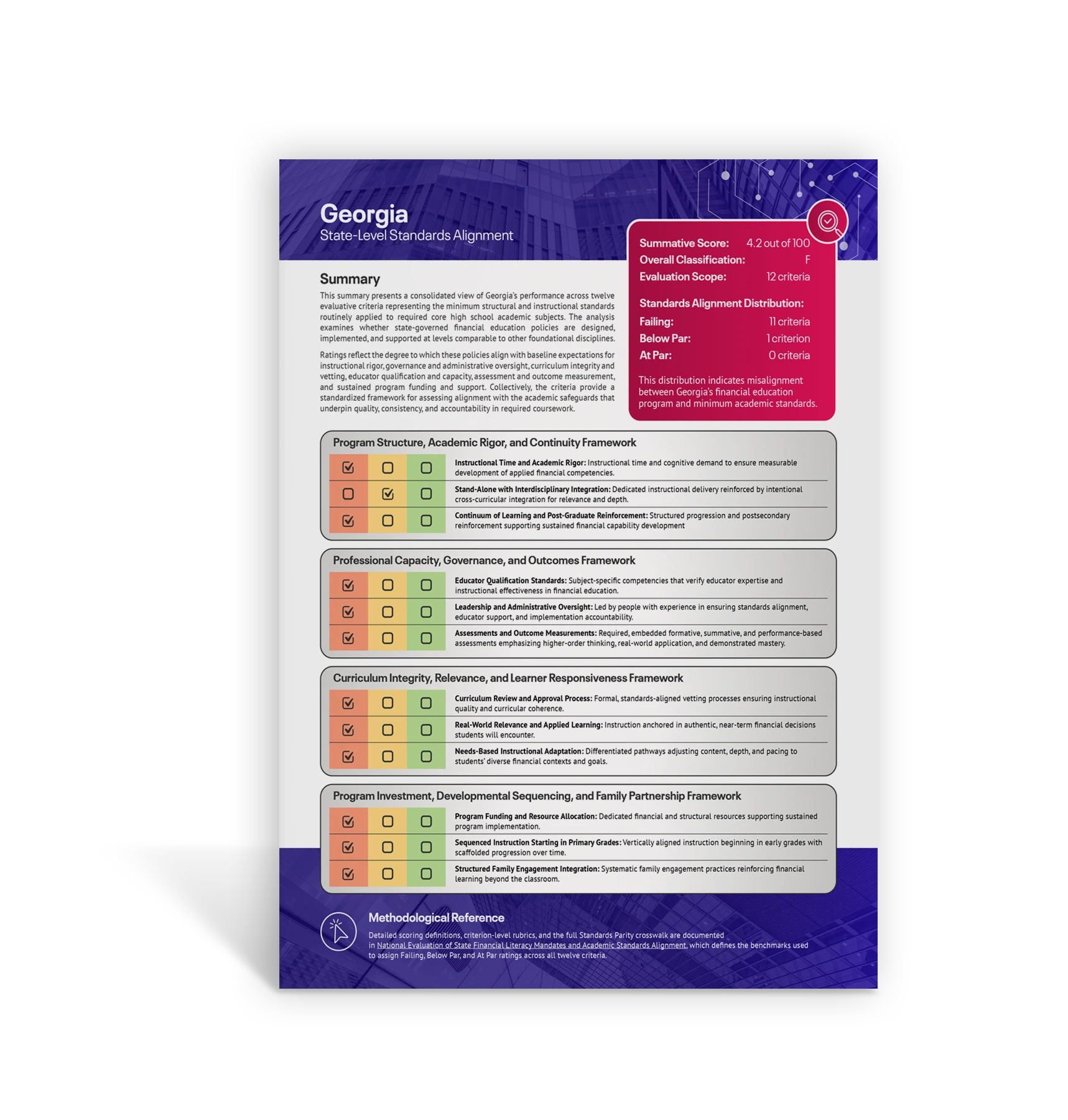
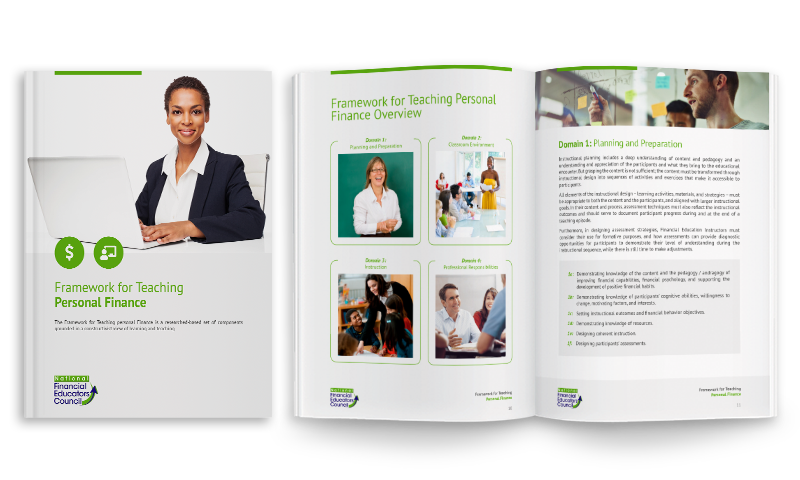
Thanks for joining me as I review Georgia’s financial literacy standards and mandates. This is a comprehensive review that will assess the bill itself and also how the school administration is delivering the programming. With all the bills I review as terms of financial literacy standards, I look at two key factors. One, does it meet minimum education requirements that other core subjects in high school must meet those standards? And second, will it prepare students for near-term financial decisions? With this bill, I do have some concerns. Let’s dive right into it. Now, the bill itself, It’s one of the better written bills out there. And a few key things I like to highlight here, and I’ll explain why I like this bill and why it’s a little better than most bills that I’ve seen out there. First, it says the students in eleventh and twelfth grade must take a financial literacy course. And I like that they limited that to eleventh and twelfth grade because they’re going to be able to apply what they learned in the near term. A lot of the bills out there say anytime in a high school career, ninth, tenth, eleventh, or twelfth grade, they can take it, but I like if we only have one semester to do it later in the year so they’re prepared in a timeframe that they’re more apt to make, to actually need the information to apply it to their decision making. I also like to point that they started with establishing standards. Here we see in line three, require the State Board of Education to establish content standards. and allow such course to count toward various subject matter math social studies or elective so that’s good i like that they’re establishing standards first that’s with the education practice of backwards design you start with standards then you build the curriculum or select the curriculum based off that i also like the fact that they mentioned a professional standards commission to establish procedures and provide for qualifications for teachers Very critical. Teachers are the most important aspect of student outcomes. I’m glad they mentioned that in the bill. And they go on with additional standards here. The next page is important as well. Line item twenty-two. Each year, each local board of education shall require all students to as a condition of graduation to complete a financial literacy education course so it is mandated they get a half credit which is wonderful to start I’m a big believer in four years of financial education but that’s at least it has its standalone class there and they also mentioned some other minimum standards and once again mentioned professional development for the educators and let’s see here. So as we can see, this is what they need to meet. They need to, for the educators, they have to have teaching credentials and also a special certification to teach financial literacy education. The other parts of the bill that I like are things that are not mentioned. And the things that are not mentioned are things like specific topics to teach. what to teach, how to teach, because it gives the administration freedom. Oftentimes we see politicians with ideas of what they want taught, and most of the time it’s a random selection of topics. So from Bill’s perspective, I think it’s okay. I mean, I would love to see four-year requirement. I’d love to see more in-depth and higher rigor required of the bill, but most bills pigeonhole the administration into these random requirements that don’t facilitate good outcomes for students. So at least with this bill, it’s saying, hey, we need to have standards. We need to have professional instructors to teach, and it’s a mandated course. So from that perspective, good job. Now let’s dive in to the implementation. And I’m going to start with the professional standards piece because this is critical. So here we have what is provided here as far as the financial literacy endorsement. What you need to teach personal finance. And again, you need to have a four-year or five-year teaching certificate. So you need to be a professional teacher. I don’t necessarily agree with that. I don’t necessarily disagree. Typically, teachers unions have an influence on that, which is fine. They also must complete a approved financial literacy endorsement program. Wonderful. Specialized training in the subject they’re going to teach. Just like if you’re teaching math, science or history or anything else, you need to have specialized training on that subject matter. Most states don’t require it. Nice job here on requiring that by the people that wrote a bill It meets some standards of conduct and follow procedures. Now, we’re off to a good start with teacher training, but let’s see what the GAPSC approved financial literacy endorsement program looks like. Now, from the start, it looks good. from University of Georgia. Financial literacy endorsement program, it says this is good for those teaching grades six through twelfth, so sixth through twelfth grade, even though with the bill it’s only eleventh and twelfth grade, it sounds like it’s gonna be expanded to a greater thing, and this would meet the standards that are required to teach personal finance in the classroom, so that’s good. Off to a good start still. Now, Let’s look at the curriculum you need to obtain the credentials to teach personal finance. Absolutely horrific. When I saw this, it doesn’t even match what they should be learning. First off, all the subjects here are way too advanced. They’re not required to teach these subjects in the standards we’ll cover next. And it’s only fifteen hours. So what they have them going through. And additionally, there’s no prerequisites except for they have to have a bachelor degree from a university. They have to have their teacher credentials. And that’s the only admission requirements. They don’t have to have understanding of personal finance or be in the space. All they have to have is teacher credentials and basically meet the admission requirements. That’s it. So no prerequisites. And yet we’re jumping right to three. And it’s only fifteen hours. First, we’re teaching economics. Well, that’s not financial literacy, right? Why do you teach economics to a financial literacy instructor? It’s not, we’re not teaching economics here. This is financial literacy credentials. Then we jump right into advanced wealth management. Not basic. Not the basic needs that the students will need. No, advanced wealth management, advanced retirement planning and employee benefits. They’re not even working yet. Advanced financial counseling and client communications, financial planning and analysis. These are super advanced topics. If you’re going to have any amount of competency on this level, it’s going to require years of study, right? Additionally, it doesn’t match what they’re going to be teaching students. It says nothing about helping them build a foundation, helping them understand credit, what happens when all the credit card offers come in the mail, helping them learn how to budget, move out on their own. These are advanced wealth management. The kids that they’re teaching aren’t going to be investing in stocks. They’re not going to be building a long-term financial plan. They don’t need to understand employee benefits. The requirements of what the teachers are learning do not match what they’re told to taught. And I’ll get into what they’re told to taught now, but this is a huge miss. And I can’t believe that this commission would approve this type of bill or this type of training. It makes absolutely no sense. And this is, again, the Professional Standards Commission. Have they never… picked training that matches what they’re gonna be teaching, this is an obvious miss, and it’s so poorly done, it just baffles me that they would select these topics as the curriculum to teach high school students about money. Advanced wealth management, come on. Advanced retirement planning. You gotta be joking me. I don’t know who reviewed this, but it’s like teaching somebody a subject that’s completely unrelated to what they’re teaching in the classroom. Professional development needs to be built out around what they’re teaching these kids in the classroom. So this teacher training is a complete fail, and it’s really upsetting to me that they would train these teachers on these concepts that doesn’t even apply in the lesson plans, right? Let’s dive into lesson plans now. I think you’ll see how absurd what they’re requiring teachers to learn versus what they’re actually supposed to teach. So let’s dive into the actual learner standards here. And again, you’ll see kind of overview here. Students will learn personal finance skills, they can apply to their futures, managing and balancing budgets, understanding building credit, protecting against identity theft, consumer protections, understanding tax forms, student loan applications, pay stubs, right? Tell me, how did any of that covered in those topics? It doesn’t. It’s a complete mismatch, and whoever approved this course to teach these subjects, I don’t want to insult them too much, but it baffles me. They either have a friend in places, they might just never have done this before, they just have so much on the list, they just signed off. I don’t know, but I think it’s a major miss. And if one of my education staff came to me with something this far off, I’d fire them immediately. They would be gone immediately because it shows that they’re not looking at the content they’re going to be teaching and what skill sets they need to have. The skill sets a teacher needs to have here is understanding the behavioral finance, understanding the challenges youth are going to face, understanding the basic components of money, how to teach using education methodologies and explain things in a way that motivates students to gain reasons and want to learn. That’s what they need to be teaching a major miss there. And if I sound upset, I am, because the teachers are the most important thing that determines student outcomes, and the failure of that professional standards commission, whatever they call it, will negatively impact every single student. Let’s move on to the standards breakdown. And again, the first here we see here, analyze major life decisions using economic-based decision skill making, right? So the first one, let’s get into this. The way the standards are done are so haphazard. They’re so all over the place. It’s really, if I was a teacher in Georgia school district, I would have very hard time understanding these standards. It’s all piecemealed together and nothing is cohesive. Let me show you this example here. The first standard they have, Apply rational decision-making model to evaluate the cost and benefits of post-secondary life choices, college, technical, military, et cetera. that might be fine as a standard at some point but the they need to have explored careers and have a how are they going to decide and apply a rational decision making model if they don’t know what careers are out there what opportunities are out there what they’re paid and if you skip ahead to line item eight c we’ll get to there later it’s about evaluating job and career options but before you evaluate loan decisions, or I’m sorry, decisions on evaluating costs and benefits of post-secondary school, you need to know what direction you’re heading, right? And that’s the big problem with schools across the country. from elementary, high school, and even college. There’s no career planning. So that’s a big miss. And only having one piece on the career model late in the standards is a big miss. Again, that’s just one example of that. If we look below, we have just some random topics listed. Evaluate the cost on how to pay for college tuition. which is fine for people that are going to college you know identify FAFSA for how to fill out FAFSA forms which is great for about half the people that go to college in Georgia Apply rational decision-making of major life choices, renting versus buying a home, right? It’s really random and haphazard. They could easily build standards around life stages. This way your brain can categorize and it’s easier to learn. And that’s how, if you think of your computer, it’s exactly how your brain works. There’s files and we’re categorizing things. We know where to go to find the information we need, just like a computer. That’s how our brain works. When standards are written haphazardly, just jumping from FAFSA to rent and loan forms and all this, students can’t categorize it, and it makes it very difficult for teachers. Instead, they could have built the standards around how to move out on your own, right? Here’s what you need to know. Here’s the process, procedures. We know where to categorize that. So a big miss there as far as organization. If we skip ahead to the next slide here, We have analyzed income as a scarce resource that can be allocated effectively through budgeting. So we have them comparing different types of income, reviewing, completing tax return forms, understanding basic pay stubs of gross pay, net pay, etc. All decent information, right? Not bad information. But shouldn’t they know how to get a job, complete a resume, know how to interview, know how to shake hand, know how to go dress properly for an interview, know how to follow up and what to say? That should be, you don’t need any of this stuff if you can’t get a job. And through all of their standards, they mention nothing about how to get a job, they mentioned nothing about resumes, they mentioned nothing about how to practice in your interviewing, any of that. So they’re talking about things that you would need only if you could get a job, but they skipped getting a job. Now I’m not saying knowing this information is good, but they should focus on the core most important and urgent needs now. Later, once they get a job, they can figure out where their pay stub goes. They can ask HR, et cetera. But if we have limited time, only one semester, it needs to focus them on the most important things. And being able to earn income is important and urgent. And again, they missed that and they replaced that time they could have spent with random information that isn’t so critical for them at that stage. So again, another big miss. again here below analyze the basic components of personal budget well why don’t we have them complete a budget right complete a budget for not only now but for when they move out on their own that would have a lot more importance than just being able to analyze the components what is there to budget income expenses savings that’s a budget wow i know that how is that going to benefit a student having them complete a budget now, and also when they move out, that would be a much more valuable thing to learn. There, let’s see what we have next. Okay, financial systems. Again, we get into the roles and functions, comparing services offer, compare and contrast debt, cash, debit cards, credit cards, et cetera. Now, why wouldn’t that, why don’t we have them, what bank accounts to open, how to open up a bank account, and what you need to set up your automated bill to pay to protect your credit. Instead, we’re getting into just memorization of random things, right? How to choose a bank that’s best aligned with your needs, how to evaluate fees, et cetera. What accounts you need to open early, um in in in that are the really the backbone of your finances checking the savings account is the backbone of of your financial accounts they skip that again they add some advanced topics evaluate risk and return of various uh you know investment options right stocks bonds five twenty nine accounts describe the role of speculative investments Again, they’re not gonna be needing that unless they can earn income, budget, have the proper account set up. So this isn’t needed now. But the funny thing is, all of that teacher training, this entire fifteen hours of subpar training that doesn’t match anything, the only two line items that this may help with, out of the forty or fifty line items here, is three D and E. That’s it. The rest of the training does not apply. Huge miss there. Let’s continue. We’ll go into explain interest rates affecting various consumer decisions. Okay. You know, it might just be, you know, what to expect with credit card offers, you know, how to avoid debt issues and so forth. If they’re avoiding debt, the interest rates and so forth will have less of an impact. I think it’s important to cover compounding interest. It kind of excites people. I think it’s important to know some basic details there, but it should be a little more important. Again, we get into this next one, which is five A and B. It’s talking about, again, different types of income, different types of taxes. Well, they still don’t know how to get the job. They still don’t know how to interview. We’re jumping ahead of the game. There again, another big miss on the part of who wrote these standards. We get into, let’s see, risk management and assurance. I don’t need to get too much into there. We get into the describe how earnings of workers are determined in the marketplace. Great, again, identify skills, social media footprint, evaluate job and career opportunities. I think those are great, especially that evaluate job and career opportunities. I think a lot of time needs to be spent there. Most kids will go pick a college pathway And they’ll switch. Most kids switch majors once they enter college. It would cost them time and money. And a lot of kids enter college that don’t need college, right? So it’s really important to do that career exploration very much in depth. I’d say at least a year of career education through the course of high school would be critical because otherwise nobody can explore what they want to do, find their strengths, align their strengths with the income that they’re looking for. and select a career that best matches their goals so we have a big problem there and again um you know all these the skill development i understand but it should be focused resume get a job right and lastly explain you know protection against identity theft yeah i think it’s important to know especially today but if you look at the language use here describe describe describe describe um identify, describe, evaluate, which is a very advanced term. Let me show you what this means. So this hierarchy of the taxonomy of higher order thinking skill sets, every teacher knows this. Most of the terms they use are very low order thinking skill sets, describe, identify, et cetera. And when you’re just focused on low order thinking skill sets, They may be able to pass a test, but they’re not going to be able to apply it in their life. We need to get them to the creation and evaluation stage. Now, when they did say evaluation on the job and career opportunities, they have to understand, the people that wrote these standards need to understand to get to that stage requires we build a foundation. of other knowledge so they can evaluate successfully. You can’t just, you can’t just, you know, you have to help them and that takes time and effort. So if they’re only allocating, I think there was like, fifty something things that they had to do, forty or fifty line items they had to teach, you need to make sure you allocate enough time because if you don’t have enough time and rigor, you can’t get them to that evaluation stage. So I can’t just do an hour class and get them to a stage of evaluation that’s very meaningful. This would need to occur over multiple, multiple classes and take more time to get there. So again, a lot of what they’re mentioning here, low order thinking skill set. So let’s dive into the overall review. And I’m going to review this on twelve different factors. We look at program structure, lesson plans, educators leadership, program support. and I alluded to a lot of areas that I feel they’re missing out, but let’s look at this. So first one, and there’s three real ratings, Red X, Yellow circle and green check. Green check, good. Yellow circle, okay. Obviously, red X, fail. If we look at if it was delivered in a standalone class, yes, kudos to them. They did mention replacing other, accounting for credits of other classes, but they did not mention integrating it into other coursework, where like if you’re teaching a math class, you’re including financial literacy, calculations, et cetera in there, so they get a okay there. Assign enough time and rigor, absolutely not. The rigor, they’re using low order thinking skill sets. The time is only one semester, not enough. In addition, just because the standards are written so haphazardly, it’s gonna be very hard to deepen the level of knowledge students have on one area because not cohesive we’re not helping them you know with a life stage move out on your own helping them with you know those core things how to manage your protect your set up the right accounts to protect your overall finances credit you know the automated bill pay protect your credit etc so big fail there Ongoing education to support long-term outcomes, no mention of that. I haven’t seen a state mention that yet, and it’s a huge missed opportunity because they have all their contact information. They can follow up with education even after they graduate. I don’t know why schools fail to do that. It’s like, okay, you graduated. You’re not our problem. We’ll try to upsell you some memories and some rings and stuff like that, but we’re not going to continue the education in any form or fashion. A big miss. Relevant content that prepares students for near-term life events, absolutely not. And in fact, the teachers aren’t even trained on preparing them for near-term life events. Adopt proven curriculum that encourages higher order thinking skill sets and application, absolutely not. As I’ve shown with the language they’re using, And there wasn’t mention of curriculum, it’s just meeting certain standards. So there’s no, they’re not adopting proven curriculum that is geared to meet standards. In fact, their standards are so haphazard, any curriculum out there, people would have to be jumping from one to another and kind of checking off the list in a very random format, which is very strange how they wrote those standards. Customized lesson plans based on student needs, no mention there. Every student’s different, right? And I see, when I started teaching, it was in Orange County, California, one side of Warner Avenue, very poor school district, Santa Ana. These kids had very little hope for the future. They knew a lot about budgeting, a lot about delayed gratification. On the other side, Orange County, they have a lot of hope for the future, little knowledge of budget, little knowledge of delayed gratification, other things. That’s just one example, but it needs to be customized. Another area, they’re teaching all kids on the student loan aspect, the FAFSA forms, the, you know, choosing a college where a lot of the kids, it won’t apply to them. You know, Georgia, I think it was either a forty to fifty percent don’t go to college, right? They don’t go to college. So for that forty to fifty percent, it’s completely wasted information they may be going other positive routes trade routes welding etc other plumbing other high paid jobs so they need to customize it based on the student needs especially when you have limited time Courses led by highly qualified educators, absolute fail there. And the reason I’m so hard on them, most states don’t require any training for the educators. The reason I’m hard on them is they missed an opportunity. I don’t know who approved that, who approved the the train the trainer, the lesson plans compared to what they’re teaching students. It doesn’t match at all. It’s absurd. And this is probably the biggest fail I see because now you have teachers that think they know how to teach, but they’re going to get to the actual teacher and be like, I didn’t learn any of this in this fifteen hour class I took. In addition, fifteen hours is not enough to train a qualified teacher. They need to understand behavioral finance. Every student in there has developed habits and behaviors already established. They need to understand the emotions involved with money, how it impacts lives, how to help students develop reasons to learn. That’s the key component of reducing learning loss and having them implement what they learn. Should be teaching students, teach them how to help them work toward higher order thinking skill sets using education methodologies that work, project-based learning, visual aspects for those that the literacy levels aren’t so high, reflective activities, previewing case studies, all these things are critical and unique to financial literacy education. They fail to teach these teachers. A learner outcome focused and assessed, no mention of that. I’m sure there’s a post-test, but again, when we’re looking at indicators of actual benefit for the end user, we need to look at not only content knowledge, behavior, willingness to adopt new behaviors, if they’re more confident in making decisions, if they establish any processes, procedures, or systems that will help them. Those are just a few of indicators that will help us measure the impact of the program. Funding, no mention of funding there, and that’s very common. Most are unfunded. Mandates are pulling from other departments, but what I find is that because financial literacy isn’t very well ingrained in these things. Yes, it’s in the social studies. So they’re going to be pulling from that social studies budget. But they’re fighting with some powerhouses, right? They’re fighting with established programs in social studies. And when you’re introducing a new program, there’s always that battle for money early on. So a big miss there. No lessons that start in elementary school. Habits form early in kids seven and nine years old. It’s critical lessons start early. No mention here at all. And no mention of encouraging parental involvement with that. So overall, where are we? One okay, the rest a major failure. In fact, this one with the training the educators, I’m still upset about that as you can probably tell. It’s just absurd that tax dollars and monies are going to a department that calls themself Professional Standards Commission that can miss that. Anybody that has one year teaching experience would understand that that does not relate. It’s a major fail. And again, if they were on my team, I would fire each and every one of them immediately. So let’s move on from there and we’ll get into, let’s see, I’m gonna go through what we have for them. So I don’t just come with problems. We developed a framework for schools and administrators and those looking to implement quality programs. It outlines the things they need to meet minimum education standards, right? Things like qualified teachers, outcome-based learning, proven curriculum, the basics. Every other subject on this chart that I showed you, every other subject that you have out there, these aren’t any crazy absurd standards these are just minimum education standards required by core subjects but financial literacy doesn’t need to meet those and it’s i would argue the most important subject they’re teaching in high school because it benefits one hundred percent of students in a way that’s very meaningful for their life we also want students to graduate being able to meet near-term financial decisions um and and just prepare them for the financial realities of of life So, again, I think there’s major failures. The bill started off okay. The implementation from the administration standpoint, absolute failure. Financial literacy needs to be taught at a level that, again, meets minimum education standards and prepares students for these near-term financial challenges. I don’t want them suffering. I don’t want them learning through the school of hard knocks. I don’t want them having to never, you know, not know how to graduate without a resume. After twelve years in school, they graduate without a resume, not knowing how to get a job. That’s absolutely horrifying to me, and it’s been done all the time. The subjects that are teaching now have been taught for the last hundred years, little change, math, science, literature, et cetera, same subjects for the last hundred years. It’s time to elevate the standards so we graduate students that are self-sufficient, capable of making qualified decisions, so they avoid the challenges many of us have gone through, and they can live happy and healthy lives. I hope Georgia takes note. Those in Georgia, your taxpayer dollars have gone to fund this very subpar program. Parents in Georgia, you should be very upset. Students in Georgia, let your teachers and principals and the administration know. And those that are on the administration staff, you need to do better. I’m here to help. Reach out if we can help and assist you. I’m not here to beat up on anybody or put anybody down, but our kids deserve an advocate in their corner. I need to be that because nobody else is there, and I hope you can get behind that. We need to get these kids in Georgia and across the country so they avoid problems I made, you know, going out, moving out on my own for the first time. We can do so with quality delivery of programming. And together, we can elevate financial literacy to meet the minimum education standards required to graduate self-sufficient students.