National Financial Literacy Standards for Learners and Financial Education Practitioner Guidelines

The NFEC’s Financial Literacy Standards for learners and educators were developed to improve the quality and enhance the impact of financial literacy instruction. These standards define what a person should know about personal finance across the core areas of this subject matter and the best practices for teaching personal finance.

The objective was to create financial literacy standards and make them available to the public to provide educators, learners, and organizations with guidelines to help improve financial capabilities and enhance the long-term outcomes of financial literacy programming.

Standards You Can Trust

Working with a team of over a hundred professionals from financial services, traditional education, personal finance, and psychology, the NFEC developed standards for both the people delivering the education and those learning the subject matter. These standards were created independently and free from sponsor influence to ensure unbiased guidance aligned with proven educational best practices.

Accreditation Matters

As the only Accredited Provider in the financial education space to establish industry standards, the NFEC sets the benchmark for excellence in teaching personal finance. Our framework reflects proven best practices for educators – covering instructional design, learner-centered methods, measurable outcomes, and professional ethics – so organizations and learners can trust the quality of instruction delivered by instructors.

Importantly, the NFEC developed these standards independently, without sponsorship or outside funding that might shape content or priorities. That independence ensures that our standards are driven solely by what produces real learning and behavior change – clear, defensible, and focused on measurable impact for learners, employers, and communities
Verify our IACET Accreditation

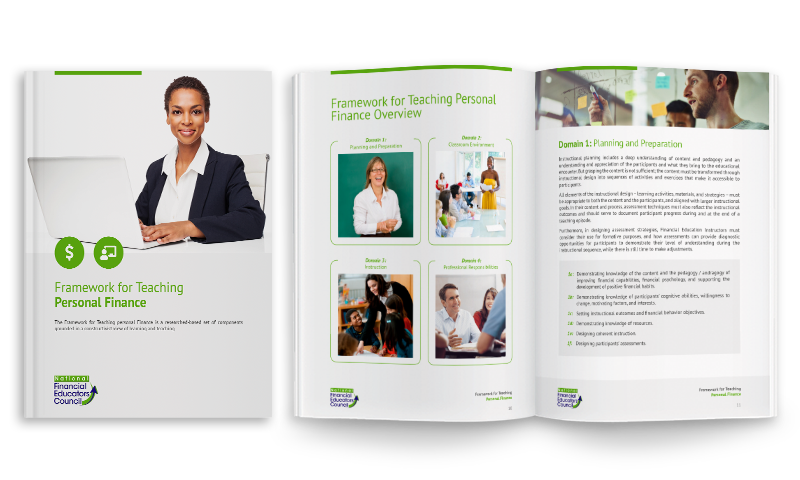
Standards for Financial Education Practitioners – Framework for Teaching Personal Finance

The NFEC developed the Framework for Teaching Personal Finance, the first – and only – national industry standards for financial education instructors. The Framework establishes clear benchmarks to help educators teach more effectively and equip learners with practical financial skills. 

Educator benchmarks are the cornerstone of financial education. Evidence shows that students of qualified instructors achieve better retention, higher lifetime earnings, greater retirement security, and improved well-being. Students of highly-qualified educators accomplish more positive outcomes than those taught by less-qualified instructors. For example, students of qualified educators may expect higher lifetime earnings and greater security at retirement [1] as well as improved mental and physical health and well-being.[2]

Developed in collaboration with the Danielson Group and aligned with InTASC, the Framework adapts Charlotte Danielson’s model for financial literacy. Grounded in constructivist learning, the model defines 22 evidence-based components that specify the knowledge, competencies, and performance expectations educators must demonstrate; and provides a roadmap of instructional practices tied to measurable participant gains and ongoing professional development. Danielson’s Framework for Teaching is backed by evidence-based research and widely accepted by educators, administrators, policymakers, and academics. It defines the skill sets distinguished educators should possess and performance levels that define educator capabilities. The Framework for Teaching has been adopted as a model approved in more than 20 states, making it the most widely-used teaching model in the US.
Financial Literacy Standards for Learners – Student Learning Outcomes

These student learning standards reports set forth learning goals and educational targets for financial literacy curriculum and instruction for elementary, high school, and adult learners. By separating material based on cognitive abilities, socioeconomic status, and life stages, the NFEC empowers instructors to scaffold lessons appropriately and ensures that students can complete the lessons successfully at each level.

The learner standards were developed through a collaboration between the NFEC educational development team and curriculum advisory board. The effort was led by consultant Dr. Heidi Jacobs, an internationally recognized education leader known for her work in curriculum mapping, curriculum integration, and developing 21st-century approaches to teaching and learning.

To guide these educational standards and ensure that instructional targets are age-appropriate, the NFEC consulted pedagogical theories including Webb’s Depth of Knowledge Theory, Core Knowledge Theory, and Piaget’s Theory of Cognitive Development. Taken together, these models offered a conceptual frame for effectively teaching kids about money in a way that meets them at their current developmental level.
Financial Literacy Standards for High School, College, & Adult Learners

Cash for Candy Easter Edition

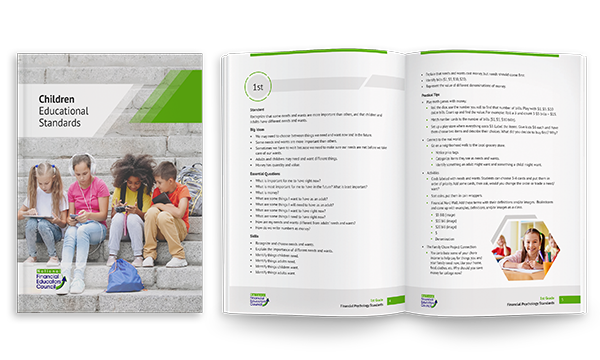
Elementary School Financial Education Standards (PK to 8th Grade)

The development team found that existing industry age breakdowns often did not match students’ cognitive readiness to learn key financial concepts. To create a better-aligned framework, the NFEC interviewed educators, reviewed research, and used evidence-based reasoning to define age and grade groupings that reflect how learners actually think and apply financial ideas.

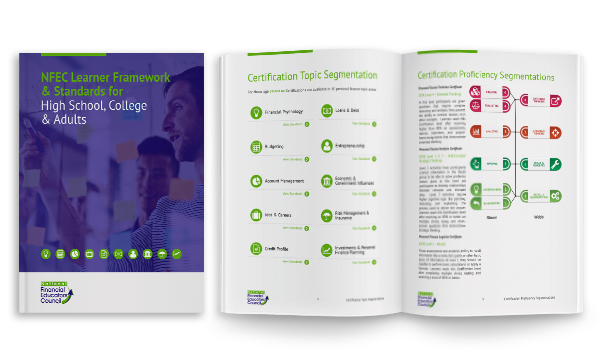
High School, College, & Adult Standards

The teen and adult band (high school and beyond) prepares learners for the consequential financial decisions centered around their life stage. Although teens and adults cover many of the same topics, the Framework treats this band as distinct in purpose and pedagogy: content is deeper, problems are more complex, and instruction emphasizes transfer, critical thinking, and long-term planning. The NFEC organizes this band into beginner, intermediate, and advanced levels so instructors can align expectations with learners’ prior knowledge, math skills, and life stage.

Across all levels, the teen and adult band integrates behavioral finance and financial psychology, showing how cognitive biases, social norms, and emotions shape decisions so learners gain both the mechanics and the habits that sustain good choices. Pedagogy favors active, experiential methods: simulations, real-world projects, internships and mentorships through community or employer partnerships, and scaffolded assignments that build toward capstone demonstrations of competence. 

Timing and relevance are critical: deliver modules when learners face real decisions (senior year: student aid and borrowing; first job: benefits and payroll; before renting or buying). Taught at the right moment, with appropriate depth and practical assessment, teen and adult financial education becomes a durable tool for lifelong financial competence and improved long-term outcomes.

Kids & Elementary School Standards

The kids band (preK–8) builds foundational money concepts with age-appropriate, developmentally grounded instruction. Early learners (preK–2) focus on concrete experiences – counting, recognizing coins, exchange, choice, and basic saving – through stories, games, and hands-on play. Upper elementary (3–5) adds simple budgeting, needs vs. wants, comparison shopping, and goal-setting via projects and family activities; middle school (6–8) introduces applied problem-solving and the math needed for personal finance (fractions, decimals, percentages) using simulations and classroom economies.

Assessment is formative and performance-based – observations, portfolios, rubrics, and short applied checks – paired with family feedback to measure retention and behavior. Sequenced lessons and scaffolded activities link concepts to everyday contexts (allowances, chores, school fundraisers) so children build practical habits that prepare them for more abstract teen- and adult-level reasoning.

The design draws on established learning theories. Piaget guides the shift from concrete to abstract concepts; Vygotsky’s zone of proximal development supports guided practice, peer collaboration, and caregiver involvement; Core Knowledge highlights domain-specific early concepts to teach explicitly; and constructivist, social-learning (Bandura), and experiential (Kolb) approaches shape hands-on, inquiry-based activities that promote lasting understanding and real-world application.

The topics in the Financial Literacy Framework & Standards reflect 11 years of refinement: review of existing standards, academic research, guidance from our Curriculum Advisory Board, and feedback from partner organizations worldwide.

For teens and adults, the Framework organizes content into 10 core personal-finance domains: Financial Psychology; Budgeting; Account Management; Jobs & Careers; Credit Profile; Loans & Debt; Risk Management & Insurance; Investments & Personal Finance Planning; Education & Skill Development; and Economic & Government Influences.

For children (PK–8), topics are grouped into five integrated areas that reflect how foundational lessons naturally overlap: Financial Psychology & Budgeting; Savings, Investing, & Income; Career & Entrepreneurship; Credit, Debt & Loans; and Risk Management & Insurance. During development the team found many kid-focused lessons that bridge multiple teen/adult topics, so combining areas at younger ages better reflects how children learn and apply concepts.

The Framework presents big ideas, age-appropriate standards (teen/adult), and essential questions (kids). Big ideas define the concepts learners should master and show relationships between key components. Standards specify the competencies required to achieve those big ideas. For younger learners we currently use essential questions and skill sets – a developmentally preferred format – and we are expanding that section into fully-defined content standards.

[1] Annamaria Lusardi and Olivia S. Mitchell, NBER Working Paper No. 17078 (May 2011), Baby Boomer retirement security: The roles of planning, financial literacy, and housing wealth. https://ideas.repec.org/p/crp/wpaper/54.html

[2] Bennett et al., BMC Geriatrics, 12:30 (2012), Correlates of health and financial literacy in older adults without dementia. https://bmcgeriatr.biomedcentral.com/articles/10.1186/1471-2318-12-30

Framework for Teaching Personal Finance https://www.financialeducatorscouncil.org/framework-for-teaching-personal-finance/ 

Policy and Standards Framework for High School Financial Literacy Education https://www.financialeducatorscouncil.org/policy-and-standards-framework-for-high-school-financial-literacy-education/

Need Support with Gap Analysis & Standard Mapping?

We help schools, content creators, policymakers, and instructional designers move from intent to action. Receive policy-ready materials or request a tailored review to align standards, teacher qualifications, curriculum, and assessments with proven best practices. Our mapping and implementation support makes adoption straightforward for streamlining curriculum alignment, teacher PD, assessment integration, and board-ready policy language.

Request a tailored consultation to evaluate current mandates, identify gaps, and receive an implementation roadmap that includes pilot design, professional development, validated assessments, and accountability metrics.