

Financial Inclusion Definition
Financial inclusion means giving people access to the world of money. A financial inclusion definition must address equality of access to financial information and services. Everyone must have the same financial opportunities. A group should not be denied access to financial information and services that others enjoy, due to external circumstances beyond their control. Worldwide financial inclusion is the ultimate goal, but sadly, we are far from that financial utopia today. In fact, billions of people around the world do not have access to any established financial systems. Increased financial inclusion is even important to those who already have it because it means a bigger, more diverse marketplace with more goods and services and more people to sell to.
What is Financial Inclusion?
A look at a financial inclusion definition reveals that financial inclusion is about identifying individuals who are underserved or lack access to basic financial infrastructure. Public policy must be crafted in such a way that encourages financial institutions to extend their services to these poor communities and encourages impoverished individuals to use financial service when they are made available. Financial inclusion definitions have been published by major international agencies along with prominent financial education programs.

Financial Groups Define Financial Inclusion
Access to financial services is a major part of global financial inclusion. Availability to financial institutions, however, is not the only step towards facilitating financial inclusion among all. Those who are disconnected from the modern financial economy must be actively encouraged to take advantage of financial services that are newly available to them. To this end, financial educators should ensure their curriculums are specially designed to alter the behaviors of the underbanked and integrate them into the global financial economy.
“Financial inclusion means that individuals and businesses have access to useful and affordable financial products and services that meet their needs – transactions, payments, savings, credit and insurance – delivered in a responsible and sustainable way.” (World Bank) https://www.worldbank.org/en/topic/financialinclusion
“Financial inclusion is the pursuit of making financial services accessible at affordable costs to all individuals and businesses, irrespective of net worth and size respectively” (Investopedia). https://www.investopedia.com
“Financial inclusion efforts seek to ensure that all households and businesses, regardless of income level, have access to and can effectively use the appropriate financial services they need to improve their lives” (Consultative Group to Assist the Poor). http://www.cgap.org
“Financial Inclusion is the process of ensuring access to appropriate financial products and services needed by vulnerable groups such as weaker sections and low-income groups at an affordable cost in a fair and transparent manner by mainstream Institutional player” (Reserve Bank of India). https://www.oecd.org
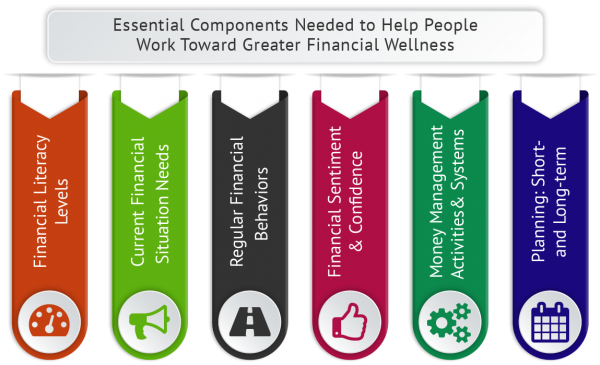
Financial Inclusion Means Education, Behavior and Access
Champlain College’s center for financial literacy emphasizes that financial literacy topics must be taught in a course that students are required to take in order to graduate. https://financialliteracy.champlain.edu/research-advocacy/2023-report-card-introduction/keys-to-success/
The Citi foundation recommends that programs should revolve around actual financial products that participants can then implement to make smarter financial choices (Citigroup). https://www.citigroup.com
In a survey by OECD, well over a quarter of respondents replied that their culture influenced their attitudes toward wealth (Organization for Economic Cooperation and Development). https://www.oecd.org
40.2% of those with low levels of financial literacy relied on parents, friends, and acquaintances as their most important source of financial knowledge, compared to 20.8% of those with the highest levels of financial literacy (National Bureau of Economic Research).
http://www.nber.org
Financial Access Must Include Financial Literacy Education
More than one in four (27%) U.S. adults admit to not paying their bills on time (National Foundation for Credit Counseling). https://www.nfcc.org
37% of recent college graduates have been late with a student loan payment at least once in the past year (US Financial Capability). http://www.usfinancialcapability.org
Two in five U.S. adults report keeping a budget and tracking their spending (National Foundation for Credit Counseling). https://www.nfcc.org
“Financial literacy is not an end in itself, but a step-by-step process. It begins in childhood and continues throughout a person’s life all the way to retirement. Instilling the financial-literacy message in children is especially important, because they will carry it for the rest of their lives.” – George Karl, former NBA coach
“Financial literacy is an issue that should command our attention because many Americans are not adequately organizing finances for their education, healthcare and retirement.” – Ron Lewis, former United States Representative
Toward Worldwide Financial Inclusion
Financial inclusion definitions describe the relationship between individuals and business and their access to basic financial services. Worldwide financial inclusion is an ideal that we must strive toward. Proving equitable access to financial institutions and the financial services they offer is a prerequisite to making the socioeconomic ladder easier to climb. Financial educators can plant the idea of helping others reach a basic level of financial security by discussing a financial inclusion definition within their curriculum.