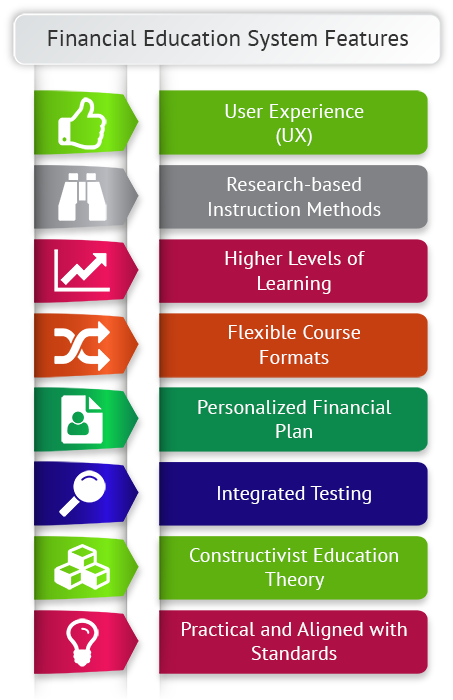
The National Financial Educators Council’s proprietary learning platform presents an authentic, dynamic learning process. By leveraging best practices in education, the NFEC helps improve people’s financial capabilities. The platform’s engaging content and vivid design create a unique user experience. Learners become inspired to take action toward building sound financial foundations.
This interactive experience is grounded in constructivist theory. That means learners construct their own understanding by participating in real-world financial activities and then reflecting on those lessons. The learner-centered approach to education applies scaffolding, simulation, project-based learning, case studies, and other accepted educational strategies. The program is designed to help participants assimilate what they learn, and then translate knowledge into action.
Based on their experience levels, the learning platform connects participants with learning outcomes that challenge them to progress to higher depths of knowledge. Whether the people you serve are moving out on their own for the first time, planning for retirement, trying to get out of debt, interested in buying a home, paying for college, or rebuilding after financial setbacks – this curriculum has an age-appropriate practical education plan to help them reach their financial goals. Learners can use the course to prepare for life events as they come up, or review lessons that interest them. They also can take the full course and earn Certification.
The platform is flexible for both facilitator and participants. It can accommodate a variety of schedules and course formats. Some organizations have leveraged the platform as a self-study course. Others offered a blended learning setting by incorporating the platform into their live classes, workshops, camps, and other in-person formats. The full program would satisfy a two-unit college level course, and the topics align with national financial education standards. If you’re an educator looking to bridge personal finance lessons into other classes, the content also aligns with common core standards.
The NFEC’s proprietary learning platform provides more than just education. The project-based learning activities help participants address life situations they’ll encounter in the real world. Creating personal budgets, reviewing their credit reports, preparing for major purchases, and factoring inflation into retirement plans are just a few examples of the practical lessons. Participants come away with a personalized financial plan and educational reminders they can refer back to throughout their lives.
The personal finance platform features integrated testing that measures changes in participants’ financial capabilities and long-term behavior modification. Pre- and post-testing are available at the topic, lesson, and full-course levels. These tests measure the knowledge participants gain across all the material they cover.
This program was developed for educators who want to deliver a 100% independent, professional-level financial education that leverages best practices in learning and education. Continue with the video tour now to learn more about the Learning Management System and other features that can help you reach your financial literacy programming goals.
*A 2 unit course semester credit hours (SCH) typically includes 30-32 contact hours per semester. Outside classroom activities generally require double to triple the contact hours, and may include project-based learning activities, completing assignments, studying notes, supplementary reading, writing papers, and participating in activities that further their knowledge about the subject.