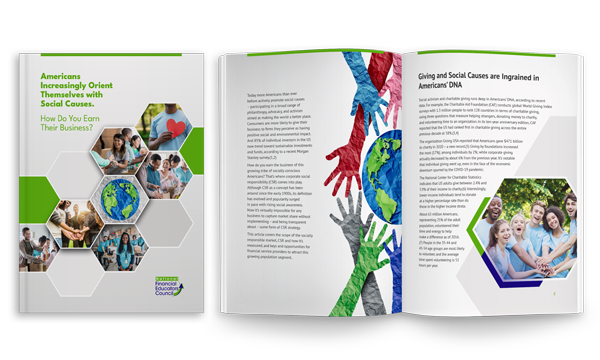
Corporate Social Responsibility Report:
People Increasingly Orient Themselves with Social Causes. How Do You Earn Their Business?

Corporate Social Responsibility* (CSR) is a business model where companies balance social good with business growth. Well-executed CSR programs integrate social impact goals with business growth objectives that have a direct positive impact on the community and on the company’s bottom line.

Helping your community work toward financial wellness can enhance your brand, expand your client base, and build your business.

Brand & Business Benefits of CSR

Businesses in the financial industry are capitalizing on CSR programs to offer a way to achieve brand differentiation and connect with potential clients on a deeper level. Americans have been the most giving people in the world for the last 10 years, according to the World Giving Index; and people want to do business with companies that align with their values.

Financial services businesses are capitalizing on CSR programs to offer a way to achieve brand differentiation and connect with potential clients on a deeper level. Companies leading CSR campaigns receive benefits that support their core business objectives, including:

Financial Education is a Preferred Method of CSR for the Financial Industry

Financial literacy is a cause that brings people together – and large financial institutions have recognized the opportunity, shifting about 4% of their total marketing budgets toward financial education according to the Consumer Financial Protection Bureau.

Business Model Alignment: One of the most critical factors for a successful CSR campaign is alignment with your business model. For those in the financial industry, financial literacy education is a cause that aligns perfectly with your brand, can be integrated naturally with your existing services, and provides a cohesive experience through prospecting and client communications.

Widespread Support for the Cause: Another key benefit of using financial wellness for CSR is the wide support for financial literacy and the economic empowerment agenda. People have a deep connection to this cause, as many have gone through personal challenges themselves. Further, the cause’s focus on helping people work toward the American Dream is one that garners vast support.

The Rise of CSR in the Financial Industry to Align with American Values

Corporate Social Responsibility (CSR) programs have increased from $120 million in 1990 to over $20 billion in 2018.

CSR programs balance purpose and profit – providing social good while maximizing business returns.

Risks of Implementing a Financial Wellness CSR Program

Although CSR campaigns offer tremendous upside potential, there are also risks. When a campaign is not executed properly, it can harm a brand’s reputation and impede the company’s business growth. The most common mistakes made when implementing social cause programs include:
Failure to Deliver Community Benefit

People want to see outcomes and can easily spot fakes. Your campaign needs to make a real difference and deliver measurable results.

Limited Integration with a Brand

Saying you are involved with a cause is different from authentic participation. People want to see that the cause is integrated into your brand’s DNA.

Awareness that Fails to Achieve Scale

Must be promoted with a marketing and PR strategy at a large enough scale to get the depth and breadth required to connect your brand with the cause.

Disconnect Between Prospecting & Client Experience

Problems occur when CSR messaging drops when prospects transition to clients. Messaging must be integrated into the client experience.

Download CSR Report

So how do you build a financial wellness CSR campaign that avoids the execution challenges and delivers a measurable ROI at an investment local and regional financial service providers can afford?

Help Us Reach Every Community with Financial Education – We Reciprocate by Providing You Benefits that Address Many of Your Core Business Objectives.

Popular Articles: Additional Topics of Interest for Financial Service Professionals

Brand Positioning that Stands Out Above Your Competitors

Be the ‘Financial Wellness’ provider your neighbors think of first for their Financial Service needs. A subtle shift in brand can yield long-term returns.

Join Our State Financial Education Advisory Board

Feel a passion for encouraging financial wellness and want to share your expertise to support your community to work toward greater financial security? Join our Advisory Board.

Solve Your Major Marketing Challenges by Answering the Call to Public Service

Help us reach every corner of America with financial education programming. We reciprocate by giving you a comprehensive, omnichannel marketing campaign.

Corporate Social Responsibility Managed Programming

Fulfill your Corporate Social Responsibility (CSR) objectives and create a measurable social impact in targeted geographic communities.

Supporting the Business Growth of Our Financial Service Partners

How financial service providers can grow their businesses by making a substantial difference in people’s lives in their communities.

Charities Aid Foundation, CAF World Giving Index, 10th Edition: Ten years of giving trends, October 2019, https://www.cafonline.org/about-us/publications/2019-publications/caf-world-giving-index-10th-edition

5W Public Relations, 5WPR 2020 Consumer Culture Report, 5W_consumer_culture_report_2020final.pdf (5wpr.com)

McAllister C, Uncommon sense: Are companies truly committed to social responsibility? Nielsen Perspectives, January 6, 2016, https://www.nielsen.com/us/en/insights/news/2016/uncommon-sense-are-companies-truly-committed-to-social-responsibility/

Heitzman A, Cause marketing statistics: 20+ examples of the power of social impact in 2021, highervisibility.com, March 24, 2021, https://www.highervisibility.com/blog/cause-marketing-statistics/

Weber Shandwick, The state of corporate reputation in 2020: Everything matters now, January 14, 2020, https://www.webershandwick.com/news/corporate-reputation-2020-everything-matters-now/

Consumer Financial Protection Bureau, Navigating the market: A comparison of spending on financial education and financial marketing, November 18, 2013, 201311_cfpb_navigating-the-market-final.pdf (consumerfinance.gov)

The U.S. Sun, Americans wish they learned more about finances growing up as survey finds parents eager to teach kids about money, January 13, 2021, https://www.the-sun.com/news/us-news/2132036/americans-learned-financessurvey-parents-teach-kids-money/

National Financial Educators Council, Americans agree schools should teach high school students financial literacy coursework, 2021, https://www.financialeducatorscouncil.org/financial-literacy-subject-survey/.

Harzog B, Survey: Majority of parents want high schools to teach personal finance. US News & World Report, September 8, 2020, https://money.usnews.com/credit-cards/articles/survey-majority-of-parents-want-high-schools-to-teach-personal-finance.

McWilliams A & Siegel D, Corporate social responsibility: A theory of the firm perspective. The Academy of Management Review, 26(1), 117-127, 2001. https://www.jstor.org/stable/259398?seq=1#metadata_info_tab_contents

Thompson V, Stocks and sustainability: How they relate. Berkeley Economic Review, March 11, 2020, https://econreview.berkeley.edu/stocks-sustainability-how-they-relate/