

Tips to Teaching Kids About Advertisements
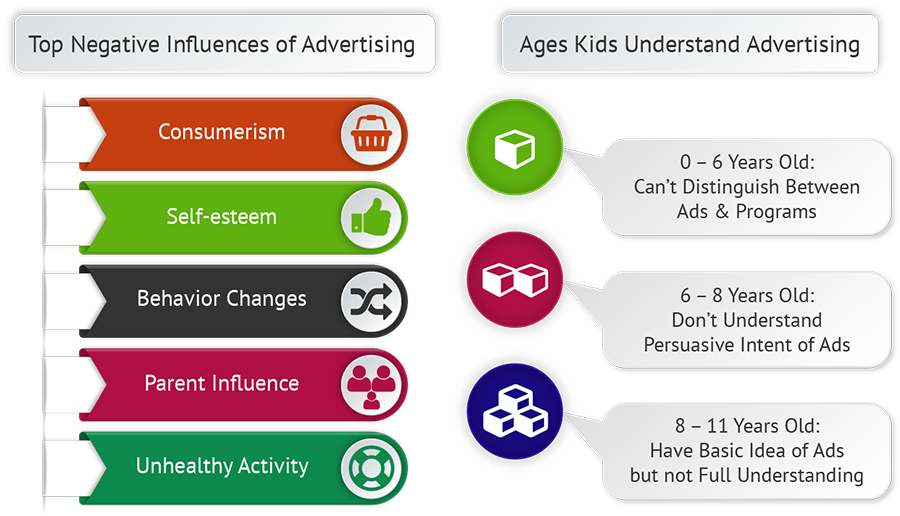
Research strongly indicates that advertising has negative consequences for children, affecting their health, self-esteem, financial behaviors, and activities. At or below age 8, children’s cognitive abilities have not yet developed to the point where they can discern that advertisements are trying to persuade them to buy something – so they take marketing messages as accurate and true. And kids do not even fully comprehend advertising until age 11.
Marketers spend $17 billion a year in the United States, with an estimated $2.9 billion spent on advertising directly aimed at children in 2021. This number is expected to rise to $21.1 billion by 2031 (1,3). By the time children reach age 21, they will have seen more than a million ads – ads which, today, have become increasingly more sophisticated. According to the American Psychological Association, kids can recall ad content and express desire for an advertised product after only a single exposure to the ad.(2) Advertising is aimed at getting people to purchase things, so young people are encouraged to buy based on “wants” versus “needs.”
To combat this problem, parents and educators need to proactively address advertising. This is an activity you should do on a regular basis so children can logically evaluate both ads and their own spending habits. As a family, watch some of the commercials that come on TV. Discuss the products that are being sold and the methods advertisers use to sell the products.
Stop Advertising to Kids Whitepaper
Advertising to children today is pervasive across a broad and growing range of platforms, which raises ethical and health concerns across the gamut of life aspects.
This report explores the problems posed by advertising to children and youth – with particular focus on kids’ financial health – and suggests two policy strategies to help mitigate those risks.

Questions & Talking Points for Kids 5 to 8 Years Old
While watching commercials with kids, ask:
Questions & Talking Points for Kids 8 to 11+ Years Old
While watching commercials with kids ask:
Case Study
The Ad Masters conducted a study where they trained kids how to understand and limit emotional responses to advertising. The training consisted of six 60-minute sessions.
The first three sessions aimed to increase advertising literacy based on educational techniques derived from the media and advertising literacy education literature and existing advertising interventions (e.g., Media Smart). Children learned how to recognize different forms of advertising and were taught about advertising’s intent, source, and tactics.
The fourth session aimed to increase children’s ability to cope with advertising, specifically the stop part of the “stop-and-think” response. By using the emotion labeling technique, children learned to become aware of and control their initial emotional responses toward appealing advertisements.
The fifth session also aimed to increase children’s ability to cope with advertising, now focusing on the think part of the stop-and-think response. By using implementation intentions, they learned to enact their preferred advertising coping strategy.
The final session aimed to stimulate children’s motivation to engage in advertising coping strategies by using the self-persuasion technique.