

Setting Personal Finance Benchmarks for the Industry: NFEC

Nearly all the top professional industries, including law, accounting, medicine, education, and finance, have long had standards in place to define the educational and experiential qualifications of certified or licensed practitioners – except (until recently) the field of financial education. Now the National Financial Educators Council (NFEC) has changed that by establishing personal finance benchmarks for its certified educators and published materials. These standards offer multiple benefits including improved program quality, professional development and performance guidelines, a common vernacular to facilitate better communication, and tools for instructor preparation and evaluation. The NFEC has created four financial literacy standards documents that apply separately to financial educators, coaches, learners, and materials.

Benefits of Standards

The NFEC sets benchmarks for the financial education and coaching industry that will assist providers to become more effective and competent in helping individuals work toward financial wellness. The NFEC standards for professionals and learners offer the following benefits:

Standards for Financial Educators

Financial Instructors Standards

Empirical research has demonstrated the qualifications of financial educators that produce the highest gains in learner knowledge and test scores. The NFEC consulted that body of evidence to write its Framework for Teaching Personal Finance, a financial literacy benchmark document defining what individuals must achieve to earn credentials as certified financial educators.

Financial Literacy Educators Standards

Personal Finance Benchmarks for Coaches

To assure that financial coaches, counselors, and consultants are bound to serve clients’ best interests and have the skills to help clients build financial wellness, the NFEC wrote its Financial Coaching Standards and Code of Conduct. Using policies defined by several respected agencies, these benchmarks were designed to give coaches the educational and ethical background they need for maximum effectiveness.
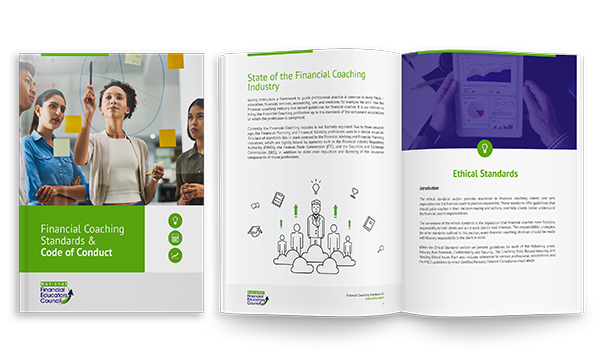
Financial Literacy Standards for Coaches


Standards for Learner & Educational Methodology Best Practices

Financial Literacy Benchmark for Students

Best practices for ensuring learner accomplishment are the targets of the NFEC’s Financial Literacy Framework & Standards, a book that sets performance goals for participants in financial training. This framework establishes objectives for both learners and educators.
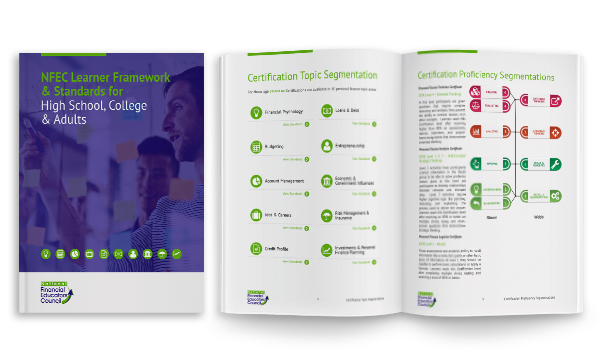

Learner Financial Literacy Standards

Standards for Educational Methodology

Incorporating insight from both pedagogical principles and research evidence, the NFEC created the National Financial Capability Strategy to set forth optimal educational methods for teaching financial literacy.

Educational Methodologies of Personal Finance Financial Literacy Curriculum PDF Download

Personal Finance Benchmarks Guide Financial Education Professionals, Learner Outcomes

Providing best practice frameworks for professionals and methodological standards for learners is common in most educational areas. However, prior to now the financial education field had not established personal finance benchmarks to guide instructor training and teaching practices. Recently the NFEC moved forward to address this lack.

Professional Standards. The NFEC partnered with the Danielson Group consultants to adapt the well-recognized Framework for Teaching (Charlotte Danielson, author) to become a financial literacy benchmark. The resulting Framework for Teaching Personal Finance identifies empirically- and theoretically-based guidelines for training and preparing financial educators. This document represents the first and only set of national standards defining the responsibilities and professional development of financial instructors. These personal finance guidelines provide public reassurance that professionals who meet these criteria are held to the highest standards of practice in personal finance education.

The NFEC also created the Financial Coaching Standards and Code of Conduct to offer personal finance benchmarks for coaches, consultants, and counselors who undertake to help people increase their financial health. Financial coaches and counselors help people deal with money management, an emotion-laden topic for most individuals; and each person has a unique financial situation. That’s why effective coaches must have cross-disciplinary training in psychology, counseling, and coaching tactics as well as personal finance knowledge. The Standards and Code of Conduct define this training.

Learner and Teaching Methods Standards. In the course of developing comprehensive financial literacy curriculum for children, teenagers, and adults, the NFEC also created personal finance benchmarks for learners. That is, they defined what a teacher should know across 10 core subject matter areas in order to meet the criteria for content knowledge. The resulting document, The Financial Literacy Framework & Standards, was designed to improve instructional quality and impact, and also sets performance goals for learners who participate in financial education.

The NFEC assembled a team of experts, studied the current body of research, and garnered feedback from hundreds of financial and educational professionals to create this financial literacy benchmark. The personal finance benchmarks are reviewed annually and updated according to trends and changes in the field. Financial literacy has been linked to financial wellness in some studies.

As the curriculum and standards were being written, the development team drew upon conceptual frameworks such as Piaget’s Cognitive Development and Webb’s Depth of Knowledge theories. Although these theories differ somewhat, they also share components that were useful to guide NFEC’s personal finance benchmarks. For example, when laying out curriculum for kids, Piaget’s theory suggests that material should be separated based on cognitive ability; and for teens/adults, Webb’s theory indicates the importance of understanding audiences and modifying lessons for maximum appeal to the target age group.

Don’t follow arbitrary benchmarks when planning your retirement.

MarketWatch on financial benchmarks and individual applicability.