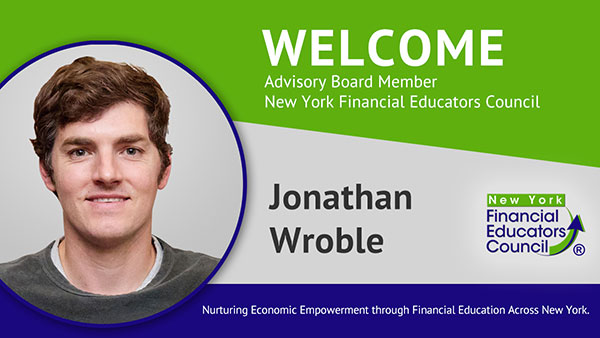
Community Champion: Jonathan Wroble
The same compassion and curiosity that Jonathan Wroble brings to his professional work also shapes his personal life. A New Yorker through and through, he draws on his experiences in the city to inspire students and help them uncover practical educational tools and real-world examples they can use to learn and thrive. His commitment to the financial wellness movement grows from a clear understanding of how essential it is for young people to receive foundational lessons they can genuinely apply in their everyday lives.
An accomplished writer and blogger, Jonathan Wroble channels his own history of making financial decisions without the benefit of early financial education into his work today. Blending creative thinking with a deep enthusiasm for teaching and empowering youth, Jonathan has established himself as a genuine community leader and advocate. His skill in curriculum design and youth engagement is strengthened by his insight, authenticity, openness, and deep community roots.


Personal Statement
When it comes to money, our big mistakes often loom larger than our quiet successes. My story is no different.
Filling out the paperwork for my first job, I opted out of both the 401(k) contribution and health insurance plan. As a 22-year-old, it was hard to conceive of retirement as something to prioritize. And as a generally healthy person, insurance seemed wasteful too.
A few months later, a carbon monoxide leak sent me to the emergency room, for a few hours spent in an oxygen mask. The bill came a few weeks later; it was more than double what I would have paid in health insurance premiums for the entire year. The 401(k) pill is even harder to swallow, since I know now the unrecoverable value of investing as early as you can. (Saving even $1,000 that year would have meant $30,000 for retirement. Worse, there was a company match!)
In hindsight, I also realize this: I was never taught these things in school. My decisions back then came down to the snap judgments of a twenty-something poring over employer jargon, not to any bedrock of money education in my head, nor a history of financial teachers I could call upon. It felt like I had a split second to make decisions with lifelong impact, without any real background to understand them.
That was almost two decades ago. In the time since, countless state mandates for personal finance have arrived, and many tools have blossomed for teaching it. Young people still lag on personal finance basics, but there’s so much more awareness of how important this is, and so much creativity for how to get kids the information they need.
With the curriculum I co-founded, Get A Financial Life NYC, the approach is to go local. GFL NYC was informed by conversations with actual New York City public high schoolers, a unique – but also very large – audience. 70,000 kids graduate from NYC public schools each year, and they share economic experiences like shopping at delis and bodegas, riding the train every day, working summer jobs with the city’s SYEP program, and targeting colleges in the world-class CUNY system.
What would a money curriculum look like if it hit all the essentials – from budgeting to banking, from saving to investing to smart spending – but was tailored to this group’s specific needs, daily decisions, and common experiences?
That’s the question GFL NYC aims to answer. As we’ve sat in the many classrooms where it’s now taught, we’ve watched students tell their own tales. A girl who bought a hijab online that turned out to be overpriced and poor quality; a boy whose Chipotle app enticed him into buying a burrito for points when he wasn’t even hungry; several kids who chose a prepaid debit card instead of direct deposit for their summer job paychecks.
Stories like these underline another important aspect of starting early with money education: You can learn from your smaller teenage mistakes before they become the more consequential missteps of young adulthood. That way, you won’t turn into the 22-year-old without health insurance who doesn’t save for his retirement.
My position on the New York Financial Educators Council’s Advisory Board is a way to continue to spread awareness not just of GFL NYC, but of the local approach to personal finance education. I hope to bring money education to kids when and where they need it, and in a sustainable and scalable way that draws on their shared experiences and inspires their future actions. It’s an honor to work alongside so many other advocates and champions on this board.
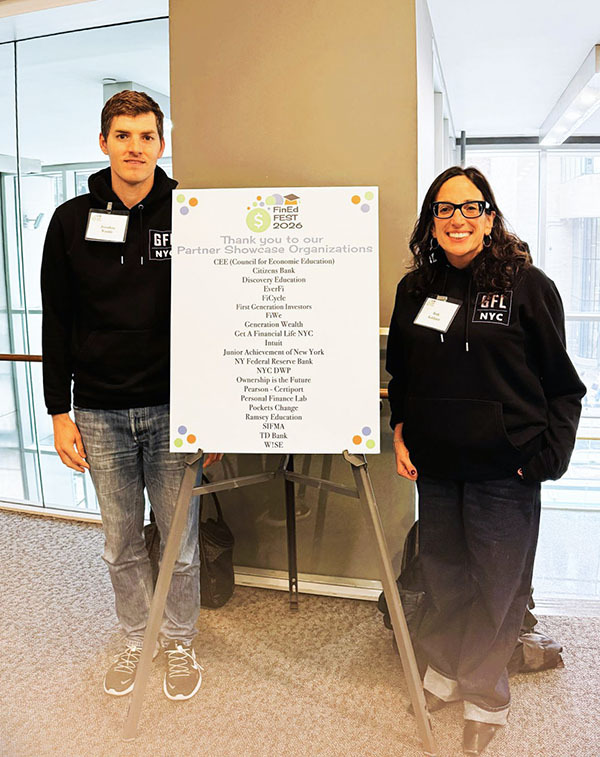
Jonathan Wroble at FinEd Fest 2026
Community Champion: Jonathan Wroble
Jonathan Wroble demonstrates a deep and unwavering commitment to the financial literacy movement, championing the belief that all young New Yorkers deserve the knowledge and confidence to shape their own financial futures. Through thoughtful advocacy, strategic guidance, accessible resources, and hands-on educational support, he has become a trusted force for empowerment across the state.
Jonathan’s professional background, academic foundation, and steady leadership – paired with his extensive community service – work together to showcase his ability to spark meaningful social change. Every day, Jonathan proves that individuals from all ages, neighborhoods, and lived experiences can overcome the obstacles that stand between them and long-term financial security. The New York Council is sincerely grateful for Jonathan’s ongoing contributions and the energy he brings to this mission. We look forward to continuing our collaboration as we expand statewide financial wellness initiatives.