Arizona Financial Literacy Standards and Mandates: Academic Alignment Review

This page presents a standards-based evaluation of Arizona’s financial literacy requirements relative to the minimum structural, instructional, and accountability standards routinely applied to required core high school academic subjects such as mathematics, science, and English/language arts.

The analysis examines whether Arizona’s state-governed financial education policies are designed, implemented, and supported at levels comparable to other foundational disciplines. Findings reflect alignment with baseline expectations for instructional rigor, curriculum vetting, educator qualifications, assessment, governance, and sustained program support.

Standards Alignment Snapshot (Arizona)

This distribution indicates structural misalignment between Arizona’s financial education approach and the minimum standards applied to other required academic subjects.

0
Alignment Score (Out of 102)

Failing

Overall Classification

Evaluation Scope: 12 criteria

Standards Alignment Distribution
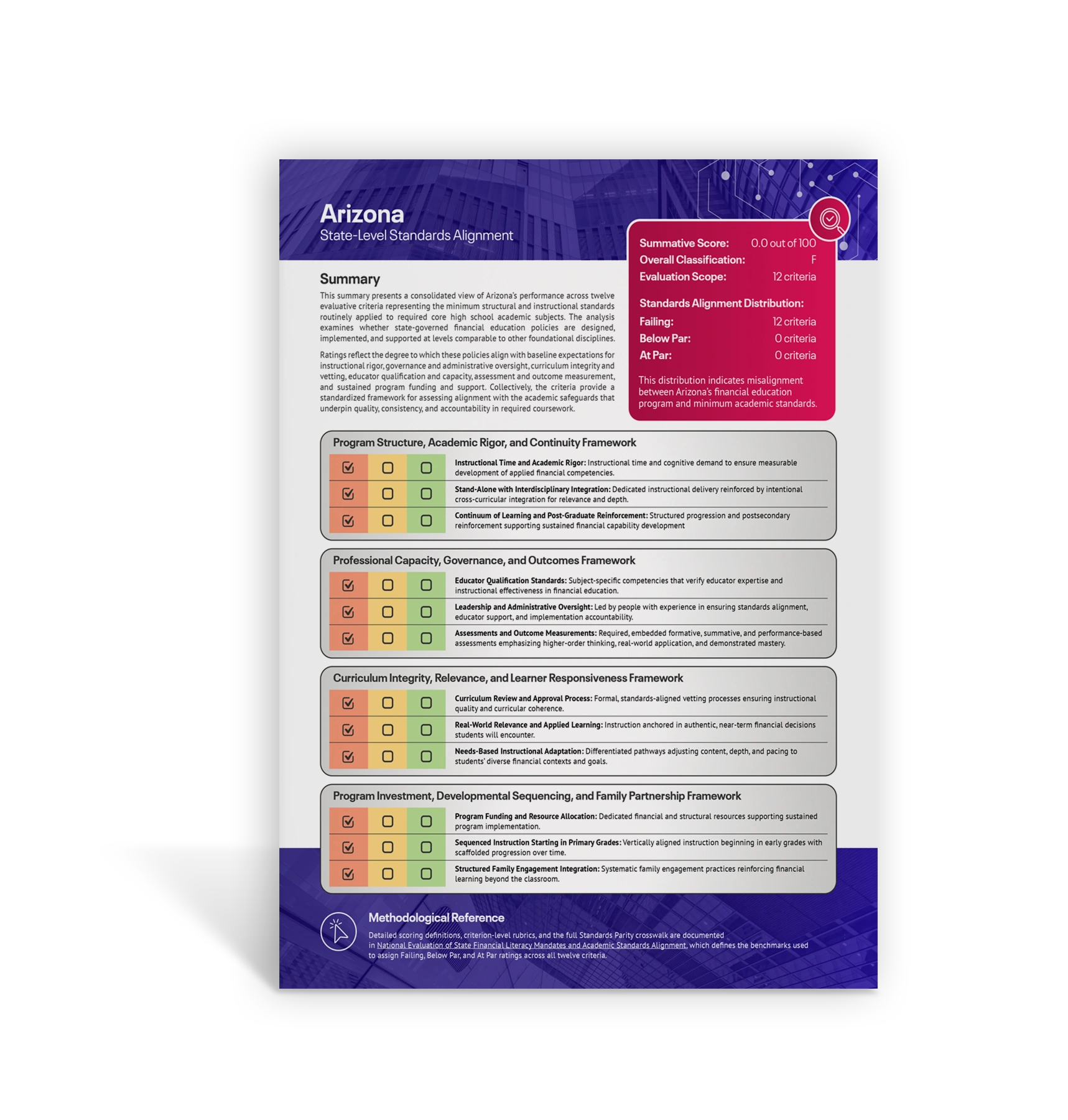
0
Failing Criteria
0
Below Par Criteria
0
At Par Criteria

Arizona: Financial Literacy Standards and Mandates Overview

As of 2026, Arizona does not require a standalone personal finance course for high school graduation. Instead, state law requires at least a half-credit economics course that must include financial literacy and personal financial management content; however, the state has not adopted dedicated, standalone personal finance learning standards equivalent to those applied to other core subjects. Source.

Personal finance topics are embedded within broader History and Social Science standards and economics requirements, not organized into a grade-banded personal finance standards framework. Source.

Pending financial literacy legislation in Arizona: Senate Bill 1058 (2024) would have required a separate, half-credit personal finance course and directed the State Board of Education and Arizona Department of Education to develop personal finance academic standards, but the bill failed on third reading in the Senate and did not become law. Source.

Arizona Financial Literacy Programs in National Context: A 50-State Academic Alignment Analysis

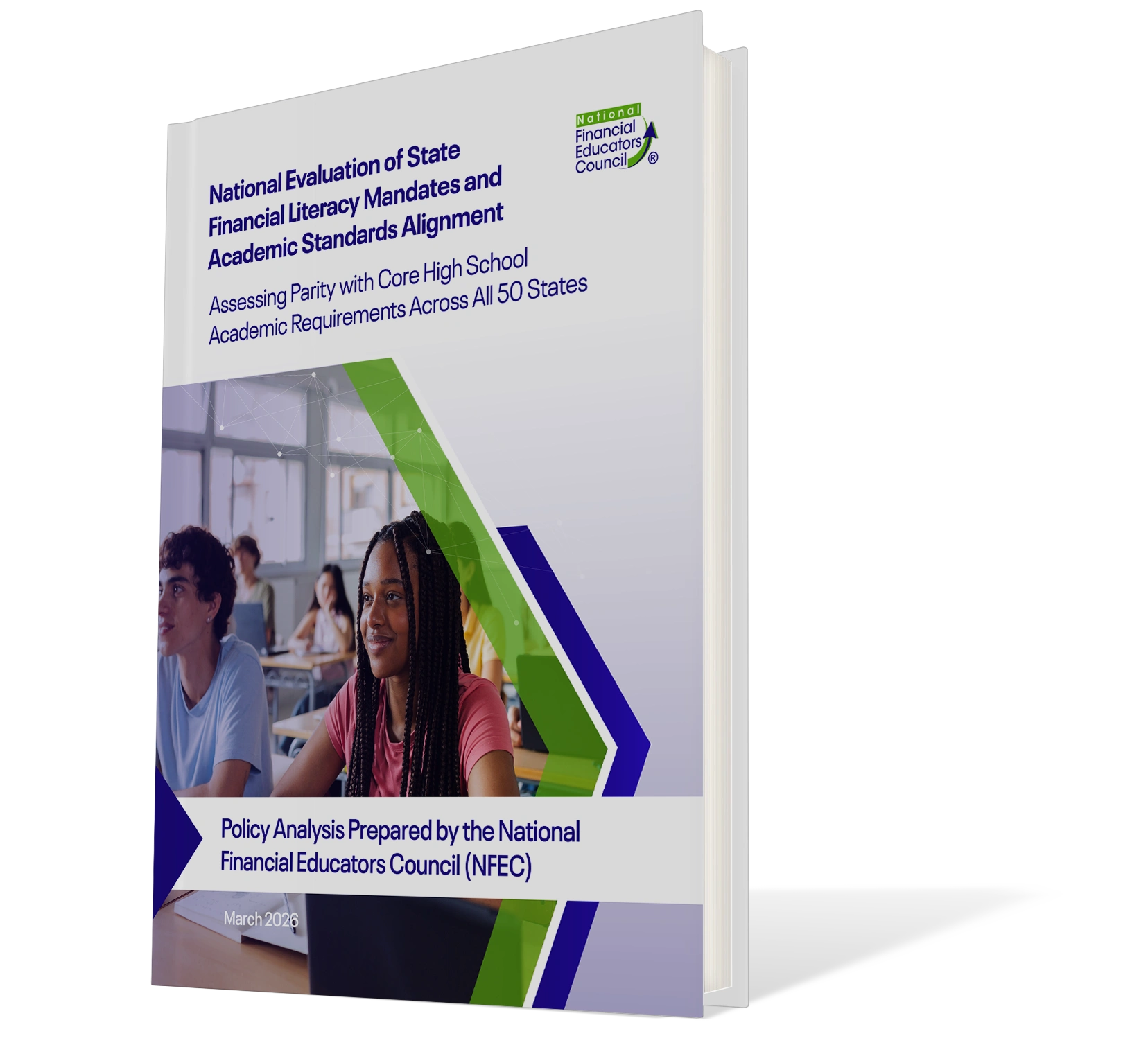
The National Evaluation of State Financial Literacy Mandates and Academic Standards Alignment provides the first standards-based, 50-state comparison of high school financial education, examining whether state mandates meet the minimum academic, governance, and accountability expectations applied to core subjects. Using a uniform 12-criterion framework, the analysis evaluates instructional rigor, curriculum oversight, educator qualifications, assessment systems, funding, sequencing, and family engagement nationwide.

The findings reveal widespread underalignment. No state reaches parity with core academic standards, and even the highest-performing states fall below baseline expectations. The report enables direct state-by-state comparison, including how Arizona’s financial literacy standards compare with the other 49 states, and offers an evidence-based roadmap to strengthen financial education through standards parity, coherent implementation, and accountable governance.

Opportunities to Advance Financial Literacy Education Across Arizona

To address the gaps identified in Arizona’s financial education standards, the National Financial Educators Council (NFEC), in partnership with its Arizona Financial Educators Council Chapter, provides a coordinated set of advocacy and policy support resources designed to elevate financial education to parity with other core academic subjects.

NFEC’s mission is to ensure that all learners graduate prepared to navigate real-world financial decisions by elevating financial education to the same level of quality, accountability, and instructional integrity as other required core academic subjects.

Standards and Policy Resources

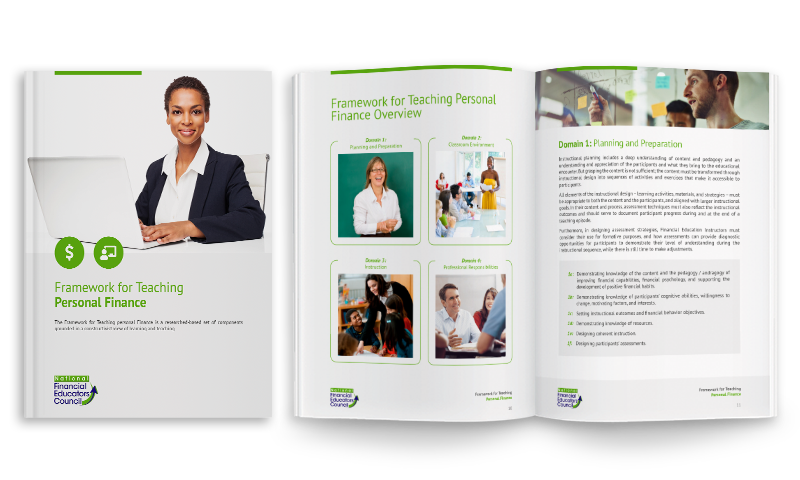
NFEC offers comprehensive financial literacy standards and policy guidance, including the Framework for Teaching Personal Finance, learner outcome standards, educator competency frameworks, and national research on financial education across all 50 states.

Advocacy Committee Engagement

Stakeholders are invited to join NFEC’s Advocacy Committee, which convenes educators, community leaders, and policy stakeholders to advance standards-based reform and align financial education with established academic expectations.

Arizona Financial Educators Council

Arizona financial literacy legislation summary (SB 1058 – Schools; academic standards; personal finance) – PolicyEngage / bill tracker

KJZZ – Coverage of Senate bill to require Arizona students to take a financial literacy course

Arizona Family (AZFamily) – News on personal finance course graduation proposal

Arizona Department of Education (ADE) – High School Graduation Requirements

Arizona Department of Education – Seal of Personal Finance

Arizona Revised Statutes §15-701.01 – High schools graduation requirements

Arizona Revised Statutes §15-260 – State seal of personal finance proficiency program

Personal finance guidelines

Financial literacy teacher certification

Teaching money management

History of Arizona’s Financial Literacy Legislation, Standards, and Mandates

Arizona historically relied on local decisions and embedded economic content rather than statewide personal finance standards. Prior to 2018, the state had no explicit K-12 personal finance standards; financial topics were addressed informally or through local initiatives.

In 2018, the State Board of Education adopted updated History and Social Science Standards requiring that the high school economics course include “Financial Literacy/Personal Finance, including but not limited to budgeting, saving, spending, investment, credit, banking, and insurance.” https://www.azed.gov/diplomaseals/sealofperfinance This created exposure to personal finance but did not establish a distinct personal finance course or standalone standards framework.

In 2018, SB 1442 established the Arizona Seal of Personal Finance, and the State Board adopted R7-2-319 to set program criteria. The Seal recognizes students who achieve a high level of proficiency in personal finance and places an official designation on their diploma and transcript. Participation in the program is voluntary for districts and charter schools. https://www.azed.gov/diplomaseals/sealofperfinance

In 2019, lawmakers amended graduation law to require at least one-half credit of economics that “shall include financial literacy and personal financial management.” https://www.azleg.gov/ars/15/00701-01.htm While this ensures some personal finance content for all students, the amount of time devoted is limited; one state treasurer estimate suggests that current implementation may provide only about two weeks of personal finance instruction within the semester-long economics course.

Despite these changes, Arizona continues to receive a B grade on national financial literacy report cards, reflecting progress but also highlighting the absence of a dedicated, stand-alone personal finance course and comprehensive standards.

In 2024, Senate Bill 1058 (sponsored by Senator J.D. Mesnard) proposed requiring a separate half-credit personal finance course for graduation and directing the State Board of Education and Arizona Department of Education to develop personal finance academic standards, with final adoption targeted by July 1, 2026. The bill advanced through committee but failed on third reading in the Senate and did not become law. https://legiscan.com/AZ/bill/SB1058/2024

As of December 30, 2025, Arizona has:

  • One-half credit economics graduation requirement that must include financial literacy content
  • An optional Seal of Personal Finance proficiency program
  • No standalone personal finance course requirement
  • No comprehensive, grade-banded personal finance standards framework