Complimentary Financial Literacy Curriculum & Standards for Kids
Children begin forming money habits from birth – through parental modeling, advertisements, peers, and daily chores. Brown University’s research on chores showed that these habits are often firmly established by about age nine (3rd grade). Without positive role models or basic instruction, children can easily fall into the same financial traps many adults experience.
The NFEC provides a suite of complimentary resources to help you share easy-to-use materials designed for both home and classroom use. We hope these tools make it simpler to give every child a strong financial foundation.

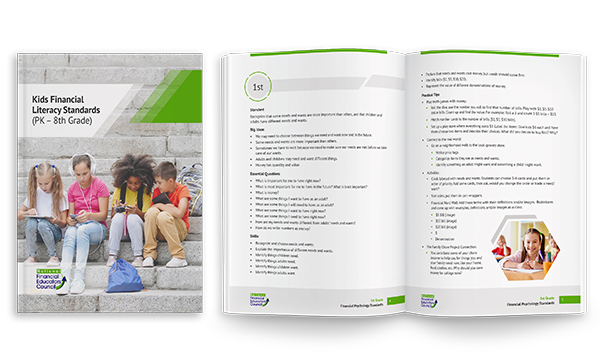
Kids Financial Education Standards & Learning Outcomes Guide
The kids’ band (preK–8) builds foundational money concepts with age-appropriate, developmentally grounded instruction. Early learners (preK–2) focus on concrete experiences – counting, recognizing coins, exchange, choice, and basic saving – through stories, games, and hands-on play. Upper elementary (3–5) curriculum adds simple budgeting, needs vs. wants, comparison shopping, and goal-setting via projects and family activities; middle school (6–8) introduces applied problem-solving and the math needed for personal finance (fractions, decimals, percentages) using simulations and classroom economies.
Assessment is formative and performance-based – observations, portfolios, rubrics, and short applied checks – paired with family feedback to measure retention and behavior. Sequenced lessons and scaffolded activities link concepts to everyday contexts (allowances, chores, school fundraisers) so children build practical habits that prepare them for more abstract teen- and adult-level reasoning.
The standards draw on established learning theories. Piaget guides the shift from concrete to abstract concepts; Vygotsky’s zone of proximal development supports guided practice, peer collaboration, and caregiver involvement; Core Knowledge highlights domain-specific early concepts to teach explicitly; and constructivist, social-learning (Bandura), and experiential (Kolb) approaches shape hands-on, inquiry-based activities that promote lasting understanding and real-world application.
Kids (PK – 2nd Grade)
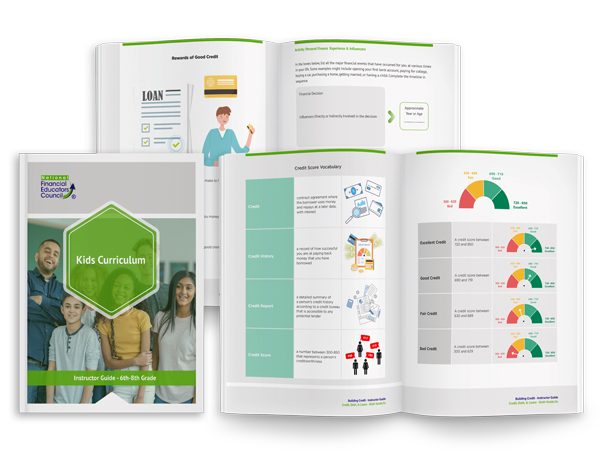
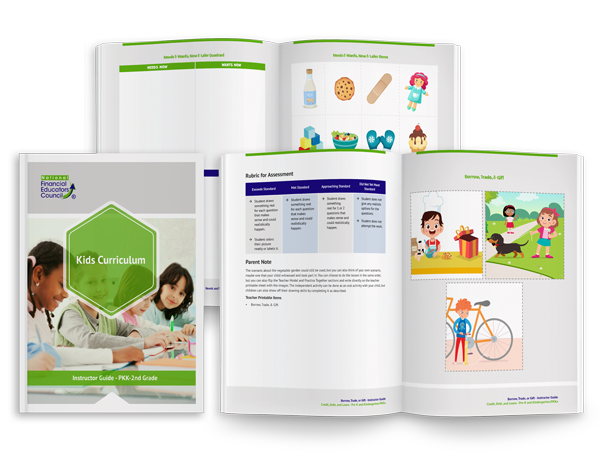
Here you can download the Student Guide for kids aged Pre-K through 2nd Grade, an activity workbook aligned with each of the age-appropriate lessons in the curriculum for this age level. The Instructor Guide guides you through the lessons as you teach – providing standards, essential questions, target skills, vocabulary, and materials needed for each lesson. Used together, they provide a complete instructional experience designed to maximize interest, comprehension, and retention.
Kids (3rd – 5th Grade)
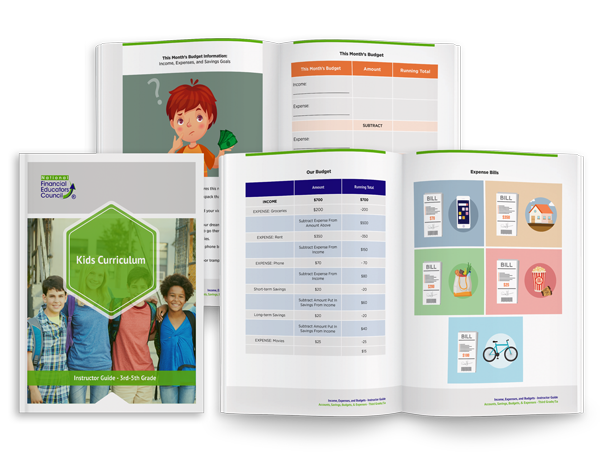
Here you can access the next level of Student Guide and Instructor Guide to accompany your teaching, for children at the 3rd – 5th-grade tier. The Student Guide offers scaffolded lessons and activities for kids at this developmental stage to do in the classroom or at home with family. The Instructor Guide provides flexible targets, structure, and pacing so your teaching delivers maximum impact.
Kids (6th – 8th Grade)
The guides for the next level of students (6th – 8th grade) may be downloaded here. The Student Guide for this learner group provides the next level of activities to accompany the lessons, gradually introducing more complex ideas and using practice to build understanding and retention. The Instructor Guide leads you through the age-appropriate simulations in concert with the student activities to help ensure that your learners meet the target outcomes.